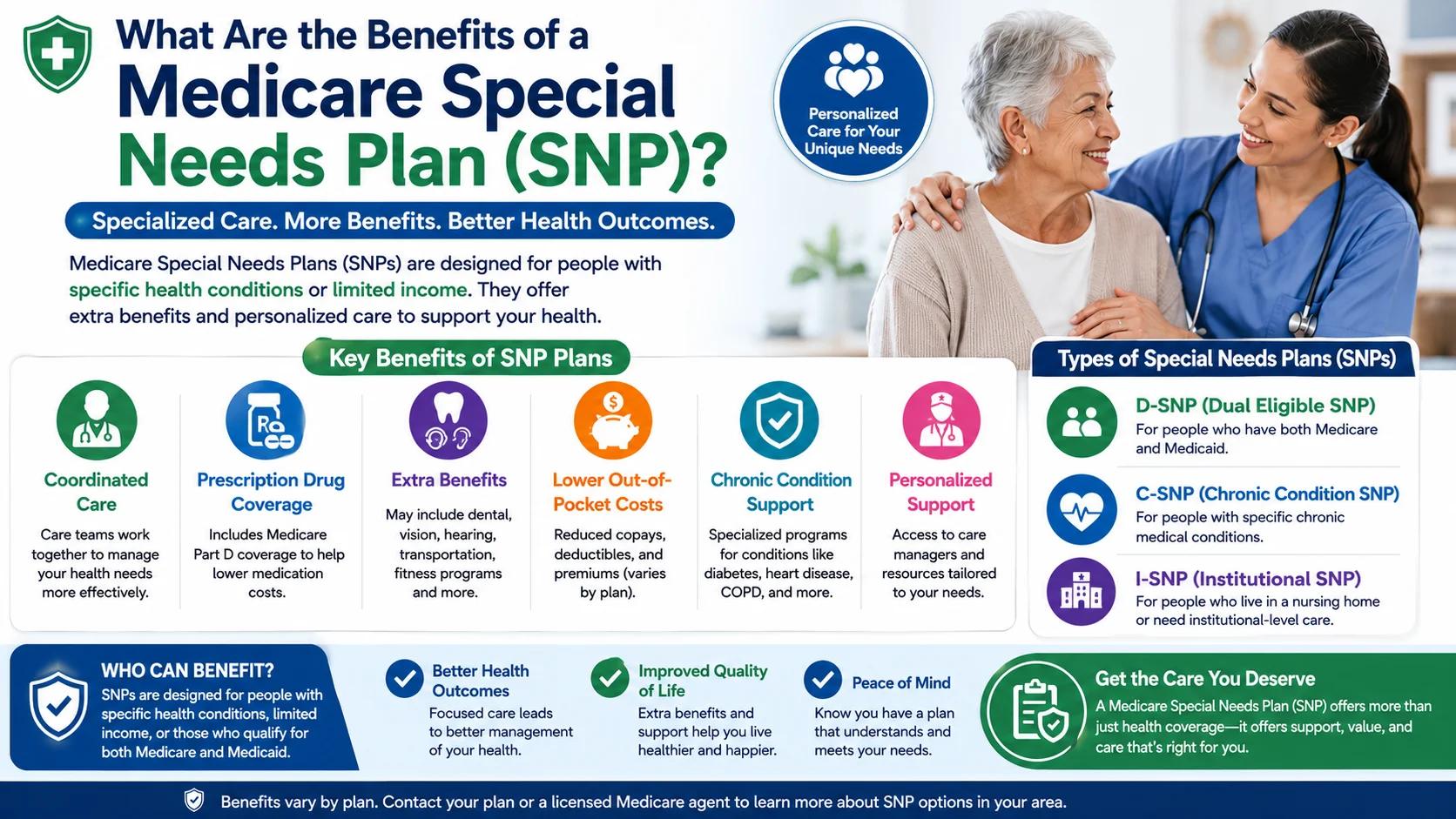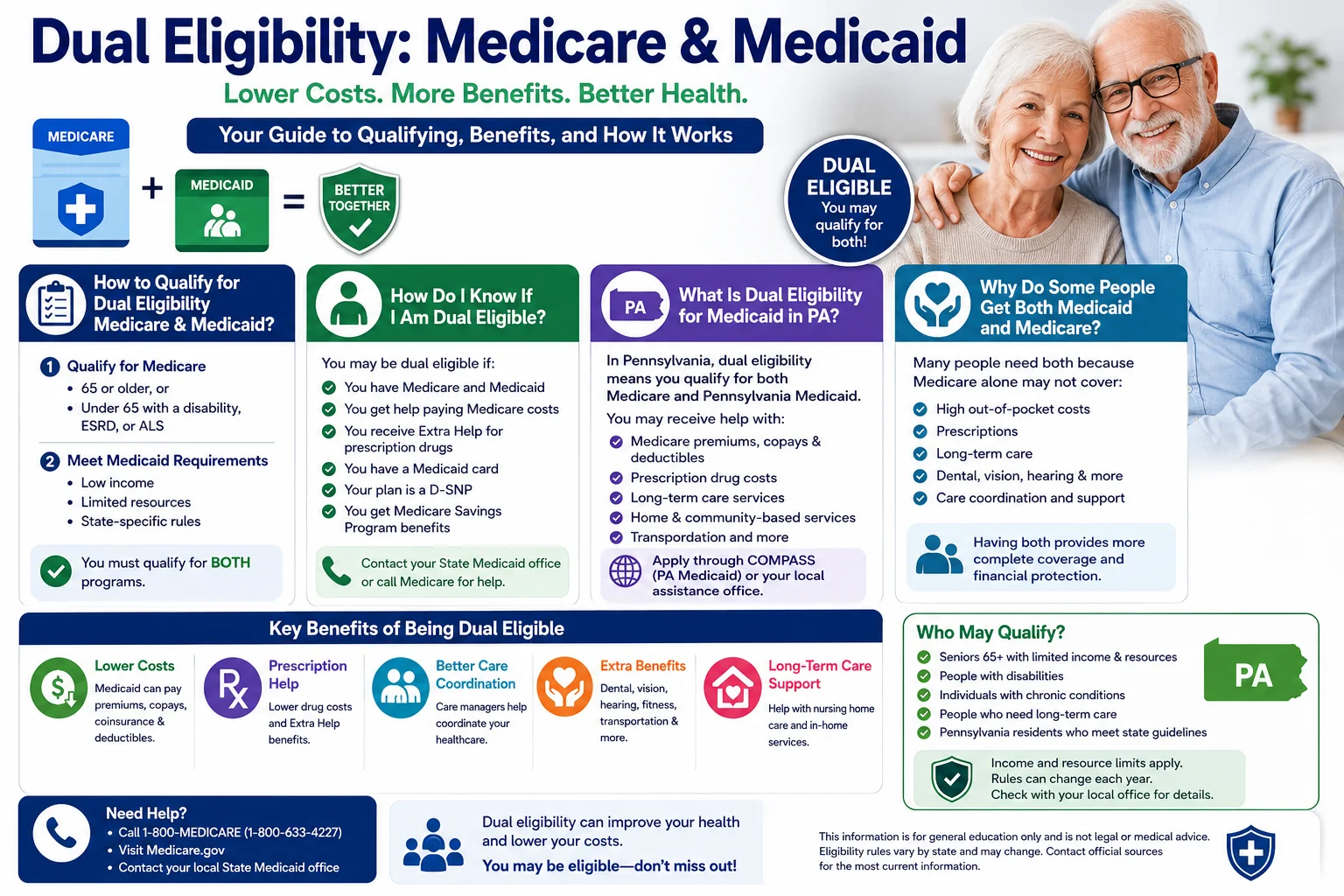
SNP stands for Special Needs Plan — a type of Medicare Advantage (Part C) plan designed specifically for people with special health or financial circumstances. There are three types of SNP plans, each serving a different population.
1. D-SNP (Dual Eligible Special Needs Plan)
Who it’s for: People eligible for both Medicare and Medicaid (often called “dual eligibles”).
What it covers:
- Combines Medicare and Medicaid benefits into one coordinated plan
- Covers hospital stays, doctor visits, prescription drugs, and long-term care
- Often includes 0premiums∗∗and∗∗0premiums∗∗and∗∗0 or very low copays
- Automatic Extra Help for prescription drug costs
Example: A senior with low income who qualifies for full Medicaid benefits.
2. C-SNP (Chronic Condition Special Needs Plan)
Who it’s for: People with one or more severe or disabling chronic conditions (even if they do not qualify for Medicaid).
Qualifying chronic conditions include (but are not limited to):
- Diabetes
- Heart disease (congestive heart failure, cardiovascular disease)
- Chronic lung disease (COPD, asthma)
- End-stage renal disease (ESRD)
- Alzheimer’s disease / dementia
- Parkinson’s disease
- Epilepsy
- Cancer
- Stroke
- Mental health conditions (bipolar, schizophrenia, major depression)
What it covers:
- Customized care coordination for your specific condition
- Specialized providers and disease management programs
- Prescription drug coverage tailored to your medications
Example: A 68-year-old with Parkinson’s disease, diabetes, and hypertension who does not qualify for Medicaid.
3. I-SNP (Institutional Special Needs Plan)
Who it’s for: People who live in or require a long-term care institution or equivalent level of care.
Eligible settings include:
- Nursing homes (skilled nursing facilities)
- Long-term care hospitals
- Assisted living facilities (in some cases)
- Home- and community-based services (HCBS) for those who would otherwise need institutional care
What it covers:
- Coordinated care between Medicare, Medicaid (if dual eligible), and the facility
- Transition support if moving from hospital to nursing home
- Medication management and on-site services
Example: A senior living in a nursing home with dementia who requires 24/7 skilled care.
Quick Reference Table: SNP Types at a Glance
| SNP Type | Who Qualifies | Key Benefit | Typical Premium |
|---|---|---|---|
| D-SNP | Medicare + Medicaid (dual eligible) | Combines both programs, often $0 cost | $0 (with full Medicaid) |
| C-SNP | Chronic condition (e.g., diabetes, Parkinson’s, heart disease) | Condition-specific care coordination | Varies (0–0–50+ depending on income) |
| I-SNP | Lives in nursing home or needs institutional level of care | Facility-coordinated medical + personal care | Varies (often $0 if dual eligible) |
How to Select the Right SNP Plan (Step-by-Step)
Follow these 5 steps to choose the correct SNP plan for yourself or a loved one.
Step 1: Determine Your Eligibility Type
Ask these three questions:
| Question | If YES → |
|---|---|
| Do you have both Medicare and Medicaid? | You qualify for a D-SNP |
| Do you have a severe chronic condition (like Parkinson’s, diabetes, heart disease)? | You may qualify for a C-SNP |
| Do you live in a nursing home or need institutional-level care? | You likely qualify for an I-SNP |
💡 Note: You can be dual eligible (D-SNP) and have a chronic condition — in that case, a D-SNP is usually the better choice because it covers more services (like long-term care).
Step 2: Use a “One Click” SNP Finder App or Tool
Look for a Medicare-approved app or website that allows you to:
- Enter your ZIP code
- Select your Medicaid status (yes/no)
- Select your chronic condition(s) (if any)
- Indicate nursing home residency (if applicable)
The app will automatically show you only the SNP types you qualify for.
👉 Find My SNP Plan – One Click
D-SNP | C-SNP | I-SNP
Step 3: Compare Plans Within Your SNP Type
Once the app shows you available plans, compare these features:
| Feature | What to Look For |
|---|---|
| Monthly premium | $0 is common for D-SNPs; C-SNPs may have small premiums |
| Doctor & hospital network | Ensure your current specialists are in-network |
| Prescription drug coverage | Check that your medications (e.g., Parkinson’s meds, insulin, blood thinners) are on the formulary |
| Extra benefits | Dental, vision, hearing, transportation, meal delivery, over-the-counter allowance |
| Care coordination | Does the plan assign a nurse or care manager for your chronic condition? |
Step 4: Check for “Extra Help” (If Low Income)
If you have limited income and resources, you may qualify for:
- Medicare Savings Programs (pays Part B premiums)
- Extra Help (pays Part D prescription drug costs)
D-SNP plans automatically include these benefits.
For C-SNP plans, ask if the plan participates with your state’s Medicaid program or offers a Low-Income Subsidy (LIS).
Step 5: Enroll – One Click or One Call
Once you have chosen a plan:
| Method | How To |
|---|---|
| One-click app enrollment | Use a Medicare-approved app (e.g., Medicare Plan Finder, ClearCover, or your state’s SHIP tool) |
| Phone enrollment | Call the plan directly or call Medicare at 1-800-MEDICARE |
| In-person help | Contact your local State Health Insurance Assistance Program (SHIP) for free, unbiased counseling |
⚠️ Important: You can usually enroll in a D-SNP or C-SNP at any time of the year (not just during Open Enrollment) if you have a qualifying condition or dual eligibility. This is called a Special Enrollment Period (SEP) .
Example Scenarios: Which SNP Plan Should They Choose?
| Person Profile | Recommended SNP Type | Why? |
|---|---|---|
| 72-year-old with Medicaid + diabetes + heart failure | D-SNP | Dual eligible → combines both programs, $0 cost, covers everything |
| 65-year-old with Parkinson’s disease, no Medicaid | C-SNP | Chronic condition qualifies for specialized care coordination |
| 80-year-old in a nursing home with dementia, on Medicaid | I-SNP (or D-SNP if dual) | Institutional care needed; I-SNP coordinates with facility |
| 68-year-old with epilepsy + low income but not full Medicaid | C-SNP with Low-Income Subsidy | Chronic condition + partial financial help |
Summary: One-Sentence Takeaway
D-SNP if you have Medicare + Medicaid, C-SNP if you have a chronic condition like Parkinson’s or diabetes, and I-SNP if you live in a nursing home — and you can find and enroll in the right plan with one click using a Medicare-approved app.
Frequently Asked Questions (FAQ)
Q: Can I switch from a C-SNP to a D-SNP later?
A: Yes. If your financial situation changes and you become eligible for Medicaid, you can switch to a D-SNP during a Special Enrollment Period.
Q: Do all C-SNPs cover Parkinson’s disease?
A: Not all. You must check the plan’s list of qualifying chronic conditions. Many C-SNPs cover Parkinson’s, but confirm before enrolling.
Q: What if I qualify for both a C-SNP and a D-SNP?
A: Choose the D-SNP — it provides broader coverage (including long-term care and Medicaid benefits) at lower cost.
Q: Can a caregiver enroll on behalf of a senior?
A: Yes. Most apps and Medicare allow a caregiver to assist or enroll with proper authorization.