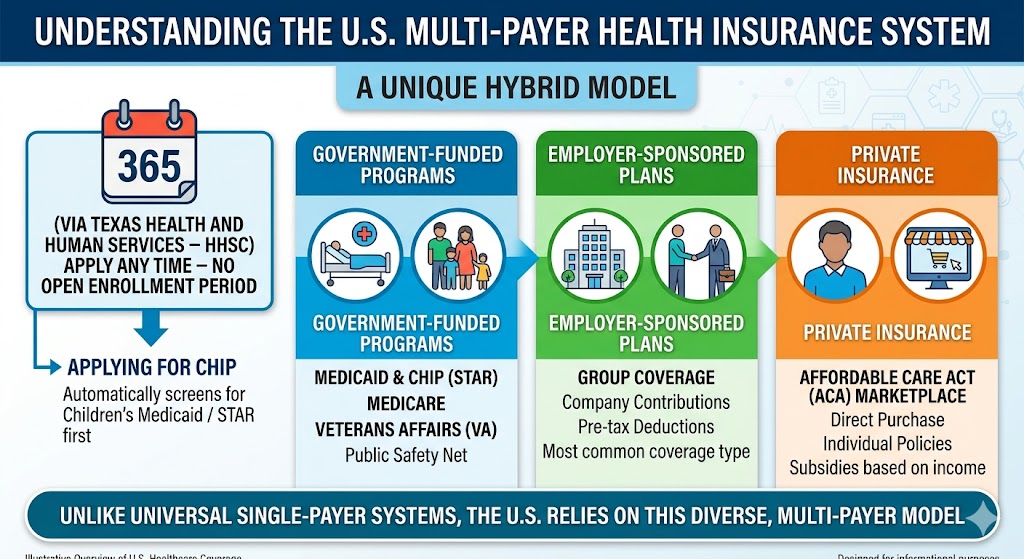
Health insurance in the United States is notoriously complex. Many people skim plan summaries during open enrollment or after a job loss, only to face unexpected bills later. Understanding key “hidden” or confusing terms can save you thousands of dollars and significant stress. This guide explains the most important jargon in plain language, with real-world examples.
The Basics: What You Pay Monthly vs. When You Use Care
Premium Your monthly (or yearly) payment to keep the insurance active. This is due regardless of whether you see a doctor. Higher premiums often mean lower out-of-pocket costs when you need care (and vice versa).
Deductible The amount you must pay out-of-pocket for covered services before your insurance starts sharing costs. Example: A $2,000 deductible means you pay the first $2,000 of covered medical bills in a year. Preventive care (checkups, screenings) is usually exempt. Tip: Distinguish between individual and family deductibles. Some plans have separate deductibles for medical and prescription drugs.
Copayment (Copay) A fixed dollar amount you pay for a specific service after meeting your deductible. Example: $25 copay for a primary care visit or $50 for a specialist. Copays are common for doctor visits, prescriptions, and urgent care.
Coinsurance Your percentage share of the cost after the deductible. If your plan has 20% coinsurance and a $1,000 covered service costs $1,000 (allowed amount), you pay $200. The insurer pays 80%.
The Most Important Cap: Out-of-Pocket Maximum (OOPM)
This is the maximum you will pay in a year for covered in-network services (including deductible, copays, and coinsurance). Once reached, the plan pays 100% for the rest of the year. Premiums do not count toward it.
2026 Note: The Affordable Care Act (ACA) sets legal maximums (around $9,000–$10,600+ for individuals, higher for families—check current figures on Healthcare.gov). Always confirm the exact limit for your plan.
Real Scenario: You have a $3,000 deductible + 20% coinsurance + $9,000 OOPM. After paying the deductible and thousands more in coinsurance, your total spending caps at $9,000 for the year.
Networks and Providers: Where You Can Go
In-Network vs. Out-of-Network In-network providers have contracts with your insurer for discounted rates. Out-of-network usually costs much more.
Allowed Amount (or Negotiated Rate) The maximum amount your insurer will pay a provider for a service. In-network providers accept this as full payment (plus your share). Out-of-network providers may not.
Balance Billing (Surprise Billing) When an out-of-network provider bills you for the difference between their charge and the insurer’s allowed amount. The federal No Surprises Act protects you in many emergency and certain in-network facility situations, but gaps remain (e.g., some non-emergency care). Always ask if everyone involved is in-network.
Types of Plans (HMO, PPO, EPO, POS)
- HMO: Lower premiums, restricted network, usually needs referrals and primary care physician (PCP).
- PPO: More flexibility, higher premiums, can see out-of-network (at higher cost).
- EPO: Like PPO but no out-of-network coverage (except emergencies).
- POS: Hybrid of HMO and PPO.
Approval and Coverage Rules
Prior Authorization (Precertification) Insurer approval required before certain services (MRIs, surgeries, specialty drugs). Skipping it can mean full denial of the claim.
Medical Necessity Insurers only cover services they deem “medically necessary” based on clinical guidelines—not just because a doctor recommends it. Denials here are common for experimental treatments or certain elective procedures.
Referral A written order from your PCP to see a specialist (common in HMOs).
Formulary The plan’s list of covered prescription drugs, often divided into tiers (Tier 1 = generics, lowest copay; Tier 4–5 = specialty drugs, highest cost).
Metal Levels and Plan Value (ACA Marketplace Plans)
Plans are categorized by actuarial value (how much the plan pays on average for a standard population):
- Bronze: ~60% (lowest premiums, highest out-of-pocket)
- Silver: ~70% (most popular, especially with subsidies)
- Gold: ~80%
- Platinum: ~90% (highest premiums, lowest out-of-pocket)
Essential Health Benefits (EHBs): All ACA plans must cover 10 categories (hospitalization, maternity, mental health, prescription drugs, preventive care, etc.).
Other Sneaky Terms
- Grace Period: Usually 3 months for Marketplace plans if you miss a premium (coverage may be retroactively terminated after the first month).
- Short-Term Limited-Duration Insurance: Cheap but skimpy plans with many exclusions, annual/lifetime limits, and no pre-existing condition protections.
- Pre-existing Condition: ACA prohibits denial of coverage, but you should still disclose accurately.
- HSA-Eligible Plans: High-deductible plans paired with a tax-advantaged Health Savings Account. Great for healthy people who can save for future costs.
How These Terms Work Together: A Simple Example
Plan: $500/month premium, $2,000 deductible, 20% coinsurance, $8,000 OOPM. You need a $10,000 covered surgery (in-network, allowed amount).
- You pay first $2,000 (deductible).
- Then 20% of remaining $8,000 = $1,600 (coinsurance).
- Total paid by you: $3,600 (well under OOPM).
- Insurer pays the rest.
If the provider is out-of-network and balance bills $4,000, you could owe much more unless No Surprises protections apply.
Pro Tips Before Buying
- Always review the Summary of Benefits and Coverage (SBC) — a standardized, easy-to-read document required by law.
- Use Healthcare.gov plan preview tools or your state’s exchange to compare total estimated costs (not just premiums).
- Check your doctors, hospitals, and medications are in-network.
- Calculate worst-case (high usage) and best-case (healthy year) scenarios.
- For families, pay special attention to individual vs. family deductibles/OOPMs.
- Read the full policy, not just marketing materials.
Health insurance literacy pays off. Taking time to understand these terms helps you choose coverage that actually protects you when you need it most — whether through an employer, Marketplace, Medicaid, CHIP, or other options.
Bottom line: Don’t pick a plan based solely on premium price. Focus on the full cost-sharing picture and your expected healthcare needs.
This article is for educational purposes. Rules can vary by state and plan—always verify details on official sites like Healthcare.gov or with a licensed agent.
ACA Metal Levels: A Detailed Guide (2026)
The Affordable Care Act (ACA) Marketplace organizes health plans into four main “metal levels”: Bronze, Silver, Gold, and Platinum. These levels are based on actuarial value (AV) — the average percentage of covered in-network medical costs that the plan pays for a standard population.
Important clarification: Metal levels do not indicate the quality of care, provider networks, or specific benefits. They only describe how costs are split between you and the insurer on average.
Standard Metal Level Breakdown (2026)
| Metal Level | Plan Pays (Avg.) | You Pay (Avg.) | Typical Deductible | Best For |
|---|---|---|---|---|
| Bronze | 60% | 40% | High | Healthy people who rarely use care |
| Silver | 70% | 30% | Moderate | Most people (especially with subsidies) |
| Gold | 80% | 20% | Low | Frequent care users |
| Platinum | 90% | 10% | Very Low | High medical needs / predictable costs |
2026 Out-of-Pocket Maximum (OOPM):
- $10,600 for individual coverage
- $21,200 for family coverage (Once reached, the plan pays 100% of covered in-network services for the rest of the year. Premiums do not count toward this.)
Detailed Breakdown of Each Level
1. Bronze Plans
- Lowest monthly premiums but the highest out-of-pocket costs when you need care.
- High deductibles (often $7,000–$9,000+ for individuals).
- Best if you are young, healthy, and want minimal monthly spending with protection against catastrophic events.
- Often paired with Health Savings Accounts (HSAs) if they meet high-deductible health plan (HDHP) rules.
- Downside: One major medical event can result in thousands in bills before coverage kicks in meaningfully.
2. Silver Plans
- The most popular choice on the Marketplace.
- Moderate balance between premiums and out-of-pocket costs.
- Key advantage: Only Silver plans qualify for Cost-Sharing Reductions (CSRs) if your income is 100%–250% of the Federal Poverty Level (FPL). These enhancements can dramatically lower your deductible, copays, coinsurance, and OOPM.
- 100–150% FPL → ~94% AV (better than Platinum)
- 150–200% FPL → ~87% AV
- 200–250% FPL → ~73% AV
Silver Loading Note (2026): In many areas, insurers “load” more costs into Silver premiums. This can make Gold plans surprisingly competitive or even cheaper than Silver for people who do not qualify for CSRs.
3. Gold Plans
- Higher premiums than Silver but significantly lower deductibles and better coverage when you use services.
- Often the sweet spot for people who expect moderate-to-high healthcare usage (chronic conditions, frequent doctor visits, families with young children, etc.).
- Many shoppers find Gold plans offer better overall value than Bronze or even standard Silver in 2026 due to premium pricing quirks.
4. Platinum Plans
- Highest premiums, lowest out-of-pocket costs.
- Very low or no deductibles and excellent coverage from day one.
- Ideal for people with serious ongoing medical needs, high-cost medications, or those who want maximum predictability.
- Least common and not available in all areas.
How to Choose the Right Metal Level
Consider these factors:
- Your expected healthcare usage this year (healthy vs. chronic conditions, planned surgeries, pregnancies, etc.).
- Your income — especially whether you qualify for premium subsidies or CSRs (use Healthcare.gov’s preview tools).
- Total estimated costs — Add premiums + expected out-of-pocket. Don’t focus only on monthly premium.
- Network & doctors — Check if your preferred providers are in-network (this varies by plan, not metal level).
- Prescription drugs — Review the formulary and tiered copays.
Pro Tip: Use the plan preview and total cost estimator tools on Healthcare.gov (or your state’s Marketplace). Enter your expected medical expenses to see real projected totals for each plan.
Real-World Example (Approximate 2026 Figures)
- Bronze: $300/month premium, $8,000 deductible, 40% coinsurance.
- Silver (no CSR): $450/month, $4,500 deductible, 30% coinsurance.
- Gold: $550/month, $1,500 deductible, 20% coinsurance.
- Platinum: $700+/month, $500 deductible, 10% coinsurance.
If you need $15,000 in covered care:
- Bronze could cost you $8,000+ out-of-pocket.
- Gold or enhanced Silver might cost you $3,000–$5,000 total (including premiums).
Bottom Line
Metal levels help you predict and manage the trade-off between monthly premiums and costs when you actually need care. For many people in 2026, Silver (with subsidies) or Gold provides the best value — but always run the numbers with your specific income, location, and health needs.
Would you like examples for a specific income level, family size, or a comparison table for a particular scenario?