That sudden itch, red patch, or unexplained rash can be alarming. Knowing exactly what to do when having an allergic reaction on your skin can mean the difference between quick relief and a medical emergency.
Skin allergies are among the most common health complaints worldwide. From poison ivy to new lotions, medications to foods, your skin is often the first organ to signal that something is wrong. But not all skin reactions are the same — and neither are the responses.
Skin Allergic Reaction
IDENTIFY & REMOVE the Allergen
Stop using new soaps, lotions, or medications. Wash skin with mild soap & cool water.
ASSESS SEVERITY – Mild vs Severe
- 💧 Cool compress (15 min)
- 💊 OTC oral antihistamine
- 🧴 Hydrocortisone cream 1%
- 🛁 Oatmeal bath for itching
- 🚫 Do NOT scratch
- 🚫 No hot water
- 🚫 No rubbing alcohol
- 📞 Call 911 immediately
- 💉 Use epinephrine (EpiPen) if available – DO NOT WAIT
- 🛌 Lie person down, legs elevated (if breathing okay)
- 🔄 If unconscious & not breathing – start CPR
Fexofenadine (Allegra) – 180 mg daily
Loratadine (Claritin) – 10 mg daily
Works in 30-60 min
Calamine lotion – for oozing blisters
Cool compress – immediate itch relief
This guide walks you through step-by-step actions for different types of skin allergic reactions, from mild contact dermatitis to severe anaphylaxis with skin symptoms.
What Is a Skin Allergic Reaction?
A skin allergic reaction occurs when your immune system overreacts to a normally harmless substance called an allergen. When your skin comes into contact with, ingests, or is injected with an allergen, your body releases histamine and other chemicals, causing inflammation and the classic symptoms of an allergic reaction.
Common triggers of skin allergic reactions include:
| Trigger Category | Examples |
|---|---|
| Topical products | Soaps, lotions, cosmetics, sunscreen, fragrances, hair dyes |
| Metals | Nickel (jewelry, belt buckles, watchbands), cobalt, chromium |
| Plants | Poison ivy, poison oak, poison sumac, mango sap |
| Medications | Antibiotics (penicillin, sulfa), aspirin, ibuprofen, topical creams |
| Foods | Nuts, shellfish, eggs, milk, wheat, soy |
| Insect stings/bites | Bees, wasps, fire ants, mosquitoes |
| Latex | Gloves, balloons, condoms, medical supplies |
| Fabrics | Wool, synthetic fibers, laundry detergents |
| Environmental | Pollen, pet dander, dust mites, mold |
Types of Skin Allergic Reactions (With Pictures in Mind)
| Type | Appearance | Common Causes | Timing |
|---|---|---|---|
| Contact Dermatitis | Red, itchy rash, sometimes with blisters or dry, cracked skin | Poison ivy, nickel, latex, fragrances | Hours to days after contact |
| Hives (Urticaria) | Raised, red, itchy welts of varying sizes | Foods, medications, insect stings, stress | Minutes to hours after exposure |
| Angioedema | Deep swelling beneath the skin, often around eyes, lips, hands, feet | Same as hives, plus ACE inhibitors | Minutes to hours |
| Eczema (Atopic Dermatitis) | Dry, scaly, intensely itchy patches | Environmental allergens, stress, irritants | Chronic, with flare-ups |
| Drug Rash | Variable — can be hives, red patches, or blisters | Medications (antibiotics, anticonvulsants, NSAIDs) | Days to weeks after starting drug |
Step-by-Step: What to Do Immediately for a Skin Allergic Reaction
Step 1: Identify and Remove the Allergen
The very first action is to stop exposure. Ask yourself:
- Did I just use a new soap, lotion, or detergent?
- Did I eat something unusual in the past few hours?
- Did I start a new medication?
- Was I exposed to plants, insects, or new jewelry?
Action: Wash the affected area with mild soap and cool water to remove any remaining allergen. For poison ivy, use specialized cleansers like Tecnu or Zanfel within 2 hours of exposure.
Step 2: Assess Severity — Mild vs. Severe
This is the most critical decision point.
| Symptom Category | Signs | Action |
|---|---|---|
| MILD | Localized redness, itching, small hives, no swelling of face/throat, breathing normal | Home care + monitor |
| MODERATE | Widespread hives, significant itching, mild swelling without breathing difficulty | Call doctor + home care |
| SEVERE (Anaphylaxis) | Difficulty breathing, tongue/throat swelling, dizziness, fainting, rapid heartbeat | CALL 911 IMMEDIATELY |
🚨 Red flag: If the reaction involves the face, mouth, or throat — or if there is ANY difficulty breathing — treat as a medical emergency.
Step 3: For Mild to Moderate Reactions — Treat at Home
If the reaction is limited to the skin and breathing is normal, try these interventions:
Immediate Relief Measures
| Treatment | How to Use | Effectiveness |
|---|---|---|
| Cool compress | Apply a cold, wet cloth to the affected area for 15-20 minutes | Reduces swelling and itching |
| Over-the-counter (OTC) antihistamines | Take oral antihistamines like cetirizine (Zyrtec), fexofenadine (Allegra), or loratadine (Claritin) | Blocks histamine; relieves itching and hives |
| Topical hydrocortisone cream (1%) | Apply a thin layer to the rash 1-4 times daily | Reduces inflammation and itching |
| Calamine lotion | Apply as needed to dry oozing or weeping blisters | Soothes and dries |
| Oatmeal bath | Add colloidal oatmeal to lukewarm bath water | Relieves widespread itching |
| Avoid scratching | Keep nails short, wear cotton gloves at night | Prevents infection and worsening |
Important: Avoid using topical antihistamines (like Benadryl cream) on widespread rashes, as they can cause skin sensitization. Oral antihistamines are safer and more effective.
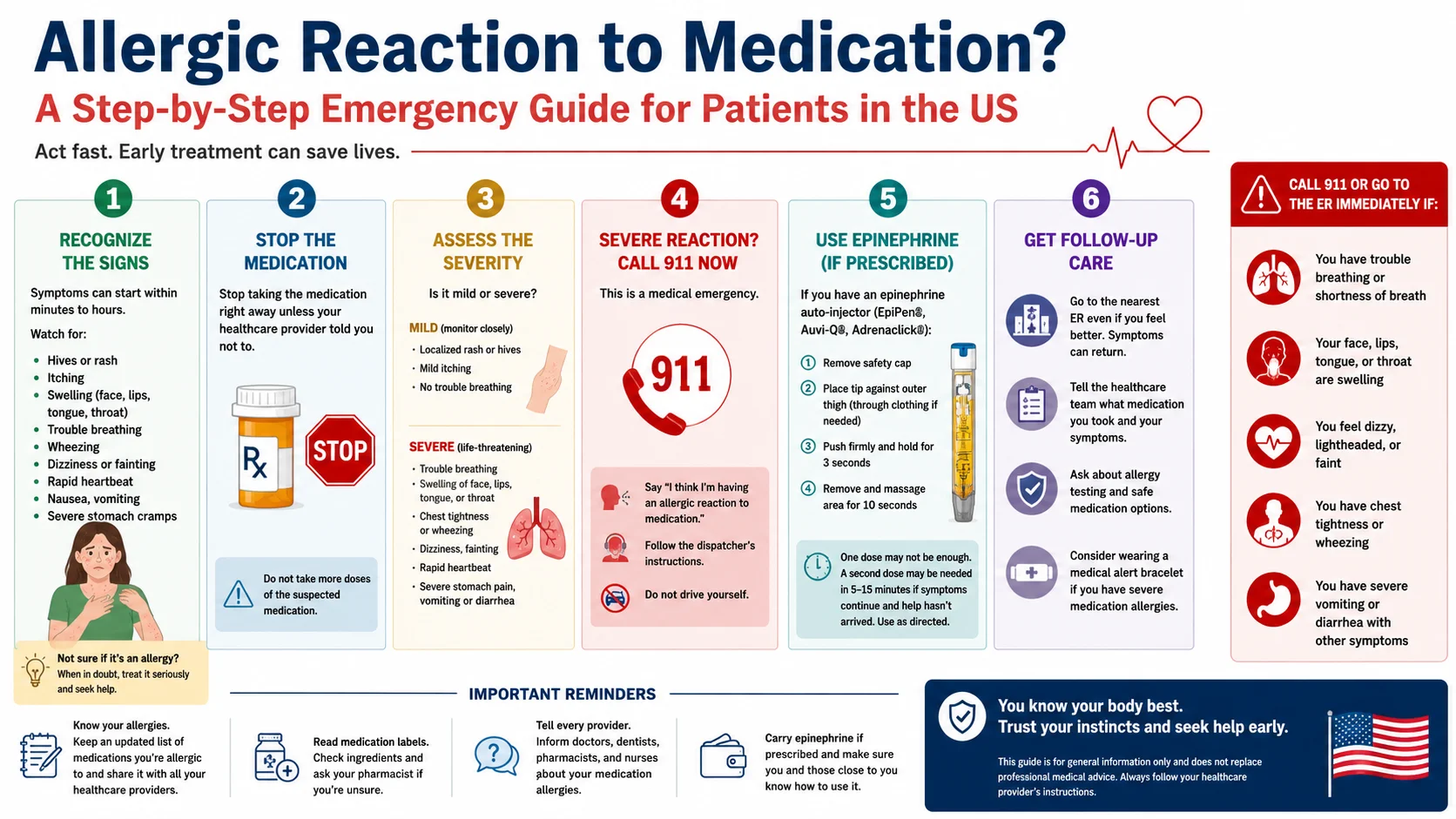
Step 4: For Severe Reactions (Anaphylaxis with Skin Symptoms) — Emergency Action
If the skin reaction is accompanied by ANY of the following, call 911 immediately:
- Swelling of the tongue, lips, or throat
- Difficulty breathing or wheezing
- Hoarse voice or trouble swallowing
- Dizziness, lightheadedness, or fainting
- Rapid or weak pulse
- Nausea, vomiting, or diarrhea
- Feeling of impending doom
The STOP Protocol for Severe Allergic Reactions:
| Letter | Action |
|---|---|
| S | STOP exposure to the allergen immediately |
| T | TELL someone and CALL 911 |
| O | OBSERVE symptoms and use epinephrine if available (EpiPen, Auvi-Q, or Neffy nasal spray) |
| P | POSITION the person lying down with legs elevated (if breathing is not difficult) |
If the patient has a prescribed epinephrine auto-injector, use it immediately at the first sign of anaphylaxis. Do not wait for symptoms to worsen. Epinephrine is the only life-saving treatment for anaphylaxis.
Step 5: When to See a Doctor
Even after initial treatment, seek medical attention if:
- The rash continues to spread after 24 hours of home care
- Blisters become painful or show signs of infection (pus, increasing redness, warmth, fever)
- You have a history of severe reactions to similar triggers
- You are unsure what caused the reaction
- Symptoms return after stopping treatment (biphasic reaction)
That sudden itch, red patch, or unexplained rash can ruin your day — and your peace of mind. Knowing how to deal with a skin allergic reaction quickly and effectively is essential for everyone, from occasional sufferers to chronic allergy patients.
This comprehensive guide answers your most pressing questions: What is the fastest way to treat an allergic reaction? What are the 7 allergy symptoms? What are the top 3 triggers? And how can you remove a skin allergy for good?
What Are the 7 Allergy Symptoms?
Allergic reactions can affect different parts of the body. Here are the 7 most common allergy symptoms affecting the skin and other systems:
| # | Symptom | Description | Most Common With |
|---|---|---|---|
| 1 | Hives (Urticaria) | Raised, red, itchy welts that vary in size and shape | Foods, medications, insect stings |
| 2 | Itching (Pruritus) | Localized or widespread itching without visible rash | Dry skin, detergents, fragrances |
| 3 | Redness & Inflammation | Patches of red, swollen, warm skin | Contact dermatitis, eczema |
| 4 | Blisters or Oozing | Fluid-filled bumps that may weep or crust | Poison ivy, severe contact dermatitis |
| 5 | Dry, Cracked, Scaly Skin | Rough patches that may flake or bleed | Eczema (atopic dermatitis) |
| 6 | Swelling (Angioedema) | Deep swelling beneath skin, often around eyes, lips, hands, feet | Food allergies, medications, insect stings |
| 7 | Burning or Stinging Sensation | Painful, raw feeling without visible blisters | Chemical irritants, severe reactions |
Note: Allergy symptoms can also affect the respiratory system (sneezing, wheezing), digestive system (nausea, diarrhea), and cardiovascular system (dizziness, fainting) — but the 7 above are specifically skin-related.
What Are the 7 Types of Skin Allergies?
Dermatologists classify skin allergies into 7 main types, each with distinct causes and appearances:
| Type | Medical Name | Appearance | Common Triggers |
|---|---|---|---|
| 1 | Contact Dermatitis | Red, itchy rash; may have blisters or dry, cracked skin | Poison ivy, nickel, latex, fragrances, preservatives |
| 2 | Atopic Dermatitis (Eczema) | Dry, scaly, intensely itchy patches, often in elbow/knee creases | Environmental allergens, stress, irritants |
| 3 | Urticaria (Hives) | Raised, red, itchy welts that come and go | Foods, medications, insect stings, heat, cold |
| 4 | Angioedema | Deep swelling beneath skin (lips, eyes, hands, feet) | Same as hives; also ACE inhibitor medications |
| 5 | Photosensitivity | Rash or blistering after sun exposure | Sunscreen ingredients, medications, plants (lime, celery) |
| 6 | Drug Rash | Variable: hives, red patches, blisters, or peeling | Antibiotics (penicillin, sulfa), anticonvulsants, NSAIDs |
| 7 | Protein Contact Dermatitis | Redness, itching, sometimes hives after touching certain foods | Raw meat, fish, fruits, vegetables, latex gloves |
What Are the Top 3 Triggers for Allergic Reactions?
Based on clinical data and allergy research, the top 3 triggers for skin allergic reactions are:
1. Contact Allergens (Nickel, Fragrances, Preservatives)
Nickel is the most common contact allergen, affecting approximately 17% of women and 3% of men. Found in:
- Jewelry (earrings, necklaces, watchbands)
- Belt buckles, zippers, buttons
- Cell phones, laptops, eyeglass frames
- Keys, coins, tools
Fragrances (perfumes, scented lotions, laundry detergents) and preservatives (formaldehyde releasers, methylisothiazolinone) are the next most common.
2. Plants (Poison Ivy, Poison Oak, Poison Sumac)
Urushiol, the oily resin in these plants, causes allergic contact dermatitis in up to 85% of the population. Reactions typically appear 12-48 hours after exposure.
3. Foods (Peanuts, Tree Nuts, Shellfish, Eggs, Milk, Wheat, Soy)
Food allergies cause hives, swelling, and in severe cases, anaphylaxis. In children, the most common triggers are milk, eggs, and peanuts. In adults, peanuts, tree nuts, fish, and shellfish dominate.
What Are the 9 Major Foods That Cause 90% of Allergic Reactions?
In the United States, the FDA identifies 9 major food allergens responsible for approximately 90% of all serious food allergic reactions:
| # | Food Allergen | Common Forms | Skin Reaction Type |
|---|---|---|---|
| 1 | Milk | Cow’s milk, cheese, yogurt, butter, whey, casein | Hives, eczema flares, angioedema |
| 2 | Eggs | Whole eggs, egg whites, baked goods, mayonnaise, pasta | Hives, eczema |
| 3 | Peanuts | Peanut butter, peanut oil, Asian sauces, baked goods | Hives, angioedema, anaphylaxis |
| 4 | Tree Nuts | Almonds, walnuts, cashews, pecans, pistachios, hazelnuts | Hives, angioedema, anaphylaxis |
| 5 | Soy | Soy milk, tofu, edamame, soy sauce, processed foods | Hives, eczema |
| 6 | Wheat | Bread, pasta, cereals, baked goods, beer | Hives, eczema, wheat-dependent exercise-induced anaphylaxis |
| 7 | Fish | Salmon, tuna, cod, halibut, anchovies | Hives, angioedema, anaphylaxis |
| 8 | Crustacean Shellfish | Shrimp, crab, lobster, crayfish | Hives, angioedema, anaphylaxis (often severe) |
| 9 | Sesame | Tahini, hummus, sesame seeds, sesame oil, baked goods | Hives, angioedema (added to FDA list in 2023) |
Important: The Food Allergy Safety, Treatment, Education, and Research (FASTER) Act of 2021 added sesame as the 9th major allergen, effective January 1, 2023.
How to Deal with a Skin Allergic Reaction: Step-by-Step
Step 1: Identify and Remove the Allergen
Ask yourself:
- Did I touch something new? (soap, lotion, jewelry, plant, chemical)
- Did I eat something unusual in the past few hours?
- Did I start a new medication?
- Was I exposed to heat, cold, or sunlight?
Action: Stop using the suspected product or remove yourself from the trigger environment. Wash the affected area with mild soap and cool water.
Step 2: Assess Severity
| Severity | Signs | Action |
|---|---|---|
| Mild | Localized redness, small hives, mild itching | Home care + monitor |
| Moderate | Widespread hives, significant itching, mild swelling | Call doctor + home care |
| Severe | Difficulty breathing, throat swelling, dizziness, fainting | CALL 911 IMMEDIATELY |
Step 3: Treat at Home (For Mild to Moderate Reactions)
Immediate Relief Measures:
| Treatment | How to Use | Works Within |
|---|---|---|
| Cool compress | Apply cold, wet cloth for 15-20 minutes | Immediate relief |
| OTC oral antihistamine | Cetirizine (Zyrtec), fexofenadine (Allegra), loratadine (Claritin) | 30-60 minutes |
| Topical hydrocortisone (1%) | Thin layer 1-4 times daily | Hours to days |
| Calamine lotion | Apply to oozing or weeping blisters | Rapid soothing |
| Oatmeal bath | Add colloidal oatmeal to lukewarm bath | Widespread relief |
Medications at a Glance:
| Medication | Type | Dose (Adults) | Best For |
|---|---|---|---|
| Cetirizine (Zyrtec) | 2nd gen antihistamine | 10 mg daily | Hives, itching |
| Fexofenadine (Allegra) | 2nd gen antihistamine | 180 mg daily | Hives, itching |
| Loratadine (Claritin) | 2nd gen antihistamine | 10 mg daily | Hives, itching |
| Diphenhydramine (Benadryl) | 1st gen antihistamine | 25-50 mg every 6 hours | Severe itching (causes drowsiness) |
| Hydrocortisone cream 1% | Topical steroid | Thin layer 1-4x daily | Localized rash |
Step 4: Know When to Seek Emergency Care
Call 911 immediately if you experience:
- Swelling of the tongue, lips, or throat
- Difficulty breathing or wheezing
- Hoarse voice or trouble swallowing
- Dizziness, lightheadedness, or fainting
- Rapid or weak pulse
- Nausea, vomiting, or diarrhea
If the patient has an epinephrine auto-injector (EpiPen, Auvi-Q, or Neffy nasal spray), use it immediately. Do not wait for symptoms to worsen.
What Is the Fastest Way to Treat an Allergic Reaction?
The fastest treatment depends on severity:
For Mild to Moderate Skin Reactions:
Fastest OTC option: Oral cetirizine (Zyrtec) — begins working within 30 minutes and lasts 24 hours.
Fastest topical option: Cool compress — provides immediate (but temporary) relief within seconds.
For Severe Reactions (Anaphylaxis):
Fastest and ONLY life-saving treatment: Epinephrine (EpiPen, Auvi-Q, or Neffy nasal spray) — works within minutes. There is no substitute. Antihistamines are too slow for anaphylaxis.
Critical: If you have a known severe allergy, carry your epinephrine auto-injector at all times and use it at the FIRST sign of a systemic reaction — do not wait.
What Is the Fastest Way to Cure a Skin Allergy?
The honest answer: There is no “instant cure” for skin allergies. However, you can achieve rapid relief and resolution by following these steps:
Fastest Relief Protocol:
| Time | Action | Expected Result |
|---|---|---|
| 0-5 minutes | Remove allergen, wash skin with cool water | Stop ongoing reaction |
| 5-10 minutes | Apply cool compress | Immediate itch relief |
| 15-30 minutes | Take oral antihistamine (cetirizine) | Itching and hives begin to subside |
| 30 minutes – 24 hours | Apply hydrocortisone cream (if localized) | Redness and swelling decrease |
| 24-72 hours | Continue antihistamines as needed | Resolution of mild reactions |
For complete resolution:
- Hives: 1-3 days
- Contact dermatitis: 2-4 weeks
- Eczema flare: Days to weeks with proper treatment
How Do I Treat an Allergic Skin Reaction Without a Doctor?
For mild, localized reactions, you can safely treat at home:
Do’s:
- ✅ Wash the area with mild soap and cool water
- ✅ Apply a cool compress for 15-20 minutes
- ✅ Take over-the-counter oral antihistamines (cetirizine, loratadine, fexofenadine)
- ✅ Apply 1% hydrocortisone cream to localized rashes
- ✅ Use calamine lotion for oozing blisters (poison ivy)
- ✅ Take a lukewarm colloidal oatmeal bath for widespread itching
- ✅ Keep nails short and wear cotton gloves at night to prevent scratching
Don’ts:
- ❌ Do NOT scratch — breaks skin barrier and introduces infection
- ❌ Do NOT use hot water — releases more histamine
- ❌ Do NOT apply rubbing alcohol — dries and irritates
- ❌ Do NOT use topical antihistamines (Benadryl cream) — can cause skin sensitization
- ❌ Do NOT pop blisters — increases infection risk
What Is the 3 Day Rule for Allergies?
The “3 Day Rule” is a clinical guideline used to distinguish between acute allergic reactions and other conditions:
The Rule:
| Timeframe | Interpretation | Action |
|---|---|---|
| First 24 hours | Acute allergic reaction most likely | Treat with antihistamines, monitor |
| 24-72 hours | If symptoms improve → mild allergy | Continue home care |
| After 72 hours (3 days) | If symptoms persist or worsen → unlikely a simple allergy | See a doctor; possible infection, autoimmune condition, or chronic dermatitis |
When the 3-Day Rule Applies:
- Contact dermatitis from poison ivy often peaks at 48-72 hours then gradually improves over 2-3 weeks
- Hives typically resolve within 24-48 hours of removing the trigger
- If a rash lasts longer than 3 days without improvement — especially with fever, pain, or blistering — seek medical attention
Exception: Chronic skin conditions like eczema can last weeks or months. The 3-day rule applies to new, acute rashes of unknown cause.
How to Remove a Skin Allergy Permanently?
You cannot “remove” an allergy permanently in the sense of erasing your immune system’s memory. However, you can achieve long-term remission or desensitization through:
1. Avoidance (Gold Standard)
Once you identify your trigger, strict avoidance prevents future reactions.
2. Allergen Immunotherapy (Allergy Shots or Sublingual Drops)
For certain environmental allergies (pollen, dust mites, pet dander), immunotherapy can reduce or eliminate symptoms over 3-5 years. This is not yet available for most contact or food allergies.
3. Topical Immunomodulators (For Eczema)
Prescription creams like tacrolimus (Protopic) and pimecrolimus (Elidel) can control chronic eczema without steroids.
4. Patch Testing and Avoidance (For Contact Dermatitis)
A dermatologist can perform patch testing to identify specific chemicals you are allergic to. Once identified, avoiding products containing those chemicals prevents future reactions.
5. Omalizumab (Xolair) for Chronic Hives
For patients with chronic spontaneous urticaria (hives lasting >6 weeks), Xolair injections can provide long-term control.
Quick Reference: Skin Allergy Action Chart
| Scenario | Immediate Action | Follow-Up |
|---|---|---|
| Mild, localized rash | Wash area + cool compress + OTC antihistamine | Call doctor if not better in 3 days |
| Widespread hives, no breathing issues | Oral antihistamine (cetirizine) + cool bath | Call doctor if persistent >24 hours |
| Swelling of lips/eyes (angioedema) | Oral antihistamine + monitor closely | Seek medical attention if worsens |
| Any difficulty breathing or throat swelling | CALL 911 + epinephrine if available | Hospital evaluation required |
| Rash with fever or blistering | See doctor same day or go to ER | Possible severe drug reaction (SJS/TEN) |
| Poison ivy rash | Wash with specialized cleanser + calamine | See doctor for prescription steroids if severe |
Summary: Key Takeaways
| Question | Answer |
|---|---|
| How to deal with a skin allergic reaction? | Remove allergen, wash skin, cool compress, OTC antihistamine, monitor symptoms. |
| Fastest way to treat an allergic reaction? | For mild: oral cetirizine (30 min). For severe: epinephrine (minutes). |
| What are the 7 allergy symptoms? | Hives, itching, redness, blisters, dry skin, swelling, burning sensation. |
| Fastest way to cure a skin allergy? | No instant cure. Relief in 30 min with antihistamines; resolution in days to weeks. |
| How to treat allergic skin reaction at home? | Cool compress, oral antihistamine, hydrocortisone cream, oatmeal bath, no scratching. |
| What are the 9 major food allergens? | Milk, eggs, peanuts, tree nuts, soy, wheat, fish, crustacean shellfish, sesame. |
| What are the top 3 triggers? | Contact allergens (nickel, fragrances), plants (poison ivy), foods (peanuts, shellfish). |
| What are the 7 types of skin allergies? | Contact dermatitis, eczema, hives, angioedema, photosensitivity, drug rash, protein contact dermatitis. |
| What is the 3 day rule? | Most acute allergic reactions improve within 72 hours. See a doctor if symptoms persist beyond 3 days. |
| How to remove skin allergy? | Avoid triggers. Immunotherapy for some allergies. Patch testing for contact dermatitis. |
Mild skin allergies are manageable at home with cool compresses, OTC antihistamines, and topical hydrocortisone. But any difficulty breathing, throat swelling, or dizziness is a medical emergency — call 911 immediately.
Know your triggers. Carry epinephrine if you have severe allergies. And when in doubt, see a doctor.
Medications for Skin Allergic Reactions: What Works
Over-the-Counter (OTC) Options
| Medication | Type | Best For | Typical Dose |
|---|---|---|---|
| Cetirizine (Zyrtec) | Oral antihistamine (2nd gen) | Hives, itching | 10 mg once daily |
| Fexofenadine (Allegra) | Oral antihistamine (2nd gen) | Hives, itching | 180 mg once daily |
| Loratadine (Claritin) | Oral antihistamine (2nd gen) | Hives, itching | 10 mg once daily |
| Diphenhydramine (Benadryl) | Oral antihistamine (1st gen) | Severe itching (causes drowsiness — good for bedtime) | 25-50 mg every 6 hours |
| Hydrocortisone cream (1%) | Topical steroid | Localized contact dermatitis | Thin layer 1-4x daily |
| Calamine lotion | Topical protectant | Poison ivy, oozing rashes | Apply as needed |
Prescription Options (For Moderate to Severe Cases)
| Medication | Use | Note |
|---|---|---|
| (triamcinolone, clobetasol) | Stubborn contact dermatitis or eczema | Requires prescription |
| (Prednisone) | Severe, widespread reactions | Short course (5-14 days); requires taper |
| Epinephrine auto-injector (EpiPen) | Anaphylaxis emergency | Prescription required; always carry if at risk |
Skin Allergic Reaction Duration: How Long Does It Last?
| Type of Reaction | Typical Duration | Notes |
|---|---|---|
| Hives (acute) | Few hours to several days | Usually resolves once allergen removed |
| Contact dermatitis | 2-4 weeks | Can last longer with continued exposure |
| Drug rash | Days to weeks after stopping medication | May take time for immune system to calm |
| Angioedema | 1-3 days | Can recur if trigger not identified |
Signs of healing: Itching decreases, redness fades, swelling subsides, blisters dry and peel.
What NOT to Do During a Skin Allergic Reaction
| ❌ Avoid | Why |
|---|---|
| Scratching | Breaks skin barrier, introduces bacteria, worsens inflammation |
| Hot showers or baths | Hot water releases more histamine, increasing itching |
| Applying rubbing alcohol | Dries and irritates already inflamed skin |
| Using benzocaine or topical antihistamines | Can cause contact sensitization (allergic reaction to the treatment itself) |
| Popping blisters | Increases infection risk; blisters protect healing skin |
| Ignoring spreading symptoms | May indicate more serious systemic reaction |
Prevention: How to Avoid Future Skin Allergic Reactions
1. Identify Your Triggers
- Keep a symptom diary — log what you used, ate, or touched before the reaction
- Consider patch testing by a dermatologist for suspected contact allergies
- For suspected food allergies, ask about skin prick testing or blood IgE testing
2. Read Labels Carefully
- Look for “hypoallergenic,” “fragrance-free,” and “for sensitive skin”
- Avoid products containing common allergens: nickel, lanolin, propylene glycol, parabens, formaldehyde releasers
3. Perform a Patch Test for New Products
Before using a new lotion, soap, or cosmetic:
- Apply a small amount to the inside of your elbow or behind your ear
- Wait 24-48 hours
- If no redness or itching appears, the product is likely safe
4. Wear Protective Gear
- Gloves when handling cleaning products, nickel-containing tools, or plants
- Long sleeves and pants when hiking in areas with poison ivy
5. Communicate with Healthcare Providers
- Always mention your known allergies before receiving medications
- Wear a medical alert bracelet if you have severe allergies (e.g., to latex, penicillin, or insect stings)
Special Situations: Skin Allergic Reactions to Medications
Drug rashes are among the most concerning skin reactions because they can be unpredictable and severe.
Mild Drug Rash
- Typically appears days to weeks after starting a new medication
- Presents as red, itchy patches or hives
- Action: Call your prescribing doctor. Do NOT stop the medication without medical advice, as some drugs require tapering.
Severe Drug Reactions (Medical Emergencies)
Stevens-Johnson Syndrome (SJS) and Toxic Epidermal Necrolysis (TEN) are rare but life-threatening drug reactions that begin with flu-like symptoms and a painful red rash that blisters and peels.
Warning signs:
- Fever, body aches, sore throat
- Painful red rash that spreads rapidly
- Blisters on skin, mouth, eyes, or genitals
- Skin peeling
If you see these signs, go to the ER immediately.
Can Skin Allergic Reactions Be Contagious?
No. Skin allergic reactions are not contagious. You cannot “catch” a rash from someone with contact dermatitis or hives. However, some skin conditions (like fungal infections or scabies) can look similar but require different treatment.
Summary: Quick Action Chart
| If You Have… | Immediate Action | Follow-Up |
|---|---|---|
| Mild, localized rash | Wash area with cool water, apply cool compress, take OTC antihistamine | Call doctor if not better in 2-3 days |
| Widespread hives without breathing issues | Take oral antihistamine, cool bath, monitor | Call doctor; may need prescription steroids |
| Facial swelling or any breathing difficulty | CALL 911 IMMEDIATELY — use epinephrine if available | Hospital evaluation required |
| Rash with fever or blistering | See doctor same day or go to ER | Possible severe drug reaction (SJS/TEN) |
| Poison ivy rash | Wash with specialized cleanser (Tecnu, Zanfel), cool compresses, calamine | See doctor for severe cases (prescription steroids) |
Frequently Asked Questions (FAQs)
Q: How long does it take for an allergic reaction on skin to go away?
A: Mild reactions (hives) resolve in hours to days. Contact dermatitis may take 2-4 weeks to fully heal.
Q: Can stress cause skin allergic reactions?
A: Stress does not cause true allergies but can trigger or worsen eczema, hives, and psoriasis flares.
Q: Should I go to urgent care or ER for a skin reaction?
A: Go to ER if there is any difficulty breathing, throat swelling, dizziness, or widespread blistering. Go to urgent care for large hives, severe itching, or concerning rash without respiratory symptoms.
Q: Can I develop a new allergic reaction to something I have used for years?
A: Yes. Allergies can develop at any time, even after years of safe exposure. This is called sensitization.
Q: What is the strongest over-the-counter cream for allergic rash?
A: Hydrocortisone 1% is the only OTC topical steroid. Stronger versions (2.5% hydrocortisone, triamcinolone) require a prescription.
When to See a Dermatologist vs. Allergist
| Specialist | Best For |
|---|---|
| Dermatologist | Chronic rashes, eczema, contact dermatitis (can perform patch testing), blistering disorders |
| Allergist/Immunologist | Hives, angioedema, suspected food/drug/insect allergies (can perform skin prick testing, blood IgE testing, drug desensitization) |
Many patients benefit from seeing both.
The Bottom Line
Not all skin reactions are emergencies, but knowing the difference saves lives.
- Mild rash? Wash, cool compress, OTC antihistamine, monitor.
- Widespread hives? Oral antihistamine, call doctor if persistent.
- Any breathing difficulty, throat swelling, or dizziness? CALL 911 — this is anaphylaxis.
- Rash with fever or blistering? Seek immediate medical attention.
Your skin is telling you something. Listen to it — and act accordingly.
References
- American Academy of Dermatology Association. (n.d.). Contact dermatitis.
- American College of Allergy, Asthma & Immunology. (n.d.). Hives (Urticaria).
- Mayo Clinic. (2024). Allergic reaction on skin: First aid.
- World Allergy Organization. (2023). Anaphylaxis guidelines.
- National Eczema Association. (2024). Eczema treatments.
Disclaimer: This article is for informational purposes only and does not constitute medical advice. Always consult a qualified healthcare professional for skin concerns or before making decisions about your health. In an emergency, call 911 immediately.