Medications save lives, but for some, they can trigger unexpected and frightening allergic responses. From a mild rash after starting an antibiotic to sudden breathing difficulty following a painkiller, drug allergies are a serious medical concern. Knowing how to distinguish a mild reaction from a life-threatening emergency, and acting swiftly, is crucial.
This guide outlines exactly what to do if you or a loved one experiences a drug allergy, based on current guidelines from the FDA, the American Academy of Allergy, Asthma & Immunology (AAAAI), and leading medical institutions .
STOP
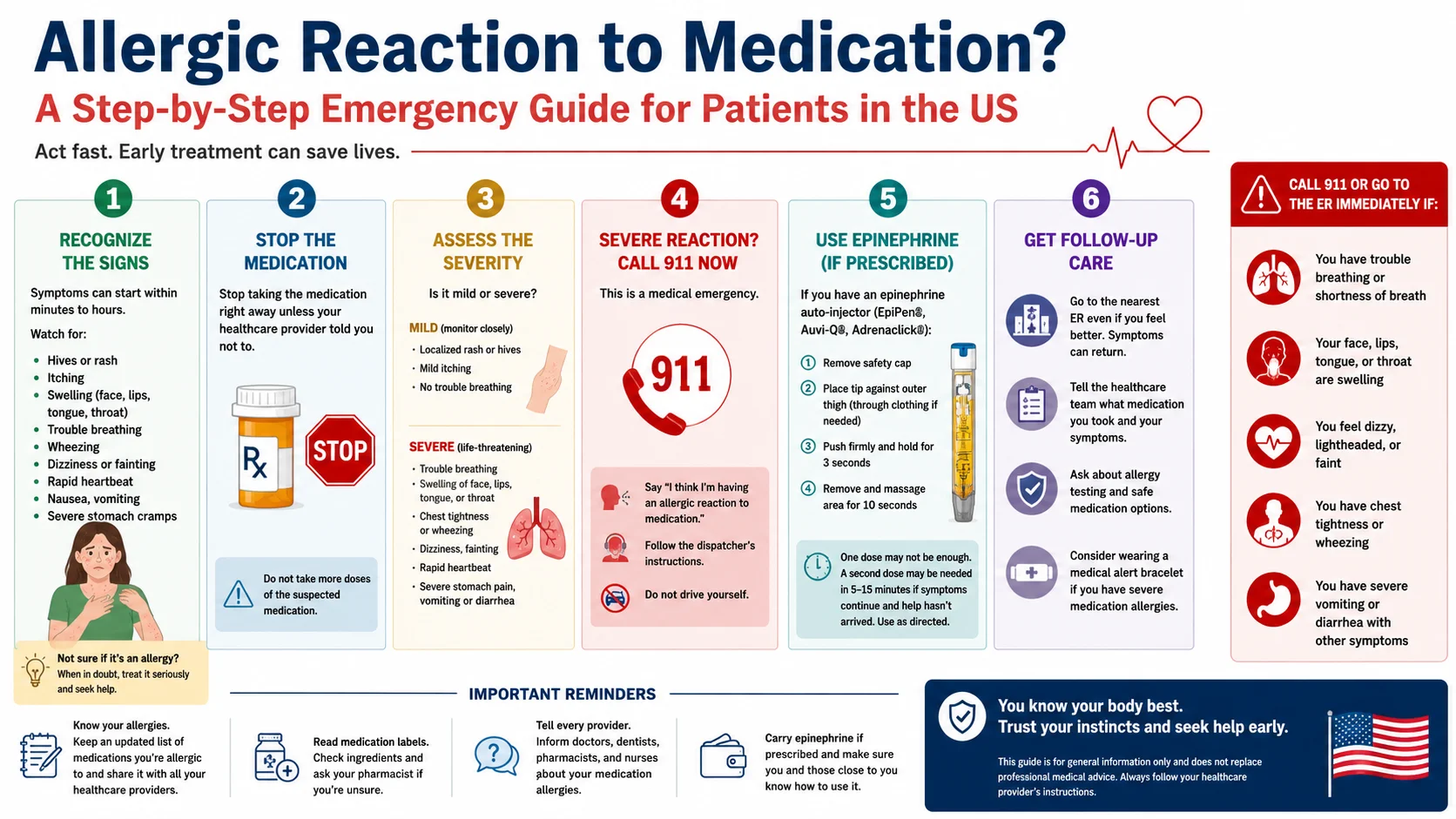
STOP the Medication
Immediately discontinue the suspected drug. Do not take another dose. However, do NOT stop prescribed medications without medical guidance for mild reactions — call your doctor first. For severe symptoms, stop and proceed to next steps.
TELL Someone / Call 911
Call 911 immediately if you or the patient shows signs of anaphylaxis: difficulty breathing, swelling of tongue/throat, dizziness, fainting, or widespread hives. Do not drive to the hospital — wait for emergency services.
OBSERVE & Use Epinephrine
Watch for severe symptoms. If the patient has a prescribed epinephrine auto-injector (EpiPen, Auvi-Q, or Neffy nasal spray), use it immediately at the first sign of anaphylaxis. Epinephrine is the only life-saving treatment.
POSITION & Prepare
Lie the person down with legs elevated (if breathing is not difficult). If vomiting or trouble breathing, position them on their side (recovery position). Loosen tight clothing. Do NOT stand them upright.
- Name of medication
- When it was taken
- Patient’s age & medical history
📋 Mild vs Severe Symptoms — How to Decide
- Localized rash/hives
- Mild itching
- No breathing difficulty
- Call your doctor
- Difficulty breathing
- Swelling of tongue/throat
- Dizziness or fainting
- 🚨 Call 911 NOW
- Update your medical record — Document the allergic reaction with your doctor
- Get a prescription for epinephrine auto-injectors if you don’t already have one
- Wear a medical alert bracelet listing your drug allergy
- See an allergist for confirmatory testing (e.g., penicillin allergy test)
Step 1: Recognize the Symptoms – Is It a Mild Reaction or Anaphylaxis?
Not every adverse reaction to a drug is an allergy. True allergic reactions involve the immune system. The most frequent allergic symptoms include skin rashes (especially hives), itching, swelling (e.g., of the face or lips), and respiratory problems .
The key distinction is severity. Anaphylaxis is a severe, potentially life-threatening allergic reaction that typically involves more than one body system (e.g., skin and breathing) or causes a drop in blood pressure .
Red Flags of Anaphylaxis (Seek Help NOW):
- Airway: Swelling of the tongue or throat, hoarseness, trouble swallowing.
- Breathing: Shortness of breath, wheezing, persistent cough.
- Circulation: Pale or clammy skin, weak and rapid pulse, dizziness, or fainting.
- Other: Feeling of impending doom, confusion, or loss of consciousness .
Step 2: Immediate Actions – What to Do Right Now
If you suspect a mild reaction (e.g., isolated localized hives or mild itching) and are breathing comfortably, call your prescribing physician immediately. Do not stop taking a prescribed medication without medical advice, as your doctor may need to prescribe a safe alternative or guide you on tapering .
If you or someone near you shows ANY signs of anaphylaxis, act immediately:
1. Call 911 Immediately
Do not drive to the hospital yourself. Call for emergency medical help. Tell the operator you suspect anaphylaxis from a medication .
2. Administer Epinephrine (If Available)
Epinephrine is the only first-line treatment for anaphylaxis—it is a medical emergency, and epinephrine is the drug of choice that can be life-saving. The guidelines are clear: do not hesitate to use it .
- How to use an auto-injector (e.g., EpiPen): Press it firmly against the outer thigh (through clothing if necessary) and hold for 3 seconds. Many people at risk carry these devices; if the patient has one, use it immediately .
- New Option: In 2024, the FDA approved an intranasal epinephrine spray (Neffy) for allergic reactions, which offers a needle-free alternative for emergency treatment .
3. Position the Body Correctly
- Lie the person down and elevate their legs. This helps maintain blood flow to vital organs.
- If they are having trouble breathing or are vomiting, they may prefer to sit up. Do not stand them up, as this can be dangerous if blood pressure drops .
- First Aid & CPR: If the person stops breathing or their heart stops beating, begin CPR immediately .
Step 3: Treatment at the Hospital – What to Expect
When emergency services arrive or you reach the hospital, medical professionals will take over. In the emergency department (ED), treatment focuses on stabilizing the patient .
Standard Hospital Treatments include:
- Epinephrine (Repeat doses as needed): Often given intramuscularly (in the thigh) or intravenously (IV) for severe cases. Delayed administration of epinephrine correlates with anaphylaxis deaths, so it is prioritized immediately .
- Oxygen Therapy: To help with breathing difficulties .
- IV Fluids: Large volumes of isotonic crystalloid solutions (normal saline) to maintain blood pressure .
- Adjunctive Medications:
- Antihistamines (H1 and H2 blockers): Such as diphenhydramine (Benadryl) and ranitidine, which help relieve histamine-mediated symptoms but act much slower than epinephrine .
- Corticosteroids: These do not have an immediate effect but are given early to try to prevent a “late-phase” reaction (biphasic anaphylaxis) where symptoms return hours later .
Step 4: Observation and Discharge
After initial treatment, you will be monitored. Patients with non-life-threatening reactions who respond well to treatment are typically observed for 4 to 6 hours before discharge .
Severe reactions or those requiring multiple doses of epinephrine often lead to hospital admission for longer observation .
At Discharge, your doctor may prescribe:
- A short course of oral antihistamines (e.g., hydroxyzine or diphenhydramine) for 2-5 days.
- Oral corticosteroids (e.g., prednisone) for 2-5 days to prevent recurrence of symptoms .
- An epinephrine auto-injector prescription (if you don’t already have one) .
Step 5: Long-Term Management – Preventing Future Reactions
Surviving a drug allergy is only the first step. The next is ensuring it doesn’t happen again.
1. Know Your Triggers
Only about 5-10% of adverse drug reactions are true allergies. The most common allergy-causing drugs are antibiotics (like penicillin), aspirin/NSAIDs (like ibuprofen), anticonvulsants, and chemotherapy agents . Knowing exactly which drug caused the reaction is critical.
2. Update Your Medical Records
Ensure your reaction is documented in your medical chart. Keep an updated list of medication allergies in your wallet or on your phone.
3. Communicate with All Healthcare Providers
“Make sure your physician, dentist and pharmacy are kept current regarding your drug allergies.” This helps determine which medications should be avoided in the future . Even over-the-counter versions of drugs you are allergic to can trigger reactions.
4. See an Allergist
If you have a history of a serious reaction or reactions to multiple drugs, ask your primary care doctor for a referral to a board-certified allergist/immunologist. They can perform testing (e.g., for penicillin allergy) and, in some cases where a necessary drug has no alternative, perform a desensitization procedure. This involves gradually introducing the drug in very small doses to allow you to tolerate it .
The Bottom Line
Timing is everything in drug allergy reactions.
- For mild symptoms: Call your doctor. Do not stop medication on your own.
- For severe symptoms (anaphylaxis): Epinephrine is first. Use an autoinjector if available, call 911 immediately, and lie the person down with legs elevated .
Drug allergies can be scary, but having a clear action plan saves lives. Stay informed, stay prepared, and always advocate for your safety.
Disclaimer: This article is for informational purposes only and does not constitute medical advice. Always consult a qualified healthcare professional for medical concerns or before making decisions about your health