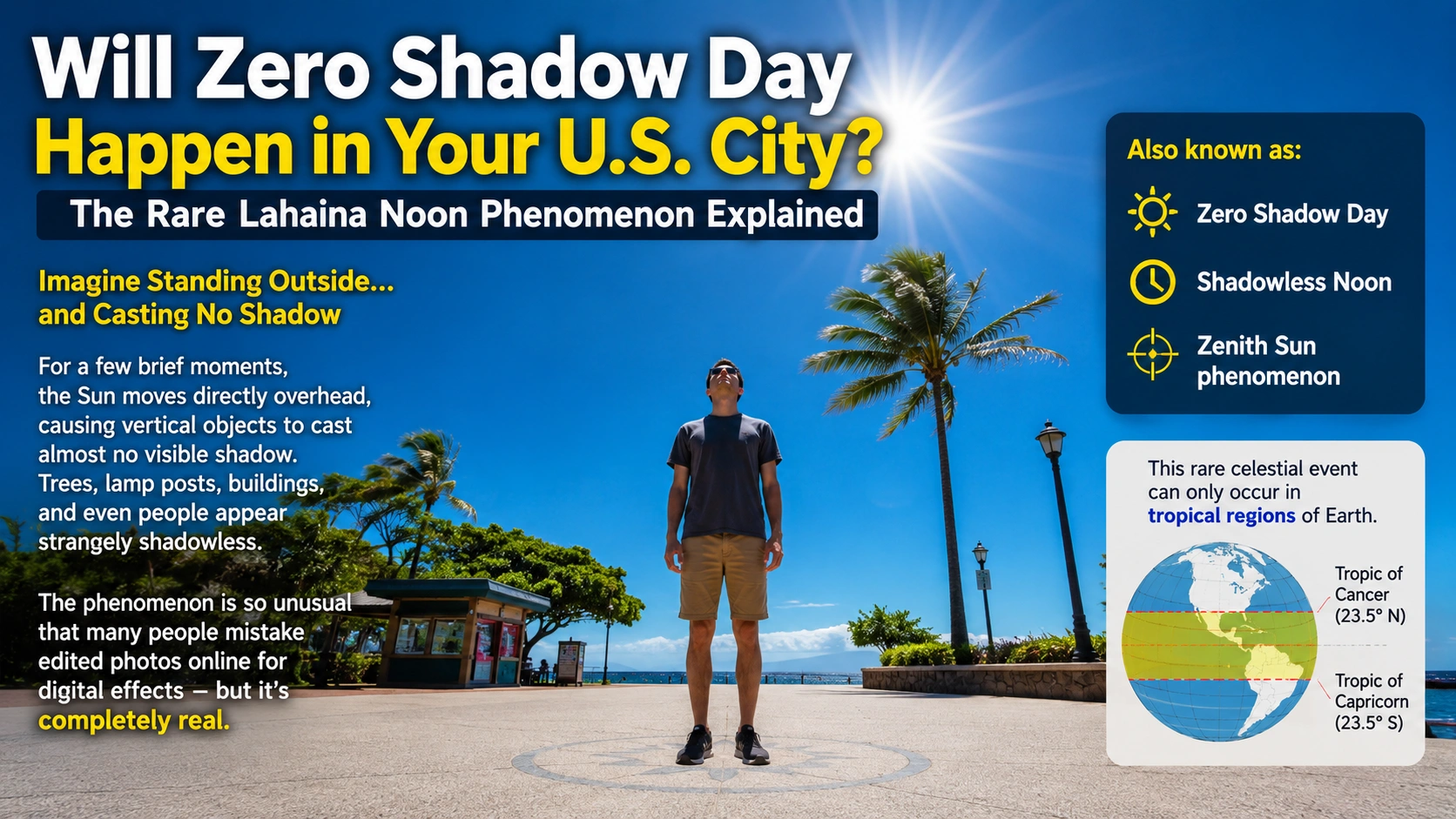
Imagine Standing Outside… and Casting No Shadow
It sounds impossible — almost like something from a science-fiction movie.
But during Lahaina Noon, it actually happens.
For a few brief moments, the Sun moves directly overhead, causing vertical objects to cast almost no visible shadow. Trees, lamp posts, buildings, and even people appear strangely shadowless.
The phenomenon is so unusual that many people mistake edited photos online for digital effects — but it’s completely real.
Also known as:
- Zero Shadow Day
- Shadowless Noon
- Zenith Sun phenomenon
this rare celestial event can only occur in tropical regions of Earth.
What Is Lahaina Noon?
Lahaina Noon occurs when the Sun is positioned exactly overhead at local noon.
At that moment:
- Sunlight falls vertically
- Shadows shrink beneath objects
- Some shadows almost disappear entirely
The event lasts only a few minutes but creates one of the most fascinating natural optical effects visible from Earth.
Why Is It Called “Lahaina Noon”?
The name originated in Hawaii and was popularized by the Bishop Museum.
“Lāhainā” roughly means:
- “Cruel Sun”
- “Merciless Sun”
a reference to the intense tropical sunlight experienced during the event.
Although the term became famous in Hawaii, similar Zero Shadow Day events occur in many tropical parts of the world.
Can You See Lahaina Noon in the United States?
Yes — but only in certain parts of the United States.
Most of the continental U.S. is too far north to experience a true Lahaina Noon.
The phenomenon mainly occurs in:
- Hawaii
- Southern tropical U.S. territories
This is because the event only occurs between:
- Tropic of Cancer (23.5° North)
- Tropic of Capricorn (23.5° South)
Why Doesn’t Most of America Experience Zero Shadow Day?
Earth is tilted by approximately:
23.5∘23.5^{\circ}23.5∘
As Earth revolves around the Sun:
- The Sun appears to shift north and south during the year
- Its overhead position moves only within the tropical zone
Because most U.S. states lie north of the Tropic of Cancer, the Sun never reaches a perfectly overhead position there.
That means:
- New York
- Chicago
- Seattle
- Denver
- Boston
cannot experience a true shadowless noon.
The Science Behind Zero Shadow Day
Zero Shadow Day happens when:
- The Sun’s declination matches a location’s latitude
- Sunlight strikes vertically at noon
At that exact moment:
- Shadows become extremely short
- Vertical objects appear almost shadowless
Astronomers use this event to teach:
- Earth’s axial tilt
- Latitude and longitude
- Solar geometry
- Seasonal movement
- Planetary motion
Why Scientists Love Lahaina Noon
Astronomers and educators consider Lahaina Noon an excellent educational tool because it visually demonstrates how Earth moves through space.
Schools and science museums often organize:
- Shadow experiments
- Outdoor observations
- Solar demonstrations
- Kids’ astronomy activities
The event helps children understand that astronomy isn’t abstract — it directly affects everyday life.
What Does Lahaina Noon Look Like?
As noon approaches:
- Shadows become shorter and shorter
- Objects appear visually “flattened”
- The shadow retreats directly underneath
At the peak moment:
- Shadows nearly vanish
- The effect lasts about 1–3 minutes
Then shadows begin lengthening again in the opposite direction.
How Long Does Lahaina Noon Last?
The true “zero shadow” effect usually lasts:
- About 1 to 3 minutes
However:
- The dramatic shortening of shadows can be observed for 15–20 minutes around solar noon.
Is Lahaina Noon Dangerous?
Although beautiful, Lahaina Noon occurs during the strongest sunlight of the day.
This means:
- UV radiation peaks
- Heat exposure intensifies
- Dehydration risk increases
Especially in tropical climates like Hawaii, outdoor observers should be careful.
Heat & UV Safety Tips
Wear:
- Sunscreen SPF 30+
- Sunglasses
- Wide-brim hats
- Lightweight clothing
Carry:
- Water bottle
- Electrolyte drinks
- Cooling towel
Avoid:
- Long exposure in direct sun
- Sugary sodas
- Overheating during observation
DIY Zero Shadow Day Activity for Kids
One of the best ways to teach children about Lahaina Noon is through a simple outdoor science experiment.
DIY “Shadow Tracker” Activity
What You Need
- A pencil, stick, or ruler
- Chalk or tape
- Notebook
- Clock or phone timer
- Sunny outdoor area
Instructions
Step 1: Place the Object Upright
Stick the pencil or ruler vertically into the ground or modeling clay.
Step 2: Mark the Shadow Every 10 Minutes
Use chalk or tape to mark the tip of the shadow.
Observe how:
- The shadow gets shorter near noon
- Then begins growing longer afterward
Step 3: Measure the Shadow
Kids can measure:
- Length
- Direction
- Time changes
This turns astronomy into a hands-on learning activity.
Bonus DIY Activity: Build a Mini Sundial
Children can also create a simple sundial using:
- Paper plate
- Pencil
- Compass
- Markers
This helps explain:
- Timekeeping
- Solar movement
- Earth’s rotation
Fun Facts About Lahaina Noon
- It only happens in tropical regions.
- Hawaii experiences it twice every year.
- The event inspired its own Hawaiian name.
- The Sun reaches its highest possible point in the sky.
- Ancient civilizations used similar solar observations for calendars.
Can Climate Change Make Heat More Dangerous During Lahaina Noon?
Yes.
Rising temperatures and stronger heat waves are increasing concerns about:
- Heat exhaustion
- UV exposure
- Outdoor safety
- Urban heat islands
Even short exposure during intense midday sunlight can become dangerous in extreme summer weather.
Best Products for Safe Solar Observatihttps://amzn.to/4uGjyeIon
Helpful items include:
- UV-blocking sunglasses
- SPF sunscreen
- Cooling towels
- Electrolyte packets
- Insulated water bottles
Universal Search Links
- Heat Protection Essentials
- SPF 50 Sunscreen Search
- Cooling Towelshttps://amzn.to/4dvY4v8
- Electrolyte Drink Search
Final Thoughts
Lahaina Noon is one of Earth’s most fascinating natural events — a moment when shadows nearly disappear and the Sun appears perfectly overhead.
Although most of the continental United States cannot experience a true Zero Shadow Day, places like Hawaii continue to attract astronomy lovers, photographers, students, and curious travelers eager to witness the phenomenon.
Beyond its visual beauty, Lahaina Noon reminds us of:
- Earth’s precise movement
- The science of sunlight
- Our planet’s geometry
- The powerful relationship between Earth and the Sun
And for kids, it transforms astronomy from textbook science into something magical they can see with their own eyes.