For artists and DIY enthusiasts who spend hours in their studios, the question “can acrylic paint cause cancer” often bubbles to the surface. A quick glance at a safety data sheet or a paint label can be alarming, especially when you see warnings about carcinogens.
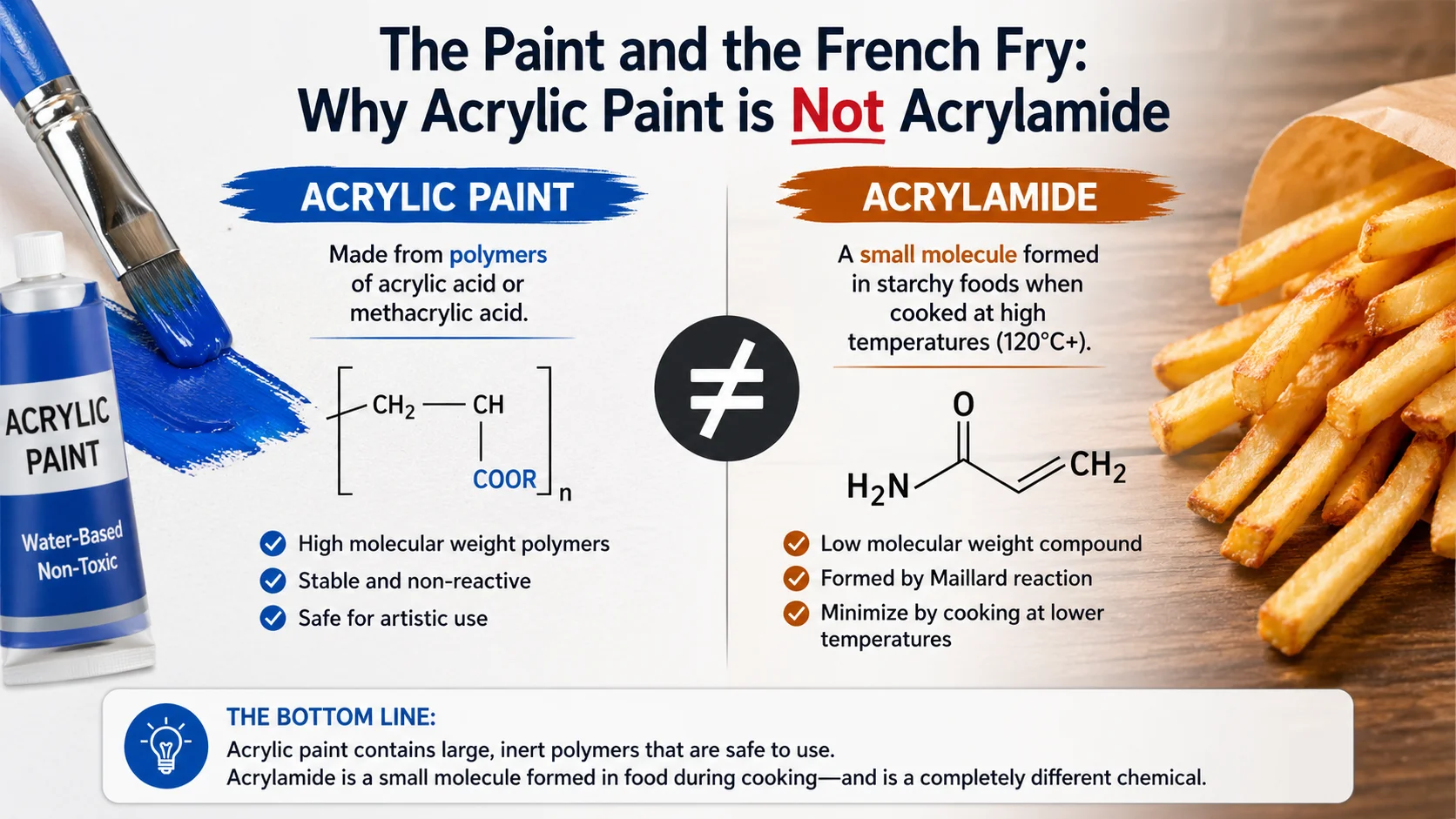
To make matters more confusing, there is another chemical with a strikingly similar name—acrylamide—that regularly makes headlines for being “probable carcinogen” found in French fries and coffee.
Despite the similar spelling, acrylic paint and acrylamide are entirely different substances with different risks. Here is the science behind the confusion and how to stay safe in the studio.
The Acrylate Family (What is in your paint)
First, let’s look at the paint in your hand. Acrylic paint consists of pigment suspended in an acrylic polymer emulsion. This polymer is essentially a chain of repeating units called acrylates (like ethyl acrylate or methyl methacrylate).
When an acrylic painting dries, the water evaporates, leaving behind a plastic film. In this cured, solid state, the paint is generally considered inert and non-toxic.
So, can acrylic paint cause cancer?
The liquid form is where the potential risk lies. The International Agency for Research on Cancer (IARC) has classified specific acrylate monomers, such as ethyl acrylate, as a Group 2B agent, meaning it is “possibly carcinogenic to humans” .
However, context is everything. The primary health risks associated with acrylic paints are usually respiratory irritation, skin reactions, or dizziness from solvent fumes (if using airbrush cleaners or varnishes), rather than a high risk of cancer for the average hobbyist.
One specific product, acrylic lacquer (often used in spray cans), poses a higher risk. The danger here is rarely the “acrylic” part, but the solvents (like toluene and benzene) and carbon black that carry it . Carbon black (used for deep black colors) is classified as a Group 2B carcinogen, and inhalation of aerosolized solvents is linked to long-term organ damage.
The Acrylamide (The one in your food)
Now, let’s look at Acrylamide. If you are worried about cancer, this is the chemical that scientists are watching closely, but it has almost nothing to do with painting.
Acrylamide is not an ingredient you add to things; it is a byproduct of cooking. It forms when starchy foods (like potatoes or grains) are heated to high temperatures (above 120°C / 248°F) via frying, baking, or roasting.
This substance is classified by the WHO/IARC as Group 2A: “Probably carcinogenic to humans” . In animal studies, high doses of acrylamide have been shown to cause cancer and damage the nervous system and reproductive organs.
However, while it is “probable” in animals, human studies have been mixed. The primary sources of acrylamide exposure for humans are tobacco smoke (smokers have 3-5 times higher levels) and diet (potato chips, coffee, crackers).
Why Does This Confusion Happen?
The confusion stems from the difference between monomers and polymers.
- The Toxic Part (Monomer): Both acrylates (in paint) and acrylamide (in food) start as small, reactive molecules called monomers. These can be toxic and irritating.
- The Safe Part (Polymer): In paint, these monomers are linked into long chains called polymers to make the binder. In this polymerized state, the plastic is safe. In industrial settings, polyacrylamide (the polymerized form of acrylamide) is actually non-toxic—it is the unpolymerized acrylamide residue that is dangerous.
In short:
- Acrylic Paint contains Acrylates (Monomer) -> Polymerized into the plastic film.
- Acrylamide is a different monomer (used for grouting and treating water) -> Found accidentally in burnt food.
The Verdict
So, can acrylic paint cause cancer? For the casual painter using water-based acrylics on canvas, the risk is negligible to non-existent, provided you aren’t eating the paint or sanding dried plastic into dust and inhaling it.
However, professional safety is vital if you are airbrushing or using spray lacquers.
- Ventilation is key: The real enemy is inhaling aerosolized droplets or solvent vapors. Use a spray booth or a respirator rated for organic vapors if spraying.
- Don’t Sand Dry Paint: Sanding dry acrylic creates a fine plastic dust that can lodge in your lungs. If you must sand, do it wet or wear an N100 mask.
As for acrylamide, you are more likely to encounter it in a bag of potato chips than in an art studio. To reduce that risk, avoid overcooking starchy foods and don’t smoke. But you can keep painting.