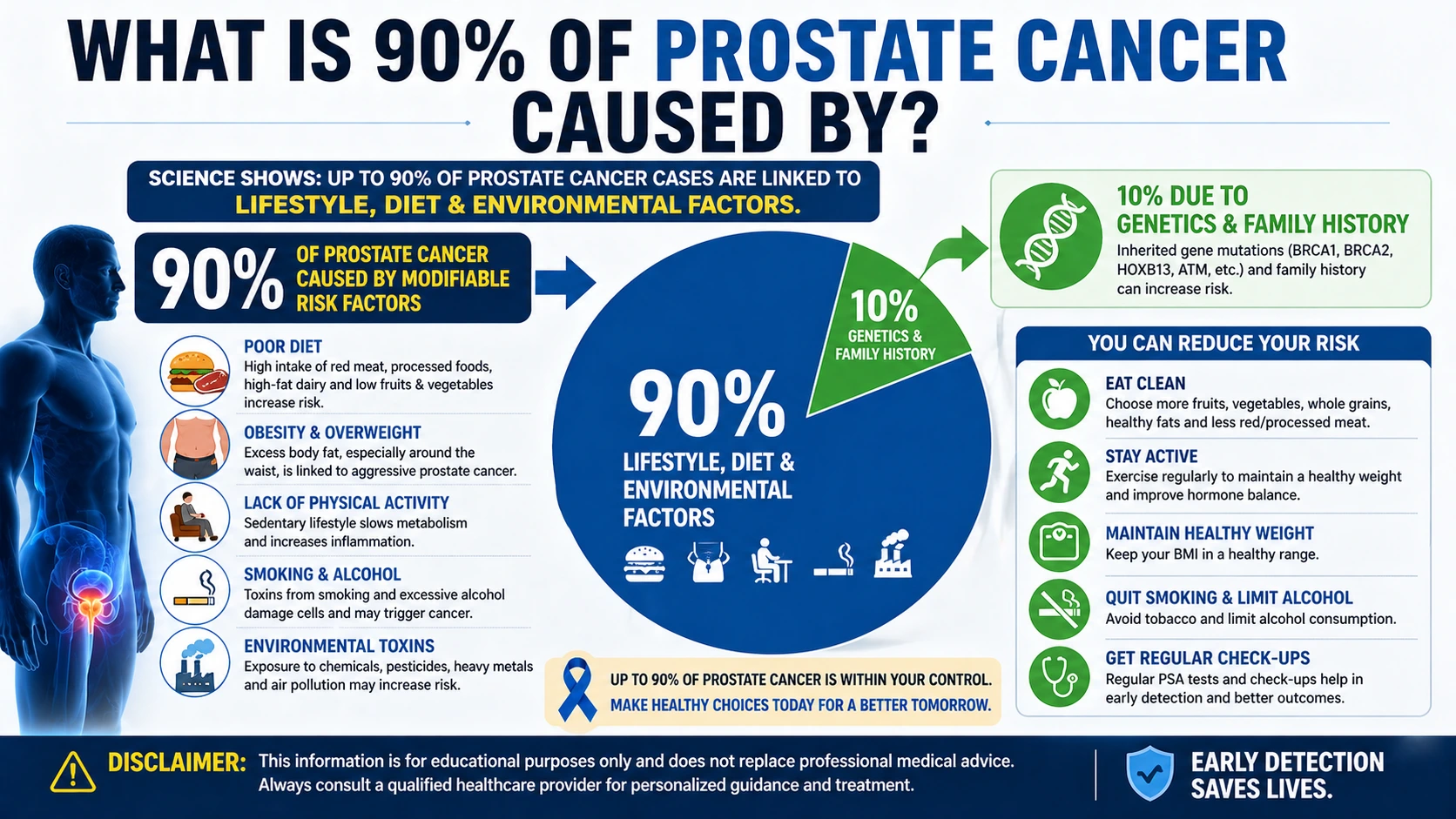
When discussing general cancer, we often hear that 90-95% of cases are linked to lifestyle and environment. However, when we zoom in on prostate cancer—the most common non-skin cancer in men—the answer shifts dramatically.
So, what is 90% of prostate cancer caused by? In a surprising twist of biology, the answer is: You cannot control 90% of it.
Unlike lung cancer (which is 90% caused by smoking) or skin cancer (largely caused by UV exposure), the overwhelming drivers of prostate cancer are factors you are born with: Age, Genetics, and Race. In fact, research indicates that only about 5-10% of prostate cancer cases are strongly linked to diet or lifestyle, while the rest stems from non-modifiable risk factors .
Here is the breakdown of why, for prostate cancer, nature trumps nurture.
1. Age: The 90% Mortality Factor
If you are looking for the single answer to “What is 90% of prostate cancer caused by?”—look at the calendar.
Prostate cancer is virtually a disease of aging. While other cancers strike children and young adults, prostate cancer rarely appears before 40. Specifically, 90% of prostate cancer deaths occur in men aged 65 or older .
The statistics are staggering:
- Under 40: Extremely rare (usually genetic).
- Over 65: The risk skyrockets.
- In their 80s: Autopsy studies show that up to 60-90% of men have some cancer cells in their prostate, though many will die with it, not of it .
If the question is what causes the fatal 90% of cases, age is the primary culprit.
2. Hereditary Factors (Genes)
You cannot outrun your DNA. While general cancer is mostly environmental, prostate cancer is one of the most heritable of all major cancers.
According to the National Cancer Institute, up to 60% of prostate cancer risk is caused by inherited factors . This is the “genetic lottery.”
- Family History: If your father or brother had prostate cancer, your risk doubles. If you have multiple relatives affected, your risk increases more than threefold .
- Specific Genes: Mutations in the BRCA2 gene (the same gene linked to breast cancer) are a major culprit. Men with a BRCA2 mutation are five times more likely to develop prostate cancer . Other genes like HOXB13 and ATM also play a role .
- Hereditary Cases: Approximately 10% of all prostate cancer cases are considered “hereditary”—caused directly by a specific inherited gene mutation passed down through families .
3. Race and Ethnicity
This is an uncomfortable but critical medical fact: Your ancestry is a massive predictor of risk.
- Highest Risk: Men of African or Caribbean descent have the highest risk in the world. They are more likely to get the disease, get it at a younger age, and develop aggressive, fatal forms .
- Lowest Risk: Asian and Hispanic men have significantly lower rates than White or Black men.
Researchers believe this is driven by genetic polymorphisms (variants in the DNA) that are more common in specific populations .
4. Lifestyle: The 10% You Can Control
So, if 90% is locked in by age, genes, and race, what about the rest?
While not the “90%” answer, lifestyle still plays a role in the remaining percentage.
- Diet is a factor. High-fat diets, excessive red meat, and high calcium intake appear to increase risk, while cooked tomatoes (lycopene) and fish may be protective .
- Obesity is linked to more aggressive (though not necessarily more frequent) prostate cancer .
The “Hidden” 90% Statistic
There is one other way to interpret this question. When doctors ask “What is 90% of prostate cancer caused by?” they might also answer: Nothing.
It sounds strange, but prostate cancer is unique. The vast majority of men who get prostate cancer will never die from it. It is often a slow-growing turtle rather than a lion. For many older men, the “cause” is simply the normal process of cellular aging—cells eventually make a copying error that turns into a tumor, but the body keeps it in check.
Summary
If you ask, “What is 90% of prostate cancer caused by?” —the answer is non-modifiable risk factors: getting older (90% of deaths occur over 65), inheriting bad genes (60% of risk is hereditary), and race.
The Takeaway: Because 90% of the risk is out of your control, screening is non-negotiable. You cannot stop aging or change your father’s genes, but you can get a PSA test.
You cannot prevent the biology of prostate cancer, but you can catch it before it catches you.
Inspires quicker medical action
A celebrity’s recovery story can push people to consult a doctor sooner rather than ignoring symptoms for months or years. Provides hope and reduces fear
Hearing survival and recovery stories shows that with modern treatments—surgery, radiation, hormone therapy, medications, or lifestyle changes—many prostate conditions are manageable or treatable. Promotes preventive lifestyle changes
Public figures often discuss diet, exercise, regular checkups, and supplements, motivating others to improve prostate health proactively.
Disclaimer: This content is for informational purposes only and is not medical advice. Always consult a qualified healthcare professional before using supplements, medical devices, or starting any treatment for prostate conditions or cancer.