If you’ve been researching a new medical test, cancer screening, genetic analysis, or advanced diagnostic tool, you may have come across a sentence like this:
“This test is available under Clinical Laboratory Improvement Amendments (CLIA) regulations but is not yet FDA-approved.”
For most people, that sounds technical and confusing. Does it mean the test is safe? Experimental? Legal? Risky?
Let’s break it down in plain English.
First, What Is CLIA?
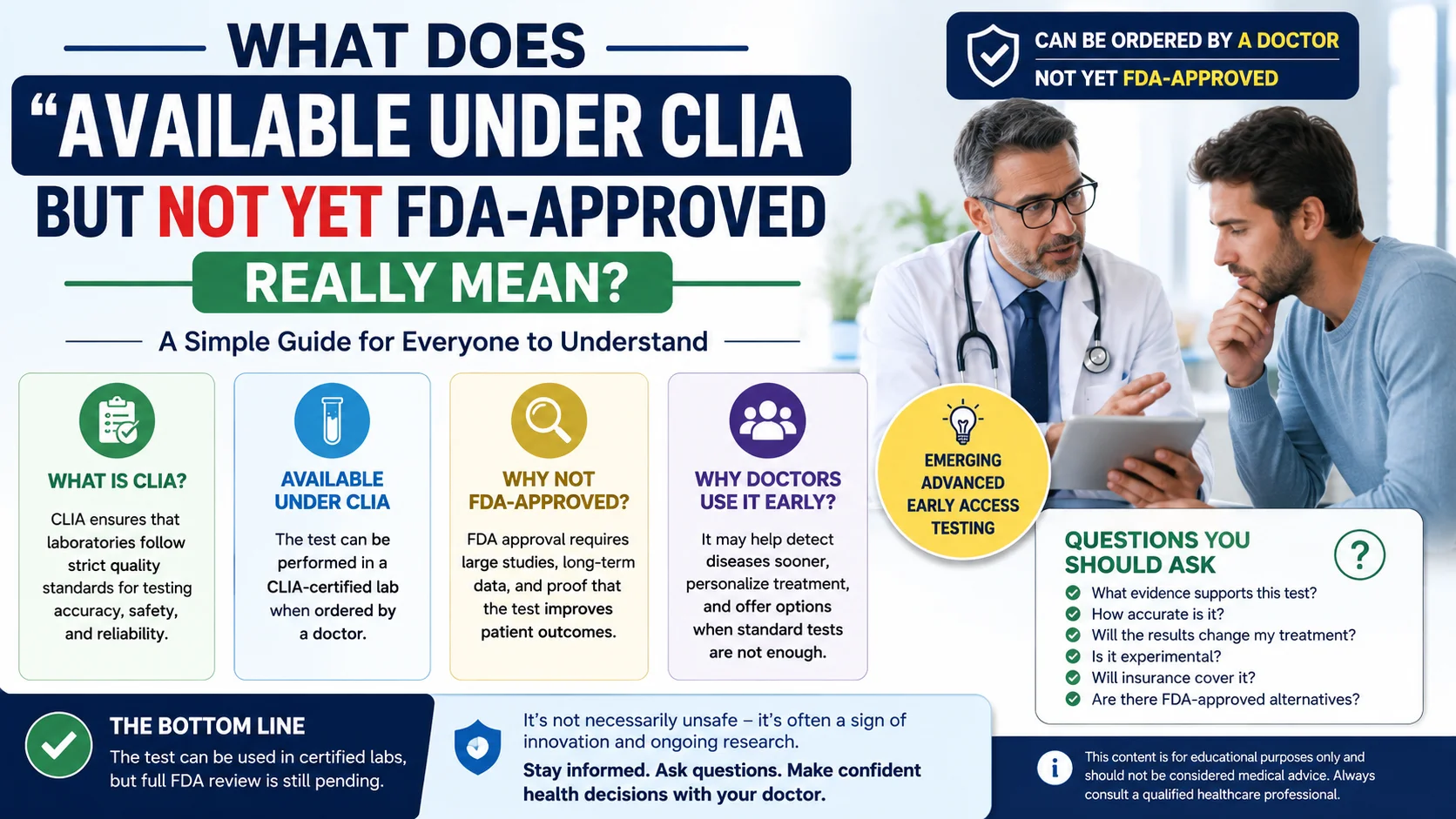
CLIA stands for the Clinical Laboratory Improvement Amendments. These are U.S. regulations designed to make sure medical laboratories perform tests accurately and safely.
A lab that is “CLIA-certified” has met quality standards for:
- Laboratory procedures
- Staff qualifications
- Equipment accuracy
- Testing reliability
In simple terms, CLIA helps ensure that a lab knows what it is doing.
So What Does “Available Under CLIA” Mean?
It means the test can legally be offered through a certified medical laboratory, usually when ordered by a doctor.
This is common with:
- Advanced blood tests
- Genetic testing
- Cancer biomarker tests
- Experimental diagnostic tools
- Precision medicine screening
Even if a test is very new, doctors may still be able to use it if it is performed in a properly regulated CLIA-certified lab.
Then Why Isn’t It FDA-Approved Yet?
The U.S. Food and Drug Administration (FDA) has a different role.
While CLIA regulates how laboratories operate, the FDA evaluates:
- Whether a medical test truly works
- How accurate it is
- Whether it improves patient outcomes
- Whether the benefits outweigh risks
FDA approval often requires:
- Large clinical trials
- Years of research
- Extensive safety and performance data
Because of this, some promising medical tests become available through CLIA-certified labs before they complete the long FDA approval process.
A Simple Everyday Analogy
Think of it like this:
- CLIA-certified means the kitchen is inspected and follows hygiene rules.
- FDA-approved means the specific recipe has been fully tested and officially endorsed.
So a meal can still be served safely even if the recipe is new and not yet formally approved nationwide.
Does This Mean the Test Is Unsafe?
Not necessarily.
Some CLIA-based tests are highly advanced and supported by strong early research. Others are still considered emerging technologies.
The important thing is understanding that:
- The test may still be under scientific evaluation
- Long-term evidence may be limited
- Different doctors may have different opinions about its usefulness
This is why physicians often use these tests carefully and selectively.
Why Doctors Sometimes Use These Tests Early
In serious diseases like:
- Cancer
- Rare genetic disorders
- Neurological conditions
- Autoimmune diseases
patients may not have time to wait years for formal approval.
Early-access testing can sometimes:
- Detect disease sooner
- Help personalize treatment
- Identify high-risk patients
- Offer options when standard testing fails
For some patients, that early information may be valuable.
Questions Patients Should Ask
If your doctor recommends a CLIA-available but non-FDA-approved test, consider asking:
- What evidence supports this test?
- How accurate is it?
- Could the results change my treatment?
- Is it experimental?
- Will insurance cover it?
- Are there FDA-approved alternatives?
Good doctors welcome these questions.
The Bottom Line
“Available under CLIA regulations but not yet FDA-approved” does not automatically mean a test is dangerous or fake.
It usually means:
- The test can legally be performed in certified U.S. labs
- Doctors may already be using it
- Research is still evolving
- Full FDA review is still pending
In modern medicine, many important innovations first appear in this gray zone between early scientific promise and full regulatory approval.
For patients, the key is staying informed, asking questions, and discussing benefits and limitations with a qualified healthcare professional.Understanding CLIA Tests, FDA Approval, and Test Complexity
Medical testing terms like CLIA waived, FDA-approved, and moderate complexity testing can sound overwhelming. But these terms simply describe how medical tests are regulated in the United States and how difficult they are to perform accurately.
Here’s a simple explanation of the most common questions people ask.
What Is the Difference Between CLIA Waived and FDA Approved?
These two terms are related but not the same thing.
CLIA Waived
A CLIA waived test is considered:
- Simple to perform
- Low risk for errors
- Easy enough for clinics, pharmacies, or small medical offices
Examples:
- Pregnancy tests
- Finger-prick glucose tests
- Rapid COVID tests
- Some cholesterol tests
These tests usually:
- Give quick results
- Require minimal training
- Use simple instructions
FDA Approved
An FDA-approved test has been reviewed by the U.S. Food and Drug Administration and shown to:
- Work as intended
- Be reasonably accurate
- Meet safety and performance standards
A test can be:
- FDA-approved but not waived
- CLIA waived and FDA-cleared
- Available under CLIA but still awaiting full FDA approval
Simple Difference
- CLIA waived = how simple and low-risk the test is
- FDA approved = whether the government formally reviewed and approved the product
How Many Levels of Testing Are There Under CLIA?
Under CLIA regulations, laboratory tests are divided into three main levels based on complexity.
1. Waived Tests
These are the simplest tests.
Features:
- Easy to perform
- Minimal chance of mistakes
- Often used in pharmacies and clinics
Examples:
- Home pregnancy tests
- Rapid flu tests
- Blood sugar finger-stick tests
2. Moderate Complexity Tests
These require:
- Trained laboratory staff
- More detailed procedures
- Quality controls
Examples:
- Routine blood chemistry panels
- Urinalysis
- Some infectious disease testing
- Automated laboratory analyzers
These are commonly performed in hospitals and diagnostic labs.
3. High Complexity Tests
These are the most advanced tests.
Examples:
- Genetic sequencing
- Advanced cancer biomarker testing
- Molecular diagnostics
- Specialized pathology testing
These tests often require:
- Highly trained scientists
- Sophisticated equipment
- Extensive validation
Are CLIA Waived Tests Accurate?
Generally, yes — when used correctly.
CLIA waived tests are designed to be:
- Simple
- Fast
- Reliable for basic screening
However, they may sometimes be:
- Less sensitive than advanced lab tests
- More affected by user mistakes
- Less detailed
For example:
- A rapid test may miss an early infection
- A laboratory PCR test may detect it more accurately
That’s why doctors sometimes order additional testing even after a waived test.
What Is the Timeline for a CLIA Waiver?
The timeline varies depending on:
- The type of test
- Clinical data quality
- FDA review requirements
Typically:
- Development and validation: months to years
- FDA review for waiver eligibility: several months
- Additional studies may extend timelines
Some companies first launch a laboratory-developed test under CLIA regulations before pursuing FDA clearance or waiver status.
What Is the FDA CLIA Database?
The FDA maintains databases that help laboratories and healthcare providers identify:
- Approved tests
- CLIA categorization
- Complexity status
- Manufacturer details
These databases help determine:
- Whether a test is waived
- Whether special certifications are required
- Where a test can legally be performed
Official FDA Resources
What Is the FDA CLIA Complexity Database?
This database classifies tests into:
- Waived
- Moderate complexity
- High complexity
Laboratories use it to determine:
- Staffing requirements
- Certification needs
- Inspection standards
What Are Non-Waived Tests?
A non-waived test is any test that is not classified as simple.
This includes:
- Moderate complexity tests
- High complexity tests
These tests require:
- Certified laboratory environments
- Trained personnel
- Detailed quality control systems
Non-Waived Testing Examples
Examples include:
- Comprehensive metabolic panels
- PCR molecular testing
- Advanced infectious disease testing
- Genetic mutation analysis
- Cancer biomarker panels
- Flow cytometry
- Tissue pathology
These are usually performed in hospitals or specialized laboratories.
What Is a CLIA Moderate Complexity Test List?
Moderate complexity tests include many routine medical laboratory procedures such as:
- Blood counts (CBC)
- Basic chemistry panels
- Electrolyte testing
- Some immunology tests
- Urinalysis
- Certain automated analyzers
The official classification depends on FDA scoring criteria involving:
- Technical skill required
- Interpretation complexity
- Risk of errors
How to Apply for a CLIA Waiver Online
Healthcare facilities usually apply through state health agencies or the federal CMS system.
Typical steps:
- Complete CMS Form 116
- Choose the type of laboratory certificate
- Pay required fees
- Submit laboratory details
- Await approval
Official CMS Information
What Is a CLIA Test Normal Range?
A “normal range” refers to expected laboratory values found in healthy individuals.
Examples:
- Blood glucose
- Cholesterol
- Hemoglobin
- Thyroid hormones
Normal ranges may vary based on:
- Age
- Sex
- Testing method
- Laboratory standards
Doctors interpret these results alongside symptoms and medical history.
What Does “Non-Waived Test” Mean?
A non-waived test simply means:
The test is more complex and requires certified laboratory oversight.
It does not mean the test is unsafe.
It only means:
- More expertise is needed
- More quality controls are required
- Laboratory certification standards are stricter
The Bottom Line
CLIA regulations help organize medical testing based on complexity and safety requirements.
In simple terms:
- Waived tests = simple and low-risk
- Moderate complexity tests = standard laboratory testing
- High complexity tests = advanced specialized diagnostics
Meanwhile, FDA approval focuses on whether a medical test has been scientifically reviewed for safety and effectiveness.
Understanding these terms helps patients make more informed healthcare decisions and ask better questions about the tests their doctors recommend.
Disclaimer:
This article is for educational purposes only and does not constitute medical or legal advice. Always consult qualified healthcare professionals or regulatory authorities for clinical and laboratory compliance decisions.