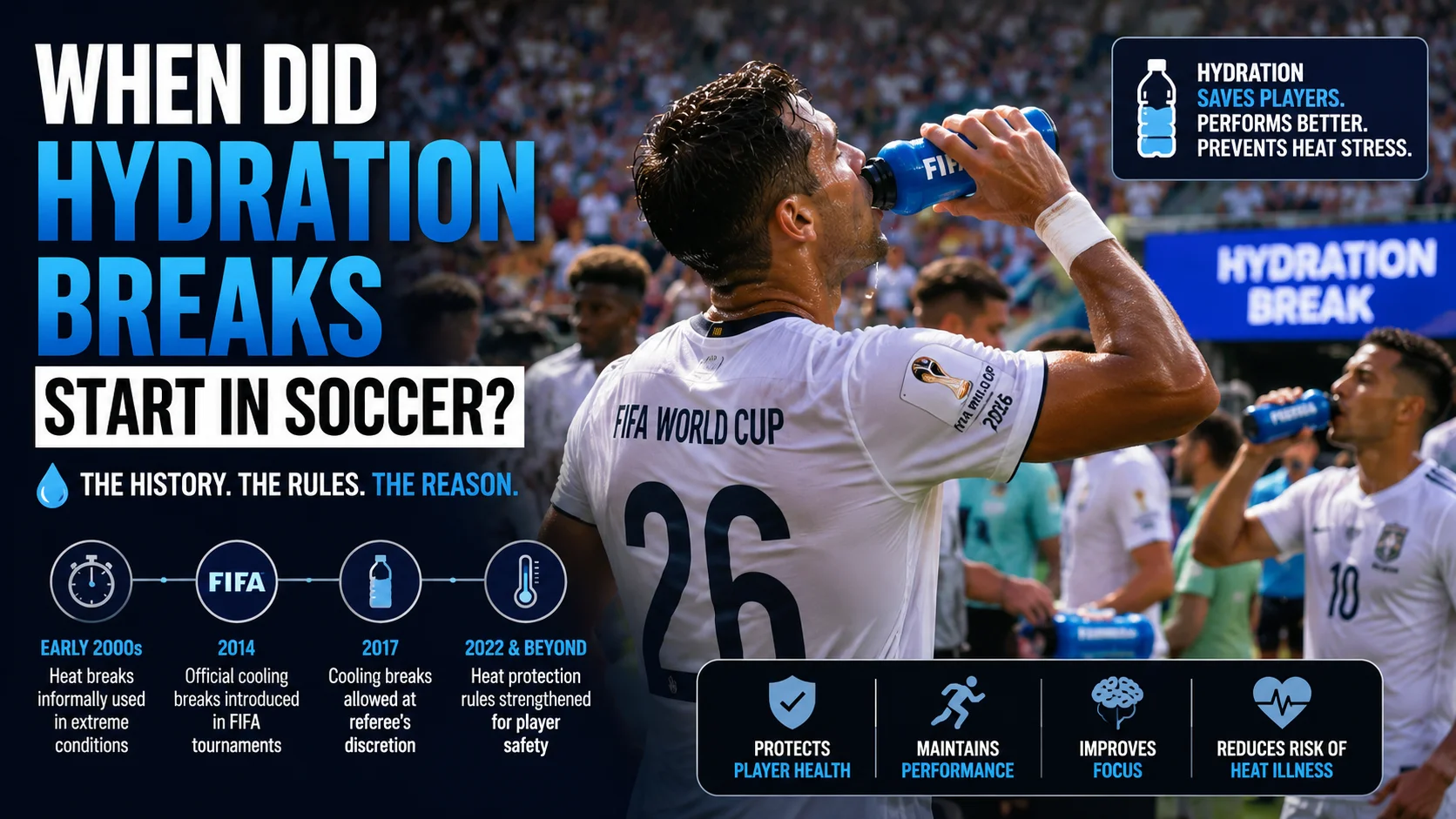
- First official cooling break: 2014 FIFA World Cup (Brazil) – Netherlands vs Mexico Round of 16
- Trigger condition (2014–2022): Wet Bulb Globe Temperature > 32°C (89.6°F)
- 2022 Qatar: Cooling breaks used when temperature exceeded 32°C
- 2026 World Cup: FIRST TIME mandatory hydration breaks in ALL matches – 3 min at 22′ & 67′, regardless of weather
- Why it matters: Prevents heat exhaustion, heatstroke, dehydration cramps, and potential fatalities
Introduction: The Day Soccer Stopped for Water
Imagine running 10 kilometers in 90 minutes, sprinting, twisting, jumping, and colliding with opponents—all while the sun beats down at 39°C (102°F) and humidity hovers near 70%. Now imagine being told you cannot drink water during the match.
That was the reality of World Cup soccer before 2014.
On June 29, 2014, in Fortaleza, Brazil, history was made. Portuguese referee Pedro Proença blew his whistle at the 30‑minute mark of the Netherlands vs Mexico Round of 16 match. Players from both teams walked to the sidelines, grabbed water bottles, and drenched themselves with wet towels.
For the first time in World Cup history, the game officially stopped for players to drink water.
The cooling break—later known as the hydration break—was born.
But how did we get here? And why did it take so long?
The 2014 Brazil World Cup: The Birth of the Cooling Break
The First-Ever Cooling Break
The first official cooling break in World Cup history occurred during the Netherlands vs Mexico Round of 16 match at the Estadio Castelão in Fortaleza, Brazil.
The conditions were brutal:
- Temperature: 39°C (102°F)
- Humidity: 68%
- Combined heat index: Extreme danger zone
FIFA’s official statement read: “Cooling breaks last three minutes in duration and are implemented by the referee at approximately 30 minutes into the run-of-play in both halves of the match”.
The players used the break to hydrate, cool down with wet towels, and receive tactical instructions from their coaches.
Who Proposed It?
The idea was first proposed by Italy’s head coach Cesare Prandelli in December 2013. FIFA approved it for implementation in February 2014, just months before the World Cup kicked off.
But FIFA didn’t act out of pure goodwill. A Brazilian labor court forced their hand.
The Legal Battle That Changed the Game
Players Sued FIFA
In May 2014, the Brazilian footballers union filed a petition against FIFA, protesting against 1 PM kick-offs in Brazil’s northern and northeastern regions, where daytime heat and humidity were extreme.
The players didn’t trust FIFA to protect them. So they went to court.
The Court Order
A labor court in Brasília issued a temporary injunction ordering FIFA to implement mandatory water breaks when temperatures reached 32°C (89.6°F) on the Wet Bulb Globe Temperature index—a measure that accounts for temperature, humidity, wind, cloud cover, and solar radiation.
FIFA faced a fine of 200,000 reals (about $90,000) per match for non-compliance.
The court ruled that playing in such conditions could “endanger the players’ health”.
Lionel Messi’s Complaint
Even the world’s best player couldn’t handle the heat. After Argentina’s tough win against Iran in Belo Horizonte, Lionel Messi complained: “It was too hot to play football. The conditions were very difficult”.
If the greatest player on Earth was struggling, imagine what it was like for everyone else.
2022 Qatar World Cup: Cooling Breaks Continue
The 2022 World Cup in Qatar presented a unique challenge. The tournament was moved to November and December to avoid the scorching summer heat, but temperatures still reached around 29°C (84°F).
FIFA continued using cooling breaks when temperatures exceeded 32°C (89.6°F).
The breaks were also used at the 2023 Women’s World Cup in Australia and New Zealand under the same threshold.
2026 World Cup: Mandatory Hydration Breaks for All
The Biggest Change in Soccer History
On December 5, 2025, FIFA announced a revolutionary change: mandatory three‑minute hydration breaks in EVERY match at the 2026 World Cup, regardless of temperature or weather conditions.
How It Works
| Detail | Specification |
|---|---|
| Timing | 22nd minute and 67th minute of each half |
| Duration | 3 minutes (whistle to whistle) |
| Added time | 3 minutes added to stoppage time at end of each half |
| All matches | All 104 World Cup matches, regardless of venue (indoor/outdoor) |
| Reason | Player welfare + competitive balance across all venues |
Why the Change?
FIFA cited two main reasons:
- Player welfare: Protecting athletes from extreme heat
- Competitive balance: Ensuring equal conditions for all teams, regardless of venue
The decision was influenced by the 2025 FIFA Club World Cup in the United States, where extreme heat impacted player performance.
The Game Format Changed
For the first time since 1897, the traditional two 45‑minute halves effectively became four quarters of roughly 22 minutes each.
This is the most significant structural change to soccer in over a century.
Historical Incidents: When Dehydration Almost Killed Players
Hydration breaks didn’t appear out of nowhere. They emerged because players were literally collapsing and dying from dehydration and heatstroke.
1994 World Cup: Ireland vs Mexico in 43°C Heat
The 1994 World Cup match between Ireland and Mexico was played in 43°C (109°F) heat.
- Over 100 fans collapsed in the stands from heatstroke
- FIFA had banned players from drinking bottled water on the pitch
- Players were so dehydrated they couldn’t provide urine samples for doping tests
- Republic of Ireland player Tommy Coyne collapsed in the dressing room afterward
Former Ireland player Jason McAteer recalled: “We honestly nearly killed him”.
David Beckham – 2006 World Cup
During England’s 2006 World Cup match against Ecuador in 30°C heat, David Beckham twice vomited on the pitch.
He was diagnosed with severe dehydration after being substituted in the 87th minute.
The England team consumed 70 liters of liquids and used 70kg of ice during the game.
Despite being severely dehydrated and vomiting, Beckham still scored the winning goal. His teammate John Terry called it “the true captain’s performance”.
Samuel Kalu – Multiple Collapses
Nigerian forward Samuel Kalu has collapsed multiple times due to extreme dehydration:
- 2019 Africa Cup of Nations (Egypt): Collapsed during training in nearly 40°C heat and was hospitalized
- 2021 Ligue 1 match (France): Collapsed in the 6th minute while standing in a defensive wall
James Rodríguez – Hospitalized for Severe Dehydration (2026)
Colombian captain James Rodríguez was hospitalized for 72 hours after a friendly match against France.
Despite playing 63 minutes in 26°C heat and showing no immediate signs of distress, he was later found to be “severely dehydrated” and put on intravenous fluid therapy.
Ronald Araújo – Dizziness from Dehydration (2024)
Uruguay defender Ronald Araújo was substituted at halftime during the Copa América because he felt “dizzy” due to dehydration.
Korey Stringer – A Tragic Reminder
While not a soccer player, the death of Minnesota Vikings tackle Korey Stringer in 2001 from heatstroke during practice serves as a grim reminder of what can happen when athletes are denied proper hydration.
His body temperature reached 109°F (43°C).
Health Benefits: Why Hydration Breaks Save Lives
The Science of Dehydration in Sports
When athletes lose as little as 2% of their body weight through sweat, it affects:
- Physical performance – reduced endurance and strength
- Movement – slower reaction times
- Reflexes – impaired coordination
- Cognitive function – poor decision-making
Heat‑Related Illnesses in Soccer
The primary purpose of hydration breaks is to prevent:
| Condition | Symptoms |
|---|---|
| Heat cramps | Painful muscle spasms |
| Heat exhaustion | Heavy sweating, weakness, dizziness, nausea |
| Heatstroke | Body temperature >40°C, confusion, seizures, organ failure, death |
How Hydration Breaks Help
During a three‑minute hydration break, players can:
- Replenish fluids lost through sweat
- Lower core body temperature with wet towels and ice
- Receive medical assessment for early signs of heat illness
- Regain mental focus and tactical awareness
Expert Opinion
Dr. Floris Wardenaar, a sports nutrition researcher at Arizona State University, found that players only drink during about one‑third of natural stoppages in play.
Mandatory hydration breaks ensure players actually hydrate, rather than relying on their own judgment during the flow of the game.
Controversy and Match Impact
Commercialization Concerns
Critics argue that hydration breaks are primarily a commercial opportunity for broadcasters to run advertisements.
FIFA’s announcement that TV networks could run commercials during breaks “gave away a major motivation behind the rule change, in the eyes of some fans”.
Broadcasters get a new 2‑minute, 10‑second window for ads during each break.
Momentum Disruption
Dutch defender Virgil van Dijk questioned the necessity of breaks in colder temperatures, calling them “unpleasant for the viewers” and an “interruption to the natural flow of the match”.
Competitive Balance vs. Tradition
Some argue that mandatory breaks in all matches—including indoor stadiums with air conditioning—undermine the traditional 45‑minute half format.
Others point out that standardization helps ensure competitive balance across different venues and climates.
Arsène Wenger’s Response
FIFA’s Chief of Global Football Development, Arsène Wenger, acknowledged the criticism: “Hydration breaks may not continue after the World Cup” and FIFA will “review their impact after the tournament”.
However, Wenger also noted that the breaks “did not affect the flow of play and had no impact on results”.
The Future of Hydration Breaks
What’s Next?
The future of hydration breaks remains uncertain. FIFA has promised to review their impact after the 2026 World Cup.
CONMEBOL Follows Suit
In March 2026, CONMEBOL (South American football confederation) announced 90‑second rehydration breaks in all Copa Libertadores and Copa Sudamericana matches, regardless of temperature.
Possible Outcomes
- Permanent adoption – Hydration breaks become a permanent feature of professional soccer
- Return to temperature‑based triggers – Only used when conditions exceed 32°C
- Modified format – Shorter breaks or different timing
- Complete removal – If criticism overwhelms the player welfare argument
Conclusion
From a Brazilian labor court forcing FIFA’s hand in 2014, to the mandatory hydration breaks of 2026, soccer’s relationship with player hydration has undergone a dramatic transformation.
The journey reflects a broader shift in sports: from treating athletes as disposable assets to recognizing them as human beings who need protection from the elements.
The 1994 World Cup saw players banned from drinking water while fans collapsed in the stands. The 2006 World Cup saw David Beckham vomiting on the pitch from severe dehydration. The 2014 World Cup finally saw the first official cooling break. And the 2026 World Cup will see hydration breaks in every single match.
It took over 30 years, multiple court cases, and countless players collapsing on the pitch—but soccer finally figured out that water breaks save lives.
“Football takes a back seat” when player health is at risk, as Bordeaux coach Vladimir Petkovic said after Samuel Kalu collapsed.
Hydration breaks aren’t just about performance. They’re about survival.
🏆 Motivational Captions for Sportsmen
Champions don’t just train harder—they recover smarter. Hydration is the difference between finishing strong and finishing on the ground.
Your body is your engine. Water is your fuel. Don’t run on empty.
The greatest ability is availability. Stay hydrated, stay on the pitch.
Every drop of sweat deserves a drop of water in return. Respect your body, and it will respect your game.
You can’t pour from an empty cup—and you can’t perform from an empty tank. Drink up, show up, and rise up.
Heat doesn’t discriminate. Neither should your hydration strategy.
Legends are made in the heat of battle—but they’re sustained by the water they drink.
💪 Stay Hydrated, Stay Champion
Key Nutrients Electrolyte Hydration Pills – 100 Servings
Don’t let dehydration steal your performance. Whether you’re on the pitch, in the gym, or chasing your dreams, proper hydration is non-negotiable.

Key Nutrients Electrolyte Recovery Plus – Blue Razz
Recover faster. Perform longer. Dominate the game.

Shop Now – Recover Like a Pro
Disclosure: This article contains affiliate links. If you purchase products through these links, I may earn a commission at no additional cost to you. I only recommend products I believe can genuinely benefit athletes and active individuals.
Disclaimer: The information provided in this article is for educational and informational purposes only and does not constitute medical advice. Always consult with a qualified healthcare professional before starting any new supplement regimen, especially if you have pre-existing medical conditions or are taking medications. Hydration needs vary based on individual factors including body weight, activity level, climate conditions, and overall health. The historical incidents and medical information referenced are based on publicly available reports and should not be used as a substitute for professional medical guidance. The author and publisher are not responsible for any adverse effects or consequences resulting from the use of any products mentioned or any information provided in this article.