Cooking Oils Explained · 2026
TL;DR
Algae cooking oil is made by fermenting microalgae in closed stainless-steel tanks, then extracting the oil the algae naturally produce. The result is a neutral-tasting oil with a very high smoke point (around 485°F / 250°C), roughly 90% monounsaturated fat, and a low environmental footprint. Compared with olive oil and avocado oil, algae oil wins on heat tolerance and neutral flavor — but olive oil still leads on polyphenols and evidence, while avocado oil is the closest all-round rival. Use algae oil for high-heat searing and frying, olive oil for finishing and raw use, and avocado oil as a versatile middle ground.
Walk down any supermarket oil aisle and you’ll see olive oil, avocado oil, coconut oil — and increasingly, algae oil. It sounds futuristic, but the process behind it is closer to brewing than to farming. And the oil it produces behaves differently from anything else on the shelf.
So how is algae cooking oil made, and does it actually beat the two oils most kitchens already rely on? Let’s break down the production process first, then put it head to head with olive and avocado oil.
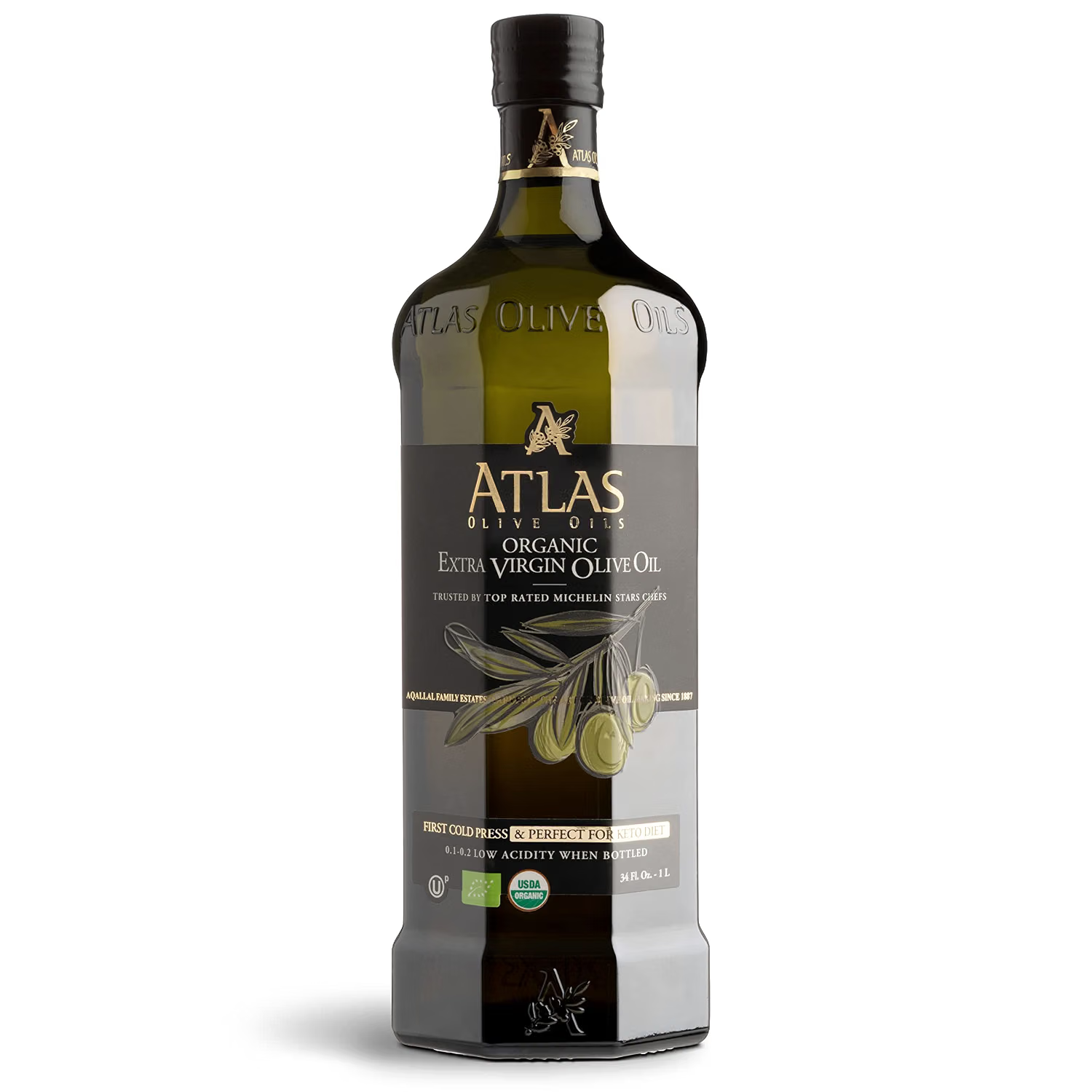
If you want a deeper dive into the kitchen staple most people already own, this guide to olive oil covers grades, polyphenol content and how to choose a genuinely fresh bottle — useful context before comparing it to newer alternatives.
⭐ Editor’s Pick
Best Algae Cooking Oil
Neutral-tasting, high smoke point, ~90% monounsaturated fat. Ideal for searing, frying and baking — without changing the flavor of your food.
Check Price & Availability →
What Is Algae Cooking Oil?
Algae cooking oil is a culinary oil pressed — or more accurately, extracted — from oil-producing microalgae. Unlike algae supplements, which are formulated for Omega-3 (EPA/DHA) content, algae cooking oil is designed for heat, neutral flavor and a fat profile dominated by monounsaturated fat.
The key difference: cooking oil comes from heterotrophic microalgae grown on sugar in dark fermentation tanks, while supplement oil comes from photoautotrophic algae grown on light. Same organism family, very different product.
“We’re not squeezing oil out of a plant. We’re brewing it.” — a fermentation scientist’s framing of modern algae oil production
How Is Algae Cooking Oil Made? Step by Step
The production process happens almost entirely indoors, in closed systems. Here’s how it works.
1. Strain selection. Producers start with a specific microalgae strain chosen for high lipid (oil) yield. The goal is an algae that naturally accumulates oil rather than one bred for pigment or protein.
2. Fermentation in closed tanks. The algae are fed plant-based sugar inside stainless-steel fermentation vessels, kept dark and temperature-controlled. Over a few days, the culture multiplies and the algae store energy as oil droplets inside their cells. No sunlight, no open ponds, no farmland.
3. Harvesting. Once the oil content peaks, the broth is drained and the algae biomass is separated out — typically via centrifugation or filtration.
4. Drying. The harvested biomass is dried into a powder or paste so the oil can be released.
5. Oil extraction. The oil is separated from the dried biomass, usually with mechanical pressing, solvent extraction, or supercritical CO₂. Food-grade producers favor solvent-free methods to keep the final product clean.
6. Refining and filtration. The crude oil is refined to remove impurities, free fatty acids and any residual pigments. This step is what gives algae oil its remarkably neutral taste and high heat stability.
7. Bottling and quality testing. The finished oil is tested for purity, oxidation and fatty acid profile, then bottled. Most reputable brands publish third-party test results.
Quick Q&A
Q: Is algae oil natural or synthetic?
It’s made by a living organism, so it’s biologically produced — not chemically synthesized. The oil itself is a natural algal lipid; the process is industrial but the source is biological.
Q: How long does production take?
Fermentation typically takes a matter of days rather than months — one reason algae oil scales faster than field-grown crops.
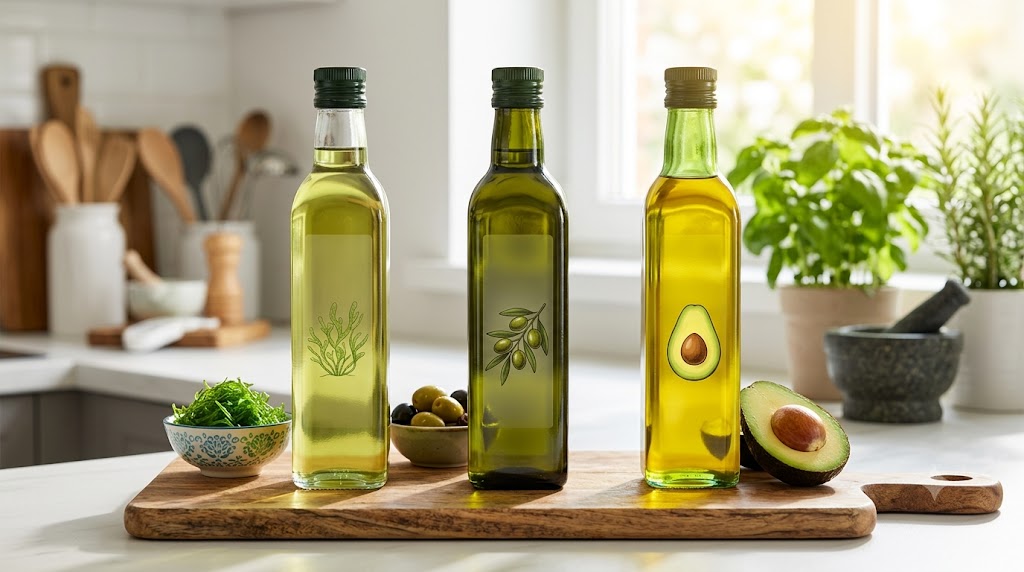
Algae Oil vs Olive Oil vs Avocado Oil
Here’s the side-by-side that matters for everyday cooking.
“The best cooking oil isn’t the healthiest one on paper — it’s the one that’s still stable when your pan is hot.”
Smoke Point & Cooking Performance
Smoke point is where an oil starts breaking down and producing harmful compounds. This is where algae oil separates itself.
Algae oil sits around 485°F (250°C) — hot enough for deep frying, hard searing and wok cooking. Extra virgin olive oil typically smokes between 375–410°F, which is fine for sautéing but not ideal for high-heat searing. Refined avocado oil is comparable to algae oil, sometimes slightly higher.
The practical takeaway: if you want one oil that handles everything from eggs to steak without smoking, algae oil and refined avocado oil are the two strongest choices. Olive oil remains excellent — just better suited to medium heat and raw applications.
Nutrition & Fat Profile
All three oils are predominantly monounsaturated, which is associated with favorable cardiovascular markers when replacing saturated fat.
Algae oil leads on monounsaturated content at roughly 90%, with very little saturated fat and minimal polyunsaturated fat — the latter being the most prone to oxidation.
Olive oil brings something the others don’t: polyphenols, especially in extra virgin form. These compounds are tied to antioxidant and anti-inflammatory effects and are a major reason olive oil dominates nutrition research.
Avocado oil has a similar fat profile to olive oil but far fewer polyphenols unless it’s cold-pressed and unrefined. It also contains some vitamin E.
“Olive oil gives you compounds. Algae oil gives you stability. You don’t have to pick just one.”
Sustainability & Cost
Algae oil’s biggest selling point beyond heat tolerance is land use. It’s produced in tanks, so it requires no orchards, no arable land and minimal water compared with olive or avocado farming. That makes it attractive as demand for cooking oil rises globally.
The trade-off is cost. Algae oil is still a premium product, generally priced above mid-range olive oil and in the same bracket as quality avocado oil. Prices should fall as production scales, but for now it’s a deliberate spend rather than a budget staple.
Which Oil Should You Cook With?
Choose algae oil if: you sear, fry or roast at high heat, want a neutral flavor that won’t change your dish, or care about a low-footprint cooking fat.
Choose olive oil if: you want polyphenols and evidence-backed health benefits, and you’re cooking at medium heat or using it raw. Extra virgin is the version worth buying.
Choose avocado oil if: you want one versatile bottle with a high smoke point and a mild taste, and you don’t mind paying a premium.
Most well-stocked kitchens end up with two: a high-heat neutral oil (algae or avocado) and a flavorful finishing oil (extra virgin olive). That combination covers nearly everything.
Semantic FAQs
How is algae cooking oil made?
Microalgae are fermented in closed stainless-steel tanks fed with plant-based sugar. The algae accumulate oil internally, are harvested and dried, then the oil is extracted, refined, filtered and bottled. It’s a fermentation process, not traditional pressing.
Is algae oil healthier than olive oil?
Not necessarily — they’re different tools. Algae oil is higher in monounsaturated fat and far more heat-stable, but olive oil contains polyphenols with stronger research backing. For high-heat cooking, algae oil is the safer choice; for raw and medium-heat use, olive oil offers more bioactive compounds.
Does algae oil taste like algae?
No. Cooking-grade algae oil is refined to be neutral, so it doesn’t taste fishy or grassy. That neutrality is one of its main advantages — it lets the food’s flavor come through.
Can you deep fry with algae oil?
Yes. Its smoke point around 485°F (250°C) makes it well suited to deep frying and high-heat searing, and its low polyunsaturated content means it oxidizes more slowly than many seed oils.
Is algae oil the same as algae Omega-3 supplements?
No. Supplement algae oil is made for EPA/DHA content using light-grown algae. Cooking algae oil is made via dark fermentation for a neutral, high-heat culinary fat. Different strains, different processes, different purposes.
Disclosure
This article contains affiliate links. If you buy through them, we may earn a commission — this does not affect our evaluation standards or recommendations.
Disclaimer
This content is for informational purposes only and is not medical or dietary advice. Smoke points and nutritional values vary by product and refining method. Individuals with specific health conditions or dietary requirements should consult a qualified healthcare professional or registered dietitian before making changes to their diet.
P.S. — You don’t need to replace your olive oil to try algae oil. Keep both: algae oil for the hot pan, olive oil for everything after the heat is off. That’s not indecision — it’s just good cooking.
TL;DR
Algae cooking oil is made by fermenting microalgae in closed stainless-steel tanks, then extracting the oil the algae naturally produce. The result is a neutral-tasting oil with a very high smoke point (around 485°F / 250°C), roughly 90% monounsaturated fat, and a low environmental footprint. Compared with olive oil and avocado oil, algae oil wins on heat tolerance and neutral flavor — but olive oil still leads on polyphenols and evidence, while avocado oil is the closest all-round rival. Use algae oil for high-heat searing and frying, olive oil for finishing and raw use, and avocado oil as a versatile middle ground.
Walk down any supermarket oil aisle and you’ll see olive oil, avocado oil, coconut oil — and increasingly, algae oil. It sounds futuristic, but the process behind it is closer to brewing than to farming. And the oil it produces behaves differently from anything else on the shelf.
So how is algae cooking oil made, and does it actually beat the two oils most kitchens already rely on? Let’s break down the production process first, then put it head to head with olive and avocado oil.
If you want a deeper dive into the kitchen staple most people already own, this guide to olive oil covers grades, polyphenol content and how to choose a genuinely fresh bottle — useful context before comparing it to newer alternatives.
|
|
⭐ Editor’s Pick Best Algae Cooking Oil Neutral-tasting, high smoke point, ~90% monounsaturated fat. Ideal for searing, frying and baking — without changing the flavor of your food. Check Price & Availability → |
What Is Algae Cooking Oil?
Algae cooking oil is a culinary oil pressed — or more accurately, extracted — from oil-producing microalgae. Unlike algae supplements, which are formulated for Omega-3 (EPA/DHA) content, algae cooking oil is designed for heat, neutral flavor and a fat profile dominated by monounsaturated fat.
The key difference: cooking oil comes from heterotrophic microalgae grown on sugar in dark fermentation tanks, while supplement oil comes from photoautotrophic algae grown on light. Same organism family, very different product.
“We’re not squeezing oil out of a plant. We’re brewing it.” — a fermentation scientist’s framing of modern algae oil production
How Is Algae Cooking Oil Made? Step by Step
The production process happens almost entirely indoors, in closed systems. Here’s how it works.
1. Strain selection. Producers start with a specific microalgae strain chosen for high lipid (oil) yield. The goal is an algae that naturally accumulates oil rather than one bred for pigment or protein.
2. Fermentation in closed tanks. The algae are fed plant-based sugar inside stainless-steel fermentation vessels, kept dark and temperature-controlled. Over a few days, the culture multiplies and the algae store energy as oil droplets inside their cells. No sunlight, no open ponds, no farmland.
3. Harvesting. Once the oil content peaks, the broth is drained and the algae biomass is separated out — typically via centrifugation or filtration.
4. Drying. The harvested biomass is dried into a powder or paste so the oil can be released.
5. Oil extraction. The oil is separated from the dried biomass, usually with mechanical pressing, solvent extraction, or supercritical CO₂. Food-grade producers favor solvent-free methods to keep the final product clean.
6. Refining and filtration. The crude oil is refined to remove impurities, free fatty acids and any residual pigments. This step is what gives algae oil its remarkably neutral taste and high heat stability.
7. Bottling and quality testing. The finished oil is tested for purity, oxidation and fatty acid profile, then bottled. Most reputable brands publish third-party test results.
Quick Q&A
Q: Is algae oil natural or synthetic?
It’s made by a living organism, so it’s biologically produced — not chemically synthesized. The oil itself is a natural algal lipid; the process is industrial but the source is biological.
Q: How long does production take?
Fermentation typically takes a matter of days rather than months — one reason algae oil scales faster than field-grown crops.
Algae Oil vs Olive Oil vs Avocado Oil
Here’s the side-by-side that matters for everyday cooking.
“The best cooking oil isn’t the healthiest one on paper — it’s the one that’s still stable when your pan is hot.”
Smoke Point & Cooking Performance
Smoke point is where an oil starts breaking down and producing harmful compounds. This is where algae oil separates itself.
Algae oil sits around 485°F (250°C) — hot enough for deep frying, hard searing and wok cooking. Extra virgin olive oil typically smokes between 375–410°F, which is fine for sautéing but not ideal for high-heat searing. Refined avocado oil is comparable to algae oil, sometimes slightly higher.
The practical takeaway: if you want one oil that handles everything from eggs to steak without smoking, algae oil and refined avocado oil are the two strongest choices. Olive oil remains excellent — just better suited to medium heat and raw applications.
Nutrition & Fat Profile
All three oils are predominantly monounsaturated, which is associated with favorable cardiovascular markers when replacing saturated fat.
Algae oil leads on monounsaturated content at roughly 90%, with very little saturated fat and minimal polyunsaturated fat — the latter being the most prone to oxidation.
Olive oil brings something the others don’t: polyphenols, especially in extra virgin form. These compounds are tied to antioxidant and anti-inflammatory effects and are a major reason olive oil dominates nutrition research.
Avocado oil has a similar fat profile to olive oil but far fewer polyphenols unless it’s cold-pressed and unrefined. It also contains some vitamin E.
“Olive oil gives you compounds. Algae oil gives you stability. You don’t have to pick just one.”
Sustainability & Cost
Algae oil’s biggest selling point beyond heat tolerance is land use. It’s produced in tanks, so it requires no orchards, no arable land and minimal water compared with olive or avocado farming. That makes it attractive as demand for cooking oil rises globally.
The trade-off is cost. Algae oil is still a premium product, generally priced above mid-range olive oil and in the same bracket as quality avocado oil. Prices should fall as production scales, but for now it’s a deliberate spend rather than a budget staple.
Which Oil Should You Cook With?
Choose algae oil if: you sear, fry or roast at high heat, want a neutral flavor that won’t change your dish, or care about a low-footprint cooking fat.
Choose olive oil if: you want polyphenols and evidence-backed health benefits, and you’re cooking at medium heat or using it raw. Extra virgin is the version worth buying.
Choose avocado oil if: you want one versatile bottle with a high smoke point and a mild taste, and you don’t mind paying a premium.
Most well-stocked kitchens end up with two: a high-heat neutral oil (algae or avocado) and a flavorful finishing oil (extra virgin olive). That combination covers nearly everything.
Semantic FAQs
How is algae cooking oil made?
Microalgae are fermented in closed stainless-steel tanks fed with plant-based sugar. The algae accumulate oil internally, are harvested and dried, then the oil is extracted, refined, filtered and bottled. It’s a fermentation process, not traditional pressing.
Is algae oil healthier than olive oil?
Not necessarily — they’re different tools. Algae oil is higher in monounsaturated fat and far more heat-stable, but olive oil contains polyphenols with stronger research backing. For high-heat cooking, algae oil is the safer choice; for raw and medium-heat use, olive oil offers more bioactive compounds.
Does algae oil taste like algae?
No. Cooking-grade algae oil is refined to be neutral, so it doesn’t taste fishy or grassy. That neutrality is one of its main advantages — it lets the food’s flavor come through.
Can you deep fry with algae oil?
Yes. Its smoke point around 485°F (250°C) makes it well suited to deep frying and high-heat searing, and its low polyunsaturated content means it oxidizes more slowly than many seed oils.
Is algae oil the same as algae Omega-3 supplements?
No. Supplement algae oil is made for EPA/DHA content using light-grown algae. Cooking algae oil is made via dark fermentation for a neutral, high-heat culinary fat. Different strains, different processes, different purposes.
Disclosure
This article contains affiliate links. If you buy through them, we may earn a commission — this does not affect our evaluation standards or recommendations.
Disclaimer
This content is for informational purposes only and is not medical or dietary advice. Smoke points and nutritional values vary by product and refining method. Individuals with specific health conditions or dietary requirements should consult a qualified healthcare professional or registered dietitian before making changes to their diet.
P.S. — You don’t need to replace your olive oil to try algae oil. Keep both: algae oil for the hot pan, olive oil for everything after the heat is off. That’s not indecision — it’s just good cooking.