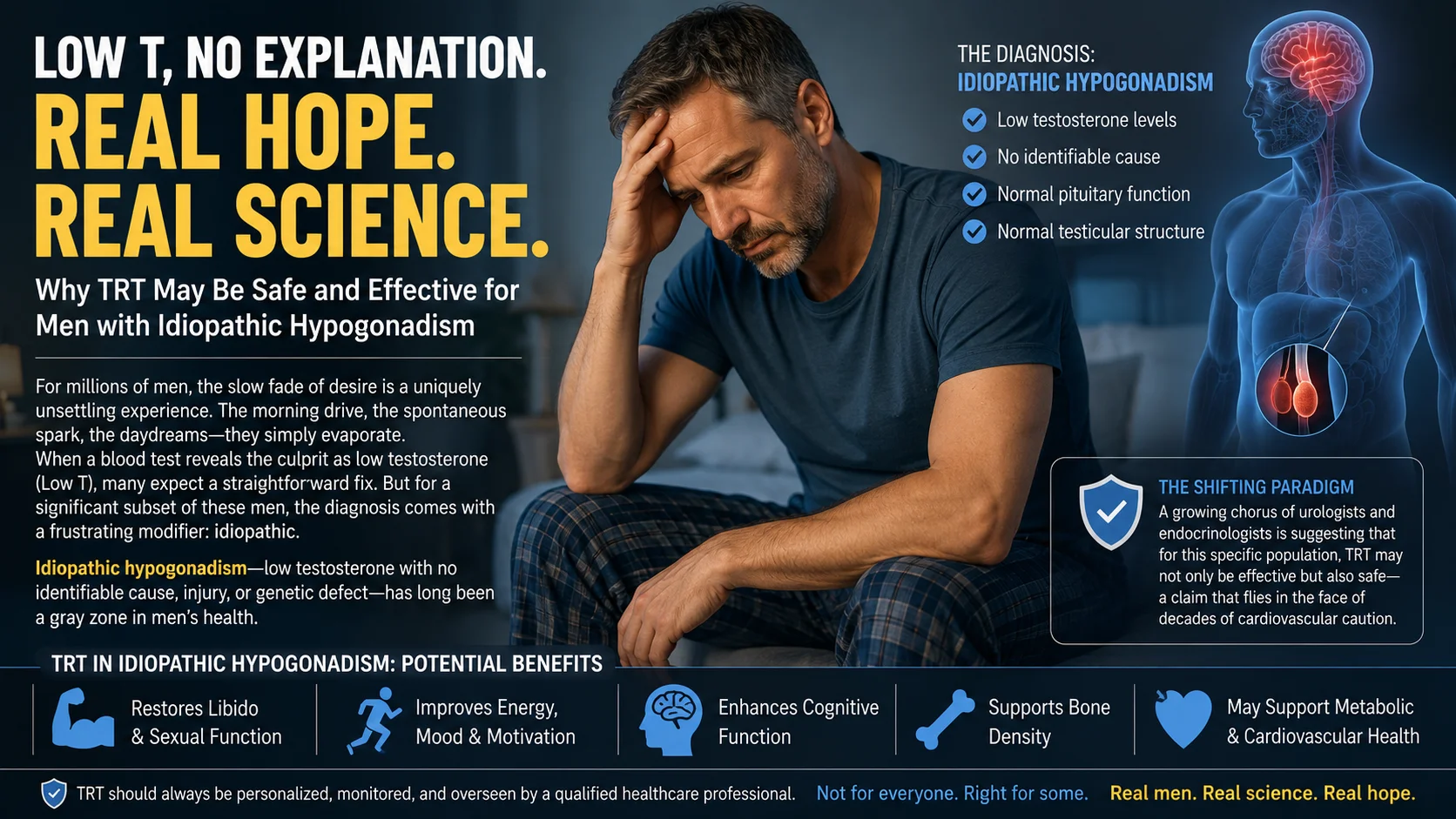
For millions of men, the slow fade of desire is a uniquely unsettling experience. The morning drive, the spontaneous spark, the daydreams—they simply evaporate. When a blood test reveals the culprit as low testosterone (Low T), many expect a straightforward fix. But for a significant subset of these men, the diagnosis comes with a frustrating modifier: idiopathic.
Idiopathic hypogonadism—low testosterone with no identifiable cause, injury, or genetic defect—has long been a gray zone in men’s health. The pituitary gland works, the testes are structurally normal, and yet the androgen engine sputters. Now, a growing chorus of urologists and endocrinologists is suggesting that for this specific population, Testosterone Replacement Therapy (TRT) may not only be effective but also safe—a claim that flies in the face of decades of cardiovascular caution.
The Silent Epidemic of Unexplained Low Libido
Idiopathic hypogonadism is, by definition, a diagnosis of exclusion. Doctors rule out pituitary tumors (prolactinomas), hemochromatosis, Klinefelter syndrome, testicular trauma, and opioid use. When all tests come back clear but total testosterone levels consistently dip below 300 ng/dL (or free testosterone is abnormally low), the patient is left with a label that sounds like a shrug: “We don’t know why.”
Yet the symptoms are very real. Low libido is the hallmark complaint, often accompanied by fatigue, brain fog, and depressive symptoms. Unlike men with primary hypogonadism (where the testes fail outright), men with idiopathic forms often maintain normal sperm production and secondary sex characteristics, making TRT a nuanced decision.
The Safety Shift: Why Clinicians Are Rethinking TRT
For two decades, TRT’s reputation has been tangled in conflicting data. A 2010 study suggested increased cardiovascular events, while larger, more recent trials—including the TRAVERSE study (2023)—painted a different picture. TRAVERSE, a landmark randomized trial of over 5,000 men with hypogonadism, found that TRT did not result in a higher incidence of major adverse cardiac events (heart attack, stroke, or cardiovascular death) compared to placebo.
Key safety insights now driving the conversation:
- No evidence of prostate cancer risk: Multiple meta-analyses confirm that TRT does not cause prostate cancer, though it can accelerate the growth of pre-existing, undetected tumors. Thus, a pre-treatment prostate exam (PSA) is mandatory.
- Manageable erythrocytosis (high red blood cell count): The most common actual risk is thickening of the blood, which can be managed by adjusting the dose, switching to a different delivery method (e.g., topical gels vs. injections), or therapeutic phlebotomy.
- Improvement in metabolic health: For men with idiopathic hypogonadism, TRT often reduces fat mass and improves insulin sensitivity, potentially lowering long-term cardiovascular risk.
Why Idiopathic Cases May Be Ideal Candidates
The safety calculus changes depending on why a man has low testosterone. For men with idiopathic hypogonadism, several factors point toward a favorable risk-benefit ratio:
- No underlying organic disease: Because the condition has no known destructive cause (e.g., cancer treatment, pituitary destruction), there is no ongoing pathological process that TRT could mask or worsen.
- Reversible effects: Many men with idiopathic low T are candidates for a trial of therapy. If side effects occur, stopping short-acting formulations (gels, nasal sprays, or pellets) typically reverses changes within weeks.
- Preserved reserve: Unlike primary hypogonadism, the testes in idiopathic cases often retain partial function. Low-dose TRT (aiming for mid-normal levels, not supraphysiologic) can restore libido without overshooting natural levels.
The Libido Response: Not a Guarantee, But Often Remarkable
It must be stated clearly: TRT is not an aphrodisiac for all men. Libido is a complex interplay of androgens, dopamine, oxytocin, and psychological state. However, in men with confirmed idiopathic hypogonadism and low libido as the predominant symptom, the results can be striking.
In clinical practice, most men notice subtle improvements in spontaneous desire by week 3 to 6 of therapy. Morning erections often return first, followed by a gradual rekindling of sexual thoughts and responsiveness to cues. A 2018 study in the Journal of Clinical Endocrinology & Metabolism found that men with idiopathic hypogonadism reported greater improvements in sexual desire scores than those with secondary hypogonadism from obesity or aging alone.
The Caveats: Who Should Not Proceed
Safety is not universal. Before suggesting TRT for idiopathic low libido, clinicians must rule out:
- Untreated prostate or breast cancer (absolute contraindication)
- Hematocrit > 50% (higher risk of blood clots)
- Severe untreated sleep apnea (TRT can worsen it)
- Desire for future fertility (TRT suppresses sperm production—a critical conversation)
For men who want children, alternatives like clomiphene citrate or hCG (human chorionic gonadotropin) can boost testosterone without shutting down spermatogenesis, though libido response is less predictable.
A Final Verdict: Personalized, Not Populist
The internet is littered with extreme claims: that TRT is a fountain of youth or a heart-attack waiting to happen. The truth, especially for men with idiopathic hypogonadism and crushing low libido, lies in the middle.
Current evidence suggests that when prescribed appropriately—starting with a low dose, monitoring hematocrit and PSA every 3-6 months, and targeting physiologic levels (400-600 ng/dL)—TRT is likely safe and often effective for this specific population. The key word is specific. This is not a blanket recommendation for age-related testosterone decline or for men with normal levels seeking an edge.
If you are a man with persistently low libido, have documented low testosterone, and have exhausted the usual suspects (sleep, stress, thyroid, prolactin), asking your urologist about idiopathic hypogonadism is a reasonable next step. For many, the risk of not treating—years of relational strain, anhedonia, and lost vitality—may far outweigh the well-understood, manageable risks of therapy.
In the end, the question isn’t “Is TRT safe?” The question is, “Is TRT safe for me?” And for the man with idiopathic hypogonadism and a silent, unexplained loss of desire, the answer is increasingly leaning toward yes.
FAQS:
1. Is TRT safe if I have low T?
Generally, yes, but safety depends on the cause and severity of low testosterone, as well as your individual health profile.
For men with confirmed hypogonadism (e.g., total testosterone consistently below 300 ng/dL), large recent trials like TRAVERSE (2023) show that TRT does not increase the risk of major heart attack or stroke when properly monitored. Common, manageable risks include:
- Elevated red blood cell count (erythrocytosis)
- Mild acne or oily skin
- Possible sleep apnea worsening
- Reduced sperm production (important if planning fertility)
TRT is not safe if you have untreated prostate or breast cancer, severe untreated sleep apnea, or a very high baseline hematocrit (>50%). Regular monitoring of bloodwork, prostate exams, and symptom checks is essential.
2. Can you get TRT without low T?
Legally and medically, no—not from a responsible, licensed physician.
Testosterone is a controlled substance (Schedule III in the U.S.) approved only for men with clinically diagnosed hypogonadism. Reputable doctors will not prescribe TRT if your total testosterone is consistently above 300–350 ng/dL, even if you have symptoms like fatigue or low libido.
However, some “men’s health clinics” or online platforms operate in a gray zone, prescribing TRT to men with “low-normal” levels (e.g., 400–500 ng/dL) by using aggressive dosing protocols. This practice is not supported by major endocrinology guidelines (Endocrine Society, American Urological Association) and carries unnecessary risks without proven benefit.
3. What happens if a man takes testosterone if he doesn’t need it?
Taking testosterone when your levels are normal or high can produce several unwanted effects:
Short-term:
- Acne, oily skin, and increased body hair
- Aggression or mood swings
- Testicular shrinkage
- Water retention and mild high blood pressure
Long-term:
- Suppression of natural testosterone production – The brain signals the testes to stop working, which can lead to persistent low T after stopping (“post-cycle crash”)
- Infertility – Sperm production may drop to zero during use
- Worsening sleep apnea
- Increased cardiovascular risk – Supraphysiologic levels (especially 1,000+ ng/dL) have been linked to higher rates of heart arrhythmias and blood clots
- Accelerated prostate growth – May unmask subclinical prostate cancer
In short: you get the risks of TRT without the benefits, because you had no deficiency to correct.
4. Why do doctors not like to prescribe testosterone?
This is a common patient perception, but the reality is more nuanced. Many primary care doctors are cautious, not unwilling. Key reasons include:
- Lack of training – Most medical schools devote minimal time to male reproductive endocrinology. Many PCPs don’t feel comfortable interpreting free testosterone, SHBG, or managing TRT side effects.
- Historical safety concerns – Older studies (pre-2010s) suggested TRT could increase heart attack risk. Though newer evidence has largely refuted this, outdated fears persist.
- Monitoring burden – Responsible TRT requires regular blood draws (every 3–6 months), dose adjustments, and PSA checks. In a 15-minute primary care visit, that’s time-consuming.
- Fertility issues – TRT suppresses sperm production. Many younger men want children, and doctors may avoid TRT without first discussing alternatives like clomiphene or hCG.
- Overuse concerns – Doctors see many men requesting TRT based on a single low testosterone reading (e.g., drawn at 4 PM after poor sleep and a high-carb meal). Responsible physicians insist on confirmation before prescribing.
That said, specialists (urologists and endocrinologists) prescribe TRT regularly. If your doctor is reluctant but you have confirmed hypogonadism, a referral is usually the best path.
Disclaimer: This article is for informational purposes and does not constitute medical advice. Testosterone therapy should only be initiated and monitored by a qualified healthcare provider after thorough diagnostic evaluation.