Health & Science Desk
Dateline: May 12, 2026
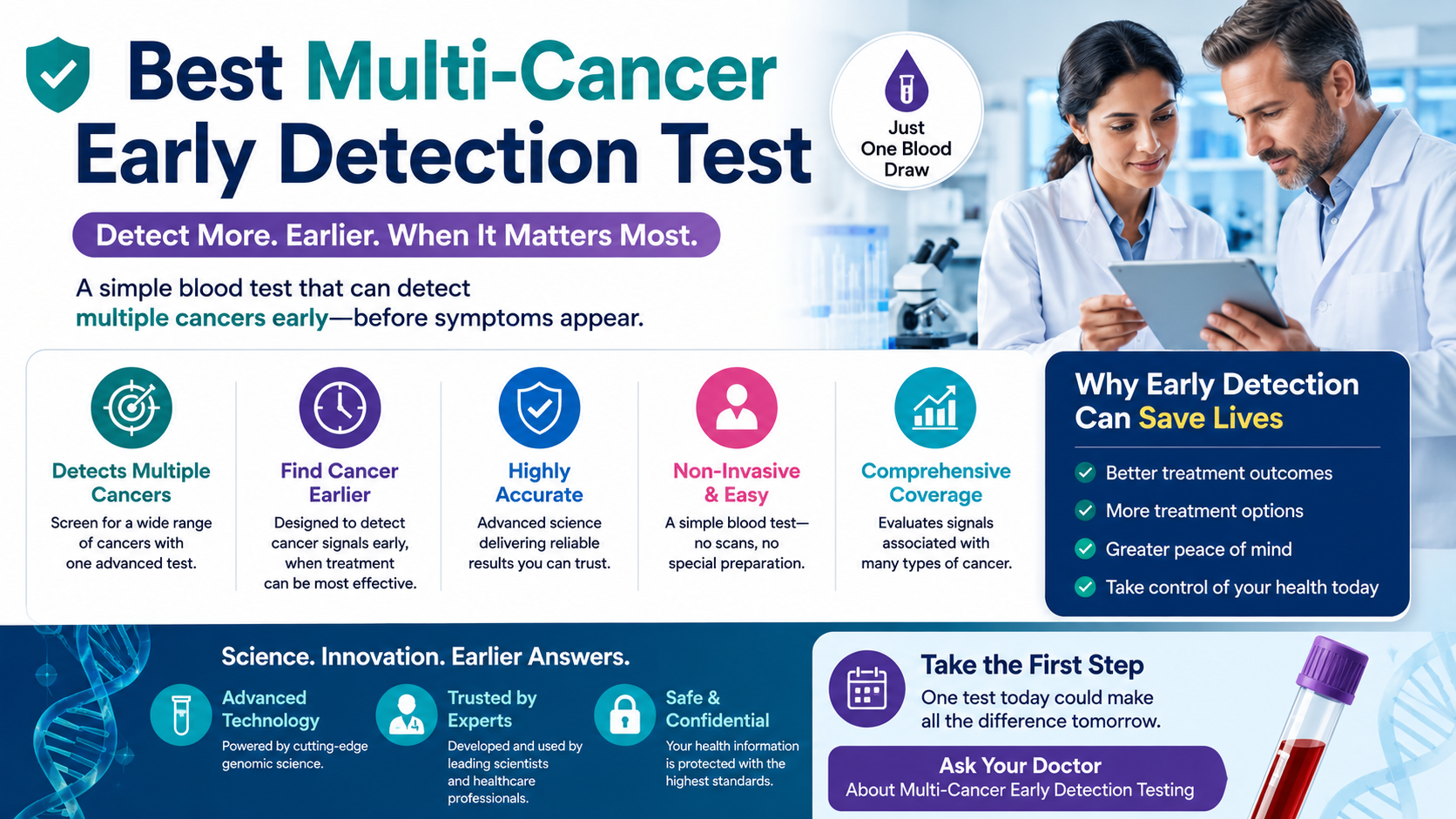
The concept of a single blood test capable of screening for dozens of cancers has long been a holy grail in oncology. Today, these tests—known as Multi-Cancer Early Detection (MCED) tests—are no longer science fiction. They are available for purchase, though patients and doctors are currently grappling with a complex landscape regarding their approval, cost, and clinical utility.
While no MCED test has yet received full approval from the U.S. Food and Drug Administration (FDA), the field is approaching a critical tipping point. Here is the current state of the “best” options available, what the data actually shows, and how much you can expect to pay.
The Frontrunner: Galleri by GRAIL
When discussing the leading candidate for the best multi-cancer early detection test, Galleri by GRAIL is the name that appears most frequently in clinical data and news headlines .
Galleri is designed to detect cancer signals across more than 50 cancer types through a single blood draw. It works by using next-generation sequencing to analyze methylation patterns of cell-free DNA (cfDNA)—essentially looking for the chemical “switch” signatures that cancerous tumors shed into the bloodstream .
- FDA Status: Not yet approved. However, GRAIL announced on January 29, 2026, that it has submitted the final module of a Premarket Approval (PMA) application to the FDA . The test has held the FDA’s “Breakthrough Device” designation since 2018, which is a status given to technologies that show potential to improve treatment of life-threatening diseases but is not an approval. Experts estimate that if the application is successful, approval could potentially come in 2027 .
- Cost: $949. Currently, because the test is not FDA-approved and is not yet covered by standard insurance or Medicare (outside of specific research studies), patients generally pay for this out-of-pocket .
Why Is There Confusion About Its Effectiveness?
Despite the excitement, recent data has created a nuanced picture. The company’s large-scale NHS-Galleri trial in the United Kingdom, which enrolled over 140,000 participants, failed to meet its primary goal. The test did not produce a statistically significant reduction in late-stage (Stage III-IV) cancer diagnoses compared to standard care .
However, GRAIL points to secondary data from the U.S.-based PATHFINDER 2 study as evidence of value. In that study, Galleri demonstrated a Positive Predictive Value (PPV) of 61.6% —meaning that if a patient received a positive “cancer signal detected” result, there was a 61.6% chance they actually had cancer within a year. Furthermore, more than half (53.5%) of the cancers detected were early-stage (I or II) .
The Competitors: Abbott and Guardant
While GRAIL is the furthest along in the FDA approval process, other major players are in the race.
1. Abbott Cancerguard
Abbott is taking a slightly different approach with its Cancerguard test. Instead of relying solely on DNA methylation, Cancerguard uses a multi-biomarker approach combining DNA methylation and protein signals. Data presented at the AACR 2026 conference suggested that combining these methods catches signals that a single method might miss—specifically, 47.1% of positive signals were driven by methylation alone, while 45.5% came from a combination of methylation and proteins .
- FDA Status: Not yet approved. It is commercially available as a lab-developed test (LDT).
- Cost: Not publicly listed in recent data, but generally expected to be in the high hundreds of dollars.
2. Guardant Health Shield
Guardant’s Shield test focuses on a specific panel of eight cancers (including bladder, lung, and pancreatic). It was previously selected by the National Cancer Institute for the Vanguard Study.
- FDA Status: The Shield MCD (multi-cancer detection) version received FDA Breakthrough Device designation in mid-2025. However, this designation is for the multi-cancer version. (Note: A separate version of Shield for colorectal cancer screening is already FDA approved, but the multi-cancer version is not) .
- Cost: Currently not widely priced for the MCED version as it is still in development for that specific indication.
An Emerging Option: Low-Cost Alternatives
A significant barrier to MCED adoption is cost. In response, researchers at UCLA have developed a test called MethylScan. By focusing on methylation patterns without requiring the deep (and expensive) sequencing that Galleri requires, researchers estimate the workflow cost could be less than $20 per sample .
- Performance: In studies, MethylScan showed 63% sensitivity across four cancer types at 98% specificity.
- Status: Still in research phases. It highlights where the market is headed: cheaper, accessible population screening, but it is not yet a commercial product available to consumers.
Summary Comparison Table
The field of Multi-Cancer Early Detection (MCED) is transitioning from a “research-only” phase to a period of active clinical integration. As of May 2026, the most significant milestone is the official submission of the first full Premarket Approval (PMA) application to the FDA for an MCED test, signaling that the first regulatory approval for a multi-cancer liquid biopsy may be imminent (GRAIL, 2026).
1. Leading MCED Tests and Their Current Status
While several companies are developing these assays, three primary contenders dominate the current landscape:
Galleri® (by GRAIL)
- Regulatory Status: GRAIL submitted its final module for FDA Premarket Approval in January 2026 (GRAIL, 2026). It is currently available under Clinical Laboratory Improvement Amendments (CLIA) regulations, meaning it can be ordered by a physician but is not yet FDA-approved.
- Performance: Data from the PATHFINDER 2 study and the SYMPLIFY trial show a Positive Predictive Value (PPV) of approximately 75.5% to 84.2% in some cohorts, meaning a positive result has a high likelihood of being a true cancer (GRAIL & University of Oxford, 2025).
- Reach: It is being integrated into major EHR platforms like Epic to allow 450 health systems to order it directly at the point of care (GRAIL, 2026).
Cancerguard (by Exact Sciences)
- Status: Formerly known as the next generation of CancerSEEK, this test has received FDA Breakthrough Device Designation. Large-scale prospective trials, such as the Falcon Registry (enrolling 25,000 individuals), are currently underway to evaluate real-world effectiveness (Early Cancer Detection, 2026).
- Goal: Modeling studies suggest this annual test could reduce mortality by up to 18% in high-risk groups (Early Cancer Detection, 2026).
Shield™ (by Guardant Health)
- Status: Primarily known for its FDA-approved colorectal cancer (CRC) version, the Shield MCD (Multi-Cancer Detection) version is being evaluated in the National Cancer Institute’s Vanguard Study (Early Cancer Detection, 2026). It uses DNA methylation and genomic alterations to identify signals across various tumor types.
2. Clinical Utility: What the Data Shows
The “value” of an MCED test depends on its ability to find cancer at a stage when it is still curable.
| Metric | Current Performance (General Range) | Note |
| Specificity | >99% | Designed to be very high to avoid overwhelming the healthcare system with false positives (The Permanente Journal, 2026). |
| Early-Stage Sensitivity (Stage I/II) | ~30% – 45% | Sensitivity remains lower for localized, early cancers compared to advanced stages (The Permanente Journal, 2026). |
| Late-Stage Sensitivity (Stage IV) | >90% | Most tests are highly accurate at detecting advanced disease where DNA shedding is high (The Permanente Journal, 2026). |
| Cancer Signal Origin (CSO) | ~85% Accuracy | When the test is positive, it can predict where the cancer is located with high accuracy, guiding the diagnostic workup (GRAIL & University of Oxford, 2025). |
3. Cost and Accessibility
Because these tests are not yet FDA-approved, insurance coverage is extremely limited.
- Out-of-Pocket Cost: Most patients can expect to pay approximately $949 for a Galleri test.
- Insurance Coverage: Currently, most private insurers and Medicare do not cover MCED tests for screening purposes. However, legislative efforts like the Multi-Cancer Early Detection Screening Coverage Act are pending to allow Medicare to cover these tests once they receive FDA approval.
- Integration: Broad availability through primary care workflows is expected by the end of 2026 as EHR integrations (like Epic) go live (GRAIL, 2026).
The Bottom Line for Consumers
As of May 2026, there is no “best” MCED test that is fully FDA approved. The market leader, Galleri, is the closest, having submitted its application, but it remains investigational.
What to consider before buying:
- False Positives: Even with high specificity, a positive result requires follow-up scans and procedures to rule out cancer, which can cause anxiety and incur additional medical costs.
- False Negatives: No test catches 100% of cancers. A negative result does not mean you are cancer-free.
- Insurance: Expect to pay full price (approx. $949) . Insurance coverage is unlikely until FDA approval is granted and Medicare makes a formal coverage determination.
These tests are currently tools intended to complement—not replace—standard screenings like mammograms, colonoscopies, and Pap smears.
References: