When you think of digestion, your mind likely jumps to the churning acids of the stomach or the intricate folds of the intestines. Saliva, if it gets any credit at all, is often dismissed as little more than a mouth moisturizer. But to ignore saliva is to ignore the opening act of one of the body’s most complex performances. The Hidden Digestive Role of Saliva is a fascinating story of chemistry, protection, and efficiency—a story that proves digestion begins the second you take your first bite.
The Enzymatic Spark Plug
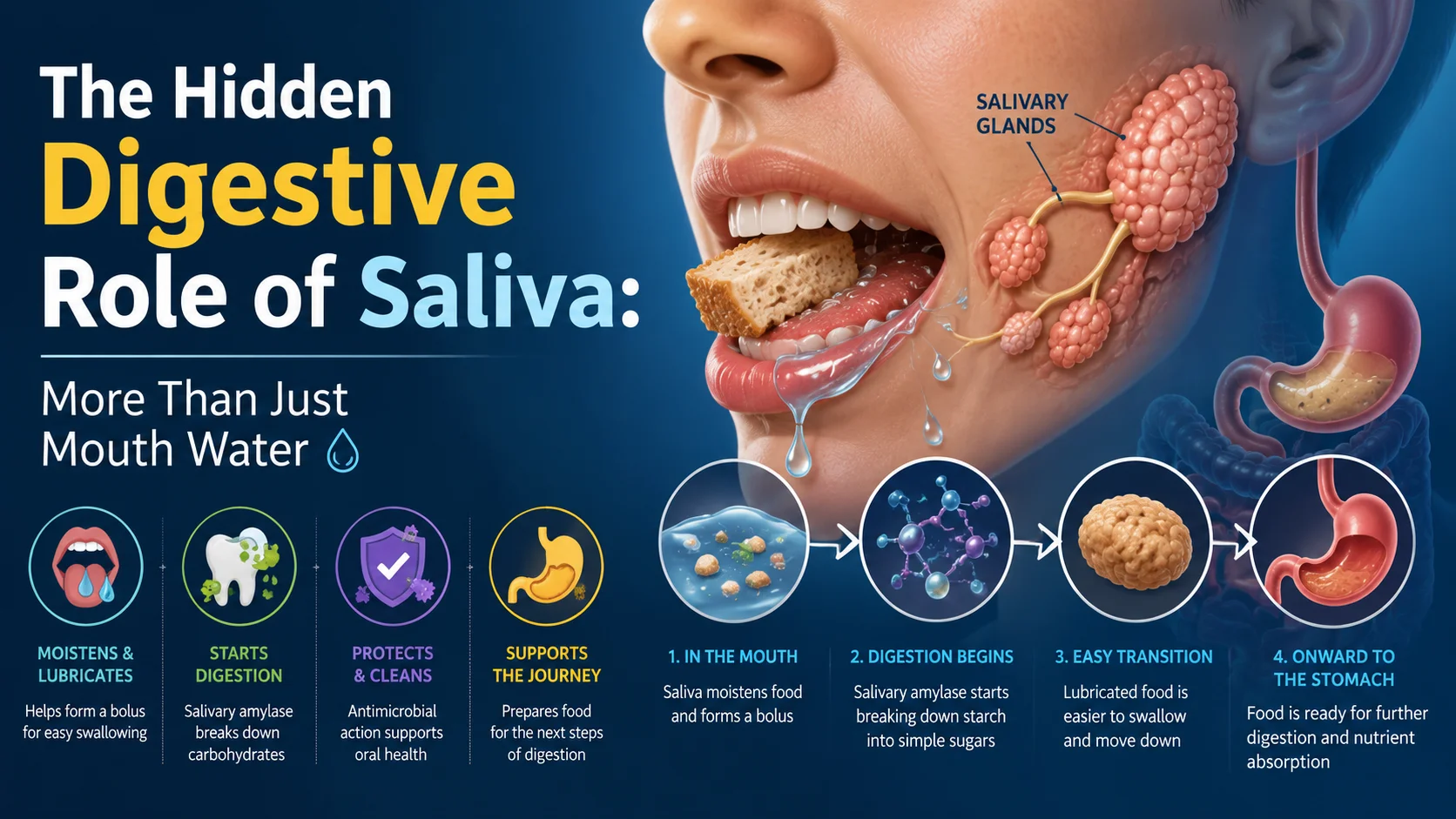
Most people know that saliva is mostly water. But that 0.5% of “other stuff” is where the magic happens. Floating in that clear fluid is a potent enzyme called amylase. Amylase is a biological catalyst that starts breaking down starches (complex carbohydrates) into simple sugars right there on your tongue.
Try this experiment at home: take a saltine cracker, chew it slowly, and hold it in your mouth for 30 seconds. You will notice a subtle, sweet taste emerging. That is not your imagination; that is amylase at work. By the time you swallow, your body has already begun converting that cracker into usable energy. Without this hidden digestive role, your stomach and small intestine would have to work twice as hard to process simple starches.
The Mechanical Lubricant
Digestion is not just chemical; it is also mechanical. Swallowing a dry clump of un-moistened food is difficult, uncomfortable, and even dangerous. Saliva acts as a natural lubricant, transforming a dry, crumbly bolus of food into a slippery, cohesive ball that slides effortlessly down the esophagus.
This is why people with chronic dry mouth (xerostomia) often struggle with dysphagia (difficulty swallowing). The hidden digestive role of saliva here is architectural: it creates the perfect texture for safe transport, preventing choking and protecting the delicate lining of the throat from abrasive damage.
The Taste Trigger
Digestion requires planning. To release the right acids and enzymes, your stomach needs a “heads up” that food is coming. Saliva serves as that messenger. As you chew, saliva dissolves the food’s chemical compounds, allowing them to reach your taste buds. Those taste buds send signals to the brain, which then relays instructions to the stomach: “Prepare for protein” or “Ready for fats.”
Without saliva, food would be as flavorless as cardboard, and your digestive system would operate blindly, leading to inefficiency and indigestion. Thus, saliva is the interpreter between your food and your gut.
The Silent Protector
While digestion is its primary job, saliva performs a critical side duty: oral immunity. It contains an enzyme called lysozyme, which literally breaks down the cell walls of bacteria. Every time you swallow, you are not just moving food; you are flushing your mouth of harmful microbes and food debris that could cause cavities or gum disease.
Furthermore, saliva is a pH buffer. After you eat sugary or acidic foods, the pH in your mouth drops dangerously low, softening your enamel. Saliva rushes in to neutralize the acid, essentially “rinsing and re-mineralizing” your teeth with calcium and phosphate. This hidden digestive role loops back to nutrition: you cannot digest food efficiently if you have no healthy teeth to chew it with.
When the System Fails
The importance of saliva becomes painfully obvious when it is missing. Patients undergoing radiation therapy for head and neck cancers often lose salivary function. They experience not only constant thirst and mouth sores but also severe digestive distress. Without the initial breakdown of starches and proper lubrication, they may suffer from malnutrition, rapid weight loss, and esophageal damage. This clinical reality underscores that saliva is not a luxury—it is a digestive necessity.
Conclusion: Respect the Spit
We have been conditioned to find saliva “gross.” We wipe it off, spit it out, and ignore its presence. But science tells a different story. The Hidden Digestive Role of Saliva is that of a master multitasker: it is a chemical breaker, a mechanical lubricant, a flavor unlocker, and a microbial warrior. The next time you sit down to a meal, take a moment to thank your spit. Before your stomach ever gets a chance to growl, your saliva has already done the first, and arguably most elegant, step of turning your meal into life.