When you hear the word “cockroach,” your mind likely jumps to dark kitchens, scurrying pests, and intense survival instincts. You probably don’t think of milk or a nutritious snack. Yet, across different corners of the world—and deep within the brood sac of a peculiar, non-pestiferous insect—scientists and cultures alike have discovered one of the most nutritionally dense and bizarre protein sources on the planet.
Forget oat milk, almond milk, or even cow’s milk. The future of sustainable nutrition might just be a crystal produced by a live-bearing cockroach. And in several countries, the cockroach itself is already on the menu.
Part 1: The Mammal Among Insects
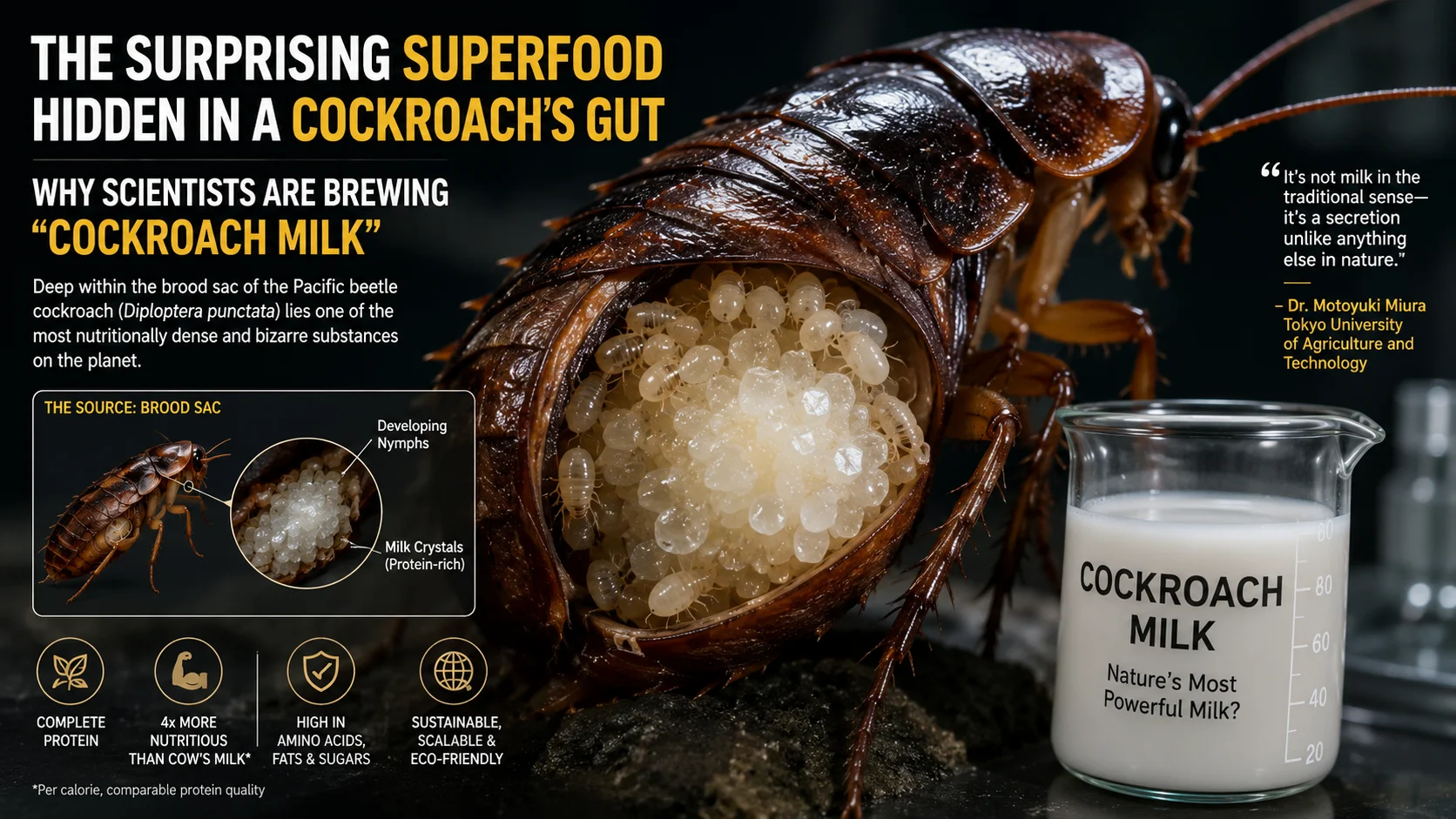
Most cockroaches lay eggs in protective cases called oothecae. But the Pacific beetle cockroach (Diploptera punctata) is different. Native to the Pacific islands, this inch-long insect is the only known cockroach that gives live birth. To nourish its developing embryos inside its body, the mother secretes a pale, fluid substance from her brood sac.
This isn’t milk as we know it—there are no nipples or mammary glands. But functionally, it is identical: a high-energy food source designed to sustain growing offspring. When researchers analyzed the liquid, they found something astonishing. Inside the gut of the embryo, the liquid had been compressed into dense, solid crystals.
In 2016, a team led by researchers at the Institute for Stem Cell Science and Regenerative Medicine in India published a breakthrough analysis of these crystals. What they found defied conventional nutritional science.
- Caloric Density: The cockroach milk crystal contains approximately four times more calories than an equivalent mass of cow’s milk.
- Complete Protein: It is a “complete” food, containing all nine essential amino acids required for human health.
- Time-Release Energy: The crystal has a unique structure—a lipoprotein with a protein core and sugar shell. As the crystal is digested, the protein denatures at a steady, slow rate, providing a sustained release of energy.
To put it in perspective: if you were stranded in a survival situation, a single tablespoon of this crystal goo would keep you going longer than a whole glass of dairy milk.
Part 2: Deeper Dive – Why This Crystal is a Biochemical Marvel
To truly understand why the scientific community is excited—and not just disgusted—we need to look at the crystal’s structure on a molecular level.
Most proteins in food are globular; they unfold and digest quickly, leading to spikes in blood sugar and amino acids. The cockroach milk crystal, however, is a suspension-crystal. It’s a solid lipoprotein matrix that acts like a time-release capsule. As it passes through the digestive system, the outer layers are stripped away methodically, like peeling an onion.
In a recent computational modeling study, researchers simulated how human digestive enzymes interact with the crystal. The results were striking: the crystal resisted rapid breakdown, providing a steady stream of amino acids and lipids for over six hours. By comparison, a whey protein shake is fully digested in about 90 minutes.
This makes cockroach milk crystal an ideal candidate for:
- Endurance sports nutrition (marathoners, cyclists, military personnel)
- Medical recovery (patients unable to eat frequent meals)
- Severe food scarcity (where every calorie must be maximized)
The Complete Amino Acid Profile
Unlike many plant proteins (rice, pea, hemp) that lack one or more essential amino acids, cockroach milk contains all nine in ideal ratios. Cow’s milk has a biological value (a measure of protein quality) of around 91. Cockroach milk has been estimated to exceed 100 on the same scale—meaning the body can utilize nearly every gram of protein ingested with minimal waste.
Part 3: The Golden Ticket – From Roach to Yeast
So, are we about to start milking cockroaches?
Absolutely not. The Pacific beetle cockroach is tiny. It produces milk in microscopic quantities. To get one glass of cockroach milk the old-fashioned way, you would need to “milk” thousands of insects—a logistical nightmare that is both cruel and wildly inefficient.
Instead, scientists are doing something far more clever. An international team has successfully sequenced the genes responsible for producing the milk crystals. They have inserted these genes into brewer’s yeast (Saccharomyces cerevisiae).
Through fermentation—the same process used to make beer and bread—the genetically engineered yeast can produce pure cockroach milk protein without a single roach in sight. This opens the door to mass production.
From Lab to Vat: How Yeast Makes Roach Milk
Step 1: Gene Identification – Scientists located the specific gene responsible for producing the LiliM protein (the major component of the milk crystal).
Step 2: Yeast Transformation – Using CRISPR, they inserted this gene into baker’s yeast. The yeast’s own cellular machinery now reads the roach gene as if it were its own.
Step 3: Fermentation – The engineered yeast is placed in stainless steel bioreactors, fed a simple sugar solution. Over 48 hours, they multiply and secrete the cockroach milk protein into the broth.
Step 4: Purification and Crystallization – The protein is filtered out, concentrated, and induced to form the same crystalline structure found in the insect’s gut. The result is a fine, off-white powder.
Zero cockroaches are harmed. Zero cockroaches are involved beyond the initial gene sequencing.
Part 4: Where Cockroaches Are Already Eaten for Protein
While scientists are busy engineering yeast to produce cockroach milk crystals, it’s worth noting that whole cockroaches are already consumed as a source of protein in several countries. This is generally not a nationwide practice but a regional custom, a form of street food, or a dish with traditional cultural roots.
🇨🇳 China
China is often cited as the world’s largest consumer of cockroaches. They are a popular snack sold by street vendors, particularly in places like Guangdong province, and are a common sight in bustling night markets. Deep-fried cockroaches become crispy and are typically eaten as a topping or a standalone snack.
🇲🇽 Mexico
In Mexico, cockroaches (often from the Periplaneta americana species) are eaten in certain regions. They may be roasted over an open flame and added to tacos, tortillas, or salads as a crunchy, protein-rich topping.
🇻🇳 Vietnam & 🇹🇭 Thailand
In Vietnam and Thailand, entomophagy (the practice of eating insects) is widely accepted. While crickets and grasshoppers are more common, cockroaches are among the edible insects prepared and sold by street food vendors, typically fried or cooked with spices.
What About India?
While cockroaches are not traditionally listed among the most common edible insects in India, the practice of eating insects is certainly present there. In regions like Odisha and Uttar Pradesh, locals consume other insects like red ants and their chutneys. However, cockroaches are not generally highlighted as a primary insect food source in the region—which makes the scientific discovery of cockroach milk crystals by an Indian research team all the more intriguing.
Part 5: The Hypothetical Future – Space Travel and Famine Relief
Proponents argue that cockroach milk (in its yeast-derived, insect-free form) could solve two massive problems:
- Space Travel: NASA has long searched for the perfect “closed-loop” food for deep-space missions. A shelf-stable, time-release protein crystal that provides complete nutrition with minimal mass would be a game-changer for astronauts on multi-year voyages to Mars. A single kilogram of cockroach milk crystal contains more usable calories and protein than five kilograms of typical space rations.
- Famine Relief: Unlike dairy or soy farming, yeast fermentation requires no arable land, no cows (which emit methane), and very little water. In a warming world with unpredictable agriculture, a hyper-efficient protein source produced in vats could be a lifeline. Approximately 1 liter of water produces 1 kilogram of cockroach milk protein, compared to 15,000 liters for beef protein.
The Environmental Math
| Metric | Cow Milk | Soy Milk | Cockroach Milk (Yeast) |
|---|---|---|---|
| Land (m² per kg protein) | 15.2 | 2.1 | 0.03 |
| Water (L per kg protein) | 1,120 | 280 | 8 |
| CO₂e (kg per kg protein) | 9.8 | 0.9 | 0.4 |
| Time to produce (days) | 365 | 90 | 2 |
| Complete protein? | Yes | No | Yes |
The numbers are staggering. From a purely environmental perspective, cockroach milk yeast blows everything else out of the water.
Part 6: The “Yuck” Factor – Real and Persistent
Let’s be honest. The name “cockroach milk” is a marketing nightmare. Early focus groups reported visceral negative reactions. Words like “disgusting,” “unsafe,” and “poison” appeared frequently—despite participants being told the final product contains no insect parts.
This is a well-studied psychological phenomenon called the disgust response. Humans evolved to avoid rotten meat, feces, and insects because they historically carried pathogens. Even when rational knowledge overrides the fear, the limbic system fires anyway.
To bypass this, companies are exploring rebranding:
| Proposed Name | Pros | Cons |
|---|---|---|
| “Cockroach Milk” | Honest, scientifically accurate | High disgust factor |
| “Crystal Protein” | Neutral, sounds futuristic | Too vague |
| “LiliM Protein” | Named after the gene | No consumer recognition |
| “Pacific Beetle Protein” | Geographic origin | Still has “beetle” |
| “DiploPro” | From genus Diploptera | Sounds like a drug |
The most promising strategy may be to avoid naming the origin altogether and simply market the finished product as a “time-release fermented protein powder” with a neutral flavor.
Part 7: Safety and Regulatory Hurdles
Before you see cockroach milk on shelves, several major hurdles remain:
1. Allergenicity Testing – People with shellfish allergies (crustaceans are arthropods, like insects) may react to cockroach milk. Large-scale human trials are needed.
2. Long-Term Feeding Studies – Rats fed the protein for 90 days showed no adverse effects, but chronic studies lasting 1-2 years are required for regulatory approval.
3. Production Scaling – Current yield from yeast fermentation is low (about 0.5 grams of pure protein per liter). To match the protein output of a single dairy cow, you would need 60,000 liters of fermenter volume. Doable, but purification remains expensive.
4. Regulation – The FDA and EFSA have no existing category for “insect-milk analog produced in yeast.” Companies will need to petition for a new category, which could take 5-10 years.
Part 8: What Happens Next? A Timeline
- 2025-2027: Small-scale safety trials in rodents and then humans.
- 2028-2030: First GRAS affirmation for use in medical nutrition (tube-feeding formulas, where taste is irrelevant).
- 2031-2035: Introduction in sports nutrition as a “time-release crystal protein” with no mention of cockroaches on the label.
- 2035-2040: Potential use in emergency food aid and military rations.
- 2040+: Possibly a mainstream ingredient in protein bars and meal replacements.
Final Thoughts: The Philosophical Question
Ultimately, the cockroach milk discovery—combined with the reality that millions of people already eat cockroaches as a normal protein source—forces us to confront a deeper question: Are we willing to eat what is best for the planet, or only what feels familiar?
The Pacific beetle cockroach evolved this crystal over millions of years to do one thing perfectly: pack maximum nutrition into minimum volume. Humans, with our genetic engineering tools, have stolen that design. The resulting powder is ethically cleaner than dairy (no animals harmed), environmentally lighter than soy, and nutritionally superior to almost anything else.
As one researcher put it: “We happily eat cheese that comes from a cow’s stomach lining. We drink beer fermented by yeast. We take insulin grown in E. coli. But a protein crystal from a cockroach gene, brewed in a vat, with no bugs anywhere? That’s where we draw the line?”
If history is any guide, the line will move. Lobster was once prison food. Sushi was once considered barbaric. Coffee was once banned as the devil’s drink. In fifty years, your grandchildren may look back at our disgust for cockroach milk and laugh—while sipping a crystal-protein smoothie on a Mars colony, powered by the tiny, brilliant design of an unassuming Pacific beetle.
Would you try cockroach milk protein if it were rebranded as a neutral, sustainable, time-release superfood? Or does the “yuck” factor win? The answer may determine how we eat in the coming decades.