
Tap the image to view the current product page.
⚡ TL;DR: The Honest Verdict
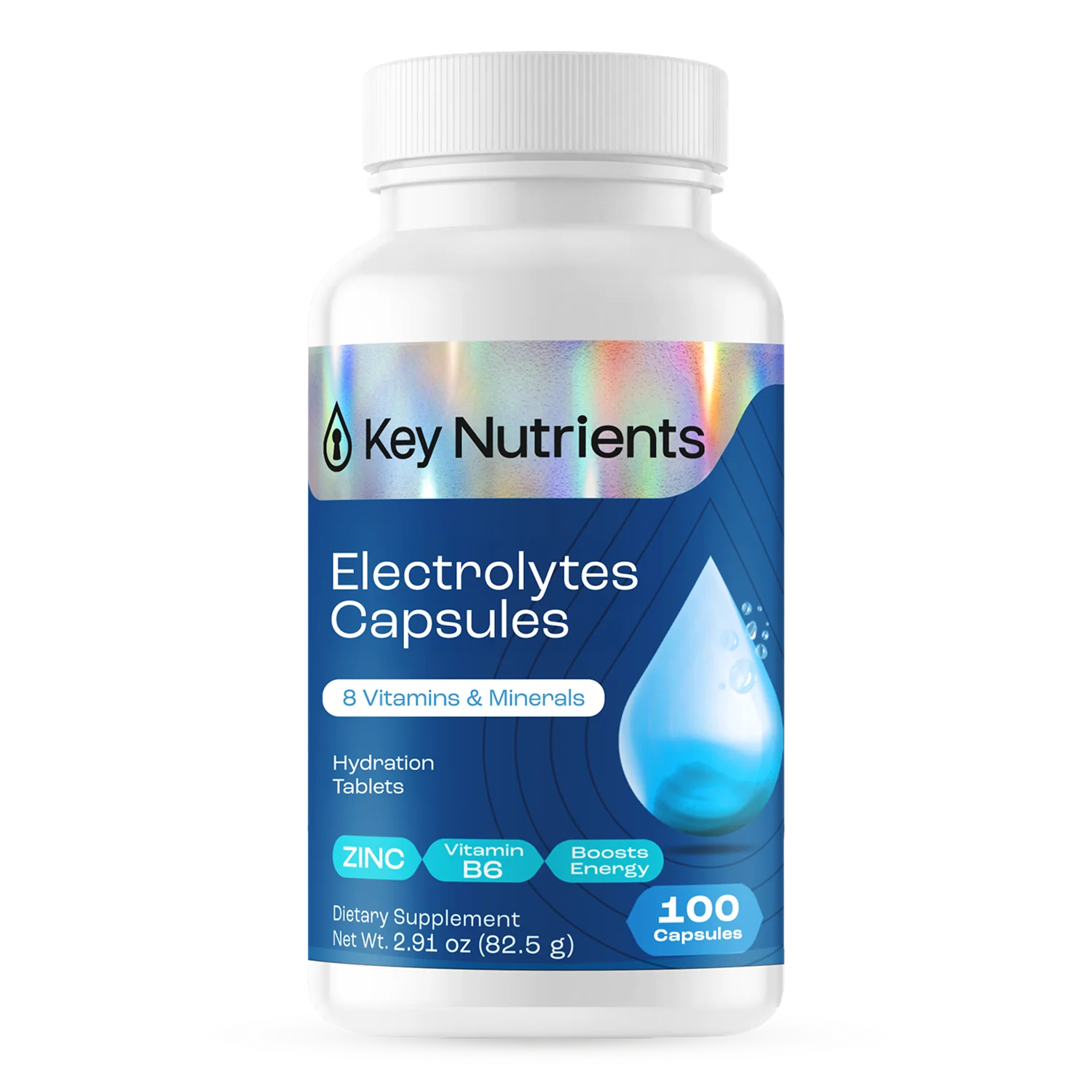
The product: Key Nutrients Electrolyte Capsules deliver a 6-electrolyte blend (sodium, potassium, magnesium, calcium, chloride, phosphorus) plus vitamin B6 and zinc in a sugar-free, unflavored capsule format. 200 capsules per bottle, 2 capsules per serving, 100 servings total.
The price: Competitive per serving, but the sodium dose is modest — just 105 mg per serving. That’s roughly one-tenth of what high-sodium powders like LMNT deliver.
The clinical evidence: There is no published clinical trial on this specific product. The ingredients have general physiological roles, but the doses are modest and the formula includes fillers (rice flour, magnesium stearate, silica) that some users may want to avoid.
The honest verdict: These capsules are a convenience product, not a therapeutic one. If you want electrolytes without flavor, mixing, or sugar — and you don’t need aggressive sodium replacement — they’re a reasonable pick. If you’re managing a medical condition where electrolyte doses matter, or you need meaningful sodium for heavy sweating, a powder is a better tool.
💊 What Are Key Nutrients Electrolyte Capsules?
Key Nutrients is a veteran-founded supplement company based in Scottsdale, Arizona, that positions itself around keto-friendly, sugar-free products. Their electrolyte capsules are designed for people who want hydration support without the ritual of mixing a powder or drinking a flavored beverage.
The format is the selling point. Capsules are portable, tasteless, and require no preparation. As Key Nutrients themselves note, capsules suit people who “prefer a straightforward routine without adding another drink to their day.” For travelers, gym-goers, or anyone who has grown tired of flavor fatigue from electrolyte powders, that convenience is real.
But convenience comes with trade-offs. Capsules are physically limited in how much mineral content they can hold. Dr. Berg’s comparison of formats notes that capsules “typically contain smaller amounts of minerals per serving than powders,” and multiple capsules may be needed to match a single powder serving. Key Nutrients requires 2 capsules per serving — manageable, but worth noting if you dislike swallowing pills.
🧪 Ingredients Breakdown: What’s Actually Inside
The label, independently transcribed and verified by two readers in October 2026, shows the following per 2-capsule serving:
| Ingredient | Amount | Form |
|---|---|---|
| Vitamin B6 | 4 mg | Pyridoxine HCl |
| Calcium | 45 mg | Dicalcium phosphate, calcium chloride |
| Phosphorus | 35 mg | Dicalcium phosphate |
| Magnesium | 50 mg | Magnesium citrate and magnesium oxide |
| Zinc | 3 mg | Zinc oxide |
| Chloride | 300 mg | Sodium chloride, potassium chloride, calcium chloride |
| Sodium | 105 mg | Sodium chloride, pink Himalayan salt |
| Potassium | 150 mg | Potassium chloride |
Other ingredients: rice flour, hypromellose (vegetarian capsule), magnesium stearate, silica.
What stands out — for better and worse:
- The sodium dose is low. At 105 mg, this is a maintenance-level product, not a rehydration tool. A single serving of LMNT delivers 1,000 mg sodium; Redmond Re-Lyte delivers 810 mg. If you are sweating heavily or fasting, these capsules will not replace what you lose.
- Magnesium is a split form. The label lists both magnesium citrate (well-absorbed) and magnesium oxide (cheap, poorly absorbed, can cause laxative effects). This is a cost-saving measure, not a premium formulation.
- Zinc oxide is the least bioavailable zinc form. It’s common in budget supplements but not ideal.
- Rice flour is a filler. It appears in the “other ingredients” list with no amount disclosed. For a product marketed as zero-carb, keto-friendly, this is worth flagging — rice flour is a carbohydrate, even if the amount per capsule is negligible.
- Vitamin B6 at 4 mg is modest (about 235% DV), but if you already take a B-complex or multivitamin, you may be doubling up unnecessarily.
✅ Benefits: What These Capsules Can (and Can’t) Do
What they can reasonably do:
- Provide a no-fuss electrolyte top-up for people who already drink adequate water and eat a varied diet. The chloride, potassium, and magnesium amounts are modest but not meaningless.
- Support keto or fasting routines where electrolyte loss is a known issue — though the low sodium content means they may not be sufficient on their own during extended fasts or heavy sweat sessions.
- Eliminate flavor fatigue. If you cannot stomach another sweet or salty drink, capsules solve that specific problem.
What they cannot do:
- Replace meaningful sodium losses. At 105 mg per serving, these are not a rehydration product for athletes, hot climates, or illness.
- Fix dehydration on their own. Capsules must be taken with water, and research suggests people taking capsules may drink less water than those drinking a mixed beverage. You still need to drink.
- Guarantee the label matches every batch. As detailed below, there are credible complaints about ingredient discrepancies.
Amazon reviewers who use the capsules for running and gym work report positive experiences with endurance and cramp prevention, particularly when taken with a full glass of water before activity. But these are anecdotal, and the dose is low enough that placebo effects cannot be ruled out.
🔬 Clinical Evidence: Does the Science Back It Up?
There is no published clinical trial on Key Nutrients Electrolyte Capsules. No PubMed-indexed study, no independent efficacy data, no third-party validation of the finished product’s performance.
The general ingredients have physiological roles. Sodium, potassium, magnesium, and chloride are essential electrolytes involved in fluid balance, nerve signaling, and muscle contraction. But the doses in this product are modest, and the forms (magnesium oxide, zinc oxide) are budget-tier.
A gymproductreview.com analysis scored the product 8.79/10 on a composite that weighted label disclosure heavily (25% of the score) while formula and consensus were omitted due to insufficient data. In other words, the product scores well on transparency about what’s on the label — not on proven efficacy or formula quality.
The bottom line on evidence: The electrolytes themselves are real and necessary. The specific product has not been independently tested for efficacy. The doses are low enough that any benefits are likely subtle and cumulative rather than dramatic.
🚩 The Red Flags You Need to Know
1. Ingredient complaints from verified purchasers. A reviewer of the capsule product on Amazon.ca wrote that the ingredient list showed maltodextrin that was not pictured in the listing image. Another claimed the product “says ZERO carbs but contains rice flour.” The current label transcription confirms rice flour is present, though no amount is disclosed. Whether the product ever contained maltodextrin is unclear — but the inconsistency in labeling and user reports is a pattern worth noting.
2. Formula changes without clear communication. Multiple reviewers across Key Nutrients products mention formula changes. One wrote: “Don’t buy this product until they go back to their old formula and remove the maltodextrin.” Another noted the current version “doesn’t contain maltodextrin” but implied earlier versions did. For a product marketed to keto and fasting communities, where ingredient changes matter significantly, this is a legitimate concern.
3. Customer service complaints. Trustpilot reviews of Key Nutrients’ direct website describe difficulty canceling subscriptions and unresponsive email support. One reviewer reported needing to contact the Arizona Attorney General’s office before receiving a cancellation confirmation. This is about the direct purchase experience, not the product itself, but it’s relevant if you’re considering subscribing.
4. The “miracle cure” review problem. Some positive reviews of Key Nutrients products are so hyperbolic — one powder reviewer claimed “vibrant skin” and “elasticity miles ahead” after 90 days — that they undermine rather than support credibility. Ignore reviews that promise skin transformations from electrolytes.
5. Hospitalization claim (unverified). One Amazon reviewer claimed they went to the emergency room after taking the product, and that family members who tried it also experienced severe stomach pain. This is a single unverified anecdote, not evidence of a systemic safety issue, but it exists in the review record.
💰 Is It Worth Buying?
Buy them if:
- You want unflavored, sugar-free electrolytes with zero preparation
- You travel frequently or keep a gym bag where powder is impractical
- You already drink enough water and eat a varied diet — these are a top-up, not a rescue
- You have verified the current label yourself and are comfortable with rice flour as a filler
Skip them if:
- You need meaningful sodium replacement for heavy sweating, heat, fasting, or keto adaptation — 105 mg is not enough
- You have diabetes or insulin resistance and want to be certain about carb content — the rice flour disclosure is a gap
- You want a product with third-party sport certification (NSF Certified for Sport) — Key Nutrients is GMP/NSF facility certified, which is not the same as batch-level testing
- You are sensitive to B6 or already take a B-complex
- You plan to subscribe directly through their website — the cancellation complaints are a real friction point
The final calculation: At roughly $0.25–$0.38 per serving, these capsules are inexpensive. But “cheap” and “worth it” are different questions. If convenience is your primary barrier to consistent electrolyte intake, these solve that problem. If performance or clinical need is your reason for buying, a powder with higher sodium and better-absorbed mineral forms is the better investment.
❓ FAQs
What are Key Nutrients Electrolyte Capsules?
They are a sugar-free, unflavored electrolyte supplement in capsule form, containing six electrolytes plus vitamin B6 and zinc. Each serving is 2 capsules, with 100 servings per 200-capsule bottle.
How much sodium is in Key Nutrients Electrolyte Capsules?
105 mg of sodium per 2-capsule serving. This is a low-to-moderate dose compared to high-sodium powders like LMNT (1,000 mg) or Redmond Re-Lyte (810 mg).
Are these capsules keto-friendly?
The product is marketed as keto-friendly and sugar-free, but the label includes rice flour as an excipient. The amount is not disclosed. If strict zero-carb is essential, verify with the manufacturer or choose a powder with a fully transparent label.
Do they contain sugar?
No sugar is listed on the label. The product is marketed as 0 sugar, 0 calories, 0 carbs. However, the rice flour disclosure means the “0 carbs” claim deserves scrutiny per serving.
Can these capsules replace electrolyte powder?
For convenience and mild maintenance, yes. For high sodium needs, no. Capsules are physically limited in mineral capacity, and this product’s 105 mg sodium per serving is much lower than what powders designed for sweat replacement deliver.
Is Key Nutrients a reputable brand?
The company is veteran-founded, US-based, and states that products are made in FDA-registered, GMP-compliant facilities with internal purity testing. However, independent reviews have flagged ingredient inconsistencies and customer service issues, and no third-party sport certification was found for this product.
Are there side effects?
The electrolytes themselves are generally safe at these doses. The B6 content (4 mg) is modest but could add up if combined with other B-complex supplements. Magnesium oxide can cause digestive discomfort in sensitive individuals. One unverified review claimed severe gastrointestinal distress.
📋 Disclosure & Disclaimer
Affiliate Disclosure: This article contains affiliate links. If you purchase through these links, we may earn a small commission at no additional cost to you. This supports our research and comparison work. We only recommend products we would consider discussing with our own healthcare providers.
Medical Disclaimer: This article is for informational purposes only and is not a substitute for professional medical advice, diagnosis, or treatment. Electrolyte needs vary significantly based on medications (especially diuretics, ACE inhibitors, and potassium-sparing drugs), kidney function, blood pressure, and diabetes control. Always consult your physician or a registered dietitian before adding any electrolyte supplement to your routine, particularly if you have kidney disease, heart failure, or are taking blood pressure medication. The FDA has not evaluated these statements, and this product is not intended to diagnose, treat, cure, or prevent any disease.
Editorial Note: The product label data cited in this review was independently transcribed and verified by two readers in October 2026. No clinical trial data exists for this specific product. Reviews cited are from public marketplaces and reflect individual experiences, not guaranteed outcomes.