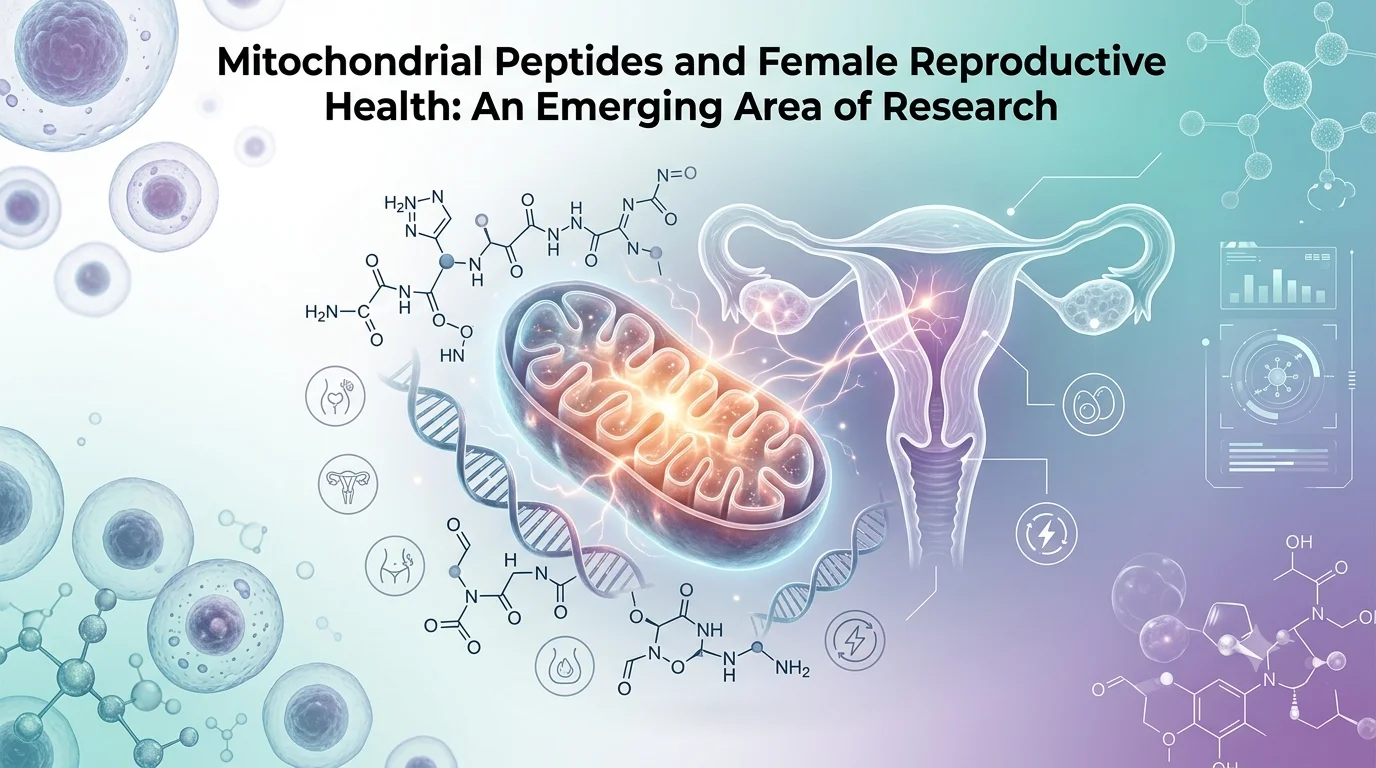
Mitochondrial-derived peptides (MDPs) — including Humanin, MOTS-c, and SHLPs — are small signaling molecules encoded by the mitochondrial genome. They regulate insulin sensitivity, oxidative stress, apoptosis, and inflammation — all of which are central to female reproductive health.
🔬 Key findings:
• Women with PCOS have significantly lower circulating MOTS-c and humanin levels[reference:0][reference:1].
• Humanin protects oocytes from in vitro aging and regulates granulosa cell viability[reference:2].
• The humanin analogue HNG attenuates endometrial fibrosis and improves fertility in intrauterine adhesion models[reference:3].
• MOTS-c acts as an endogenous regulator of granulosa cell metabolic fitness[reference:4].
The takeaway? Mitochondrial peptides represent a new frontier in the treatment of PCOS, infertility, ovarian aging, and uterine pathologies.
🔵 What Are Mitochondrial-Derived Peptides?
Mitochondrial-derived peptides (MDPs) are short chains of amino acids encoded by the mitochondrial genome. Unlike most mitochondrial proteins that stay inside the organelle, MDPs are secreted into the cytoplasm and circulation, where they act as signaling molecules that regulate metabolism, inflammation, and cell survival[reference:5].
Currently, three major families of MDPs have been identified: Humanin (HN), MOTS-c (Mitochondrial ORF within Twelve S rRNA type-c), and SHLP1-6 (small Humanin-like peptides)[reference:6]. They are produced in response to cellular stress, oxidative damage, and metabolic challenges, and they function as potent cytoprotective agents[reference:7].
In reproductive tissues — which have exceptionally high mitochondrial content due to the energetic demands of steroidogenesis, oocyte meiosis, and embryo development — MDPs play critical roles in maintaining cellular health and function[reference:8].
🟣 Humanin: The Ovarian Protector
Humanin is the first and most studied mitochondrial-derived peptide. It exerts cytoprotective effects in various tissues, including the ovary[reference:9]. In the ovary, humanin is expressed in granulosa cells, oocytes, and antral follicles, where it regulates cell viability and apoptosis[reference:10].
Research has demonstrated that:
- Inhibition of endogenous humanin in vivo increases the number of atretic (degenerating) follicles[reference:11].
- Humanin plays an important role in regulating the cellular response to oxidative stress and apoptosis in ovaries via modulation of several signaling pathways[reference:12].
- Humanin protects oocytes from in vitro aging, suggesting its potential as a therapeutic agent to preserve oocyte quality[reference:13].
A review published in Biochimica et Biophysica Acta concluded that humanin represents a “new frontier for the design of novel therapeutic approaches” for female infertility and glucose metabolism in PCOS[reference:14].
🩷 MOTS-c: The Metabolic Messenger in PCOS
MOTS-c is a 16-amino acid peptide encoded within the mitochondrial 12S rRNA gene. It regulates glucose homeostasis, insulin sensitivity, and metabolic adaptation[reference:15].
In the context of PCOS, the evidence is compelling:
- A 2026 study published in Scientific Reports found that women with PCOS had significantly lower circulating MOTS-c levels compared to healthy controls (220.2 ± 147.6 pg/mL vs. 498.3 ± 224.4 pg/mL; p < 0.001)[reference:16].
- Skeletal muscle MOTS-c expression was also reduced in the PCOS group (74.2 ± 15.2 vs. 100.0 ± 8.5 arbitrary units; p = 0.005)[reference:17].
- Serum MOTS-c levels were inversely associated with total testosterone (r = −0.224, p = 0.046) and total cholesterol (r = −0.228, p = 0.044)[reference:18].
In granulosa cells — the somatic support cells of developing follicles — MOTS-c acts as an endogenous regulator of metabolic fitness. Exogenous MOTS-c treatment has been shown to activate AMPK, induce PGC-1α, and promote mitochondrial biogenesis in human granulosa cells[reference:19].
These findings suggest that MOTS-c may represent a potential marker of tissue-specific mitochondrial involvement in PCOS and a therapeutic target for its metabolic and reproductive manifestations[reference:20].
🌿 Beyond the Ovary: Humanin in Uterine Health
Humanin’s protective effects extend beyond the ovary to the endometrium and uterine tissues.
A landmark 2023 study published in Human Reproduction investigated the role of the humanin analogue S14G-humanin (HNG) in intrauterine adhesions (IUAs) — a common cause of female infertility characterized by endometrial fibrosis[reference:21].
Key findings from the study:
- Humanin was widely expressed in endometrial epithelial and stromal cells in both humans and rats[reference:22].
- Humanin expression was downregulated in the endometria of patients and rats with IUAs[reference:23].
- HNG supplementation attenuated endometrial fibrosis, improved endometrial thickness and gland numbers, and significantly improved fertility — with mating rates of 80% in the HNG group compared to 40% in the IUA group[reference:24][reference:25].
- The mechanism involved inhibition of ferroptosis (an iron-dependent form of cell death) in endometrial epithelial cells via the Nrf2 pathway[reference:26].
These findings open the door for peptide-based therapies for uterine pathologies that currently have limited treatment options.
🟠 Ovarian Aging and Mitochondrial Peptides
Ovarian aging is characterized by declining oocyte quality, mitochondrial dysfunction, and increased oxidative stress. Mitochondrial peptides are emerging as key modulators of this process.
- Humanin has been shown to protect oocytes from in vitro aging, preserving their developmental competence[reference:27].
- MOTS-c is involved in the regulation of cellular senescence and longevity pathways[reference:28].
- Mitochondrial dysfunction is a central driver of ovarian aging, and MDPs offer a way to restore mitochondrial quality control[reference:29].
Emerging research suggests that peptide-based interventions could one day be used to extend reproductive lifespan and improve outcomes in assisted reproductive technology (ART).
✅ Future Directions: From Bench to Bedside
The science is clear: mitochondrial-derived peptides are fundamental regulators of female reproductive health. The next steps involve:
- Clinical trials to evaluate the safety and efficacy of MDP-based therapies in PCOS, infertility, and uterine pathologies.
- Biomarker development — using serum humanin and MOTS-c levels as diagnostic and prognostic tools for PCOS and ovarian dysfunction.
- Peptide engineering — developing more potent and stable analogues like HNG for therapeutic use.
- Combination approaches — integrating MDPs with existing treatments like GLP-1 receptor agonists for synergistic effects.
As Lei et al. (2022) concluded, “Given humanin’s new frontier for the design of novel therapeutic approaches for … female infertility and glucose metabolism in polycystic ovary syndrome, it is worthy of further study on its protective effects and clinical applications in reproductive function”[reference:30].
❓FAQ — Your Top Questions Answered
🔥 Ready to explore the peptide revolution?
If you’re ready to move beyond symptom management and explore science-backed, mitochondrial-targeted solutions for PCOS, fertility, and uterine health — you’re not alone.
👇 Discover how peptide innovation is changing the game for women’s health.
👉 Learn More About Peptide-Based SolutionsThousands of women are rewriting their health stories.
Your next chapter starts here.
📢 Disclosure: This article is based on peer-reviewed literature, including studies published in Scientific Reports, the Journal of Endocrinological Investigation, Human Reproduction, Biochimica et Biophysica Acta, and other academic sources. It is provided for educational and informational purposes only.
⚠️ Disclaimer: This content does not replace professional medical advice, diagnosis, or treatment. Reproductive health conditions must be managed under the supervision of qualified healthcare providers (physicians, endocrinologists, or gynecologists). Any dietary, supplement, or therapeutic changes should be discussed with your doctor. Individual results vary. This page contains affiliate links; purchases made via these links may earn the author a commission at no extra cost to you. Our content remains objective and evidence-based.
🌟 Humanin: Giving ovaries a second chance.
🔥 MOTS-c: The metabolic reset PCOS women need.
🌱 Healing the womb, one peptide at a time.
⏳ Mitochondrial peptides: Giving us a say in how we age.
🚀 The future of women’s health is mitochondrial.