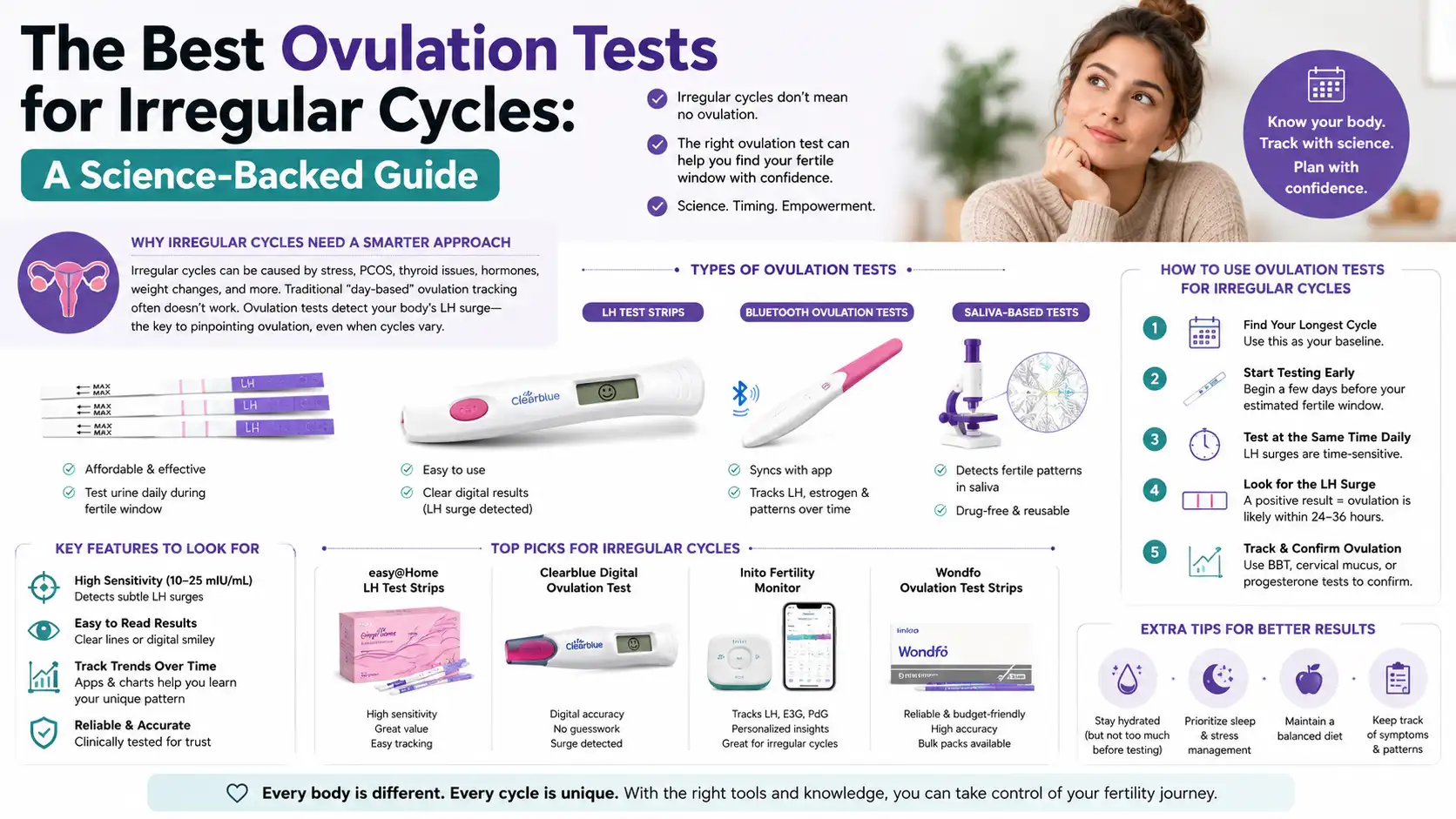
If you have PCOS, long cycles, or unpredictable periods, standard ovulation tests often fail. Here’s what actually works—and what the latest research says about sensitivity and accuracy.
For women with regular 28-day cycles, timing ovulation is straightforward: test around day 12 or 13, watch for a positive luteinizing hormone (LH) test, and plan intercourse. But for the millions of women with irregular cycles—whether from Polycystic Ovary Syndrome (PCOS), perimenopause, thyroid issues, or simply unexplained variability—standard ovulation tests often cause more confusion than clarity.
False positives, missed surges, and endless testing strips can turn trying to conceive into a frustrating, expensive guessing game.
The good news? Recent clinical studies have tested multiple ovulation predictor kits (OPKs) head-to-head, and new “fertility monitor” technology is specifically designed for irregular cycles. This guide breaks down what the science says, which products work, and how to choose based on your specific hormone patterns.
Why Standard Ovulation Tests Fail for Irregular Cycles
Most basic ovulation tests—whether digital or strip-based—rely on a simple threshold: they detect whether your LH level has crossed a fixed cutoff point, typically 25 mIU/mL. This works well for women with predictable cycles and normal LH patterns.
But for women with PCOS or irregular cycles, several problems arise:
- Elevated baseline LH: Many women with PCOS have chronically high LH levels (often 15–25 mIU/mL even outside the surge). A standard test set to trigger at 25 mIU/mL may never register a positive, or may give false positives throughout the cycle.
- Multiple LH surges: The body sometimes “tries” to ovulate but fails, producing multiple LH spikes before successful ovulation. Standard tests can’t distinguish a true surge from an anovulatory attempt.
- LH surge without ovulation: In conditions like Luteinized Unruptured Follicle Syndrome (LUFS), LH rises normally but the egg is never released. Standard LH tests cannot confirm that ovulation actually occurred.
- Unknown testing windows: With irregular cycles, you don’t know when to start testing. Testing from day 10 to day 45 means using 30+ strips per cycle—expensive and exhausting.
The solution is not simply “more sensitive” tests, but smarter tests that track multiple hormones and establish your personal baseline.
Understanding Test Sensitivity: What the Numbers Mean
Before diving into specific products, it’s important to understand what “sensitivity” actually means for ovulation tests.
LH Sensitivity Threshold: Most standard OPKs are calibrated to turn positive at 25 mIU/mL of LH in urine. This threshold was chosen because research shows it offers the best balance between detecting true surges and avoiding false positives in the general population.
However, a 2024 study published in Fertility and Sterility tested five commercial OPKs head-to-head against daily blood LH measurements and found surprising differences in sensitivity (the ability to correctly identify a true LH surge):
| OPK Brand | Price per Strip | LH Sensitivity Threshold | Detected LH Surges (Sensitivity) | Accuracy |
|---|---|---|---|---|
| Easy@Home | $0.30 | 25 mIU/mL | 75.0% | 95.9% |
| Wondfo | $0.24 | 25 mIU/mL | 69.2% | 94.9% |
| Pregmate | $0.20 | 25 mIU/mL | 76.9% | 96.9% |
| Clearblue | $1.70 | 40 mIU/mL | 61.5% | 91.8% |
| Clinical Guard | $0.18 | 25 mIU/mL | 38.5% | 91.8% |
Source: Vanderhoff et al., Fertility and Sterility, 2025
Critical Takeaways from This Study:
- Higher price does not mean better performance. Clearblue was the most expensive ($1.70/strip) but had the lowest sensitivity (61.5%)—missing nearly 4 out of 10 true LH surges.
- Sensitivity matters more than accuracy for irregular cycles. While all tests had high “accuracy” (91–97%), accuracy includes true negatives (days when no surge was present). A test that always says “negative” would still appear accurate most of the time but would be useless for detecting ovulation. A letter to the editor in Fertility and Sterility pointed out that the study’s accuracy metric was “falsely reassuring,” masking the fact that these tests missed 24 true LH surges across participants.
- Clinical Guard performed poorly—detecting only 38.5% of actual LH surges. Despite costing only $0.18 per strip, the low sensitivity makes it unreliable for anyone who truly needs to detect ovulation.
- Even the best strips (Pregmate, Easy@Home) missed 23–24% of surges. For women with regular cycles, this might be acceptable. For women with irregular cycles who have fewer ovulation opportunities, missing 1 in 4 surges is a significant problem.
Bottom Line: Standard OPKs are reasonably accurate for the general population but have meaningful failure rates. For irregular cycles, you need more than a single-hormone threshold test.
The Solution: Multi-Hormone Fertility Monitors
The best option for irregular cycles is a fertility monitor that measures multiple hormones and tracks changes relative to your personal baseline, not a population average.
Here are the top options available in the USA specifically designed for or compatible with irregular cycles:
1. Inito Fertility Monitor
Best for: PCOS, irregular cycles, and women who want confirmation of ovulation
The Inito Fertility Monitor is currently one of the most recommended options for irregular cycles. Unlike standard OPKs, Inito measures four hormones on a single test strip:
| Hormone | What It Tells You |
|---|---|
| LH | Predicts ovulation (24-36 hour warning) |
| Estrogen (E3G) | Identifies the fertile window opening |
| Progesterone metabolite (PdG) | Confirms ovulation actually occurred |
| FSH | Assesses ovarian reserve |
Key Features:
- Connects to your smartphone via an app
- Provides numerical hormone values, not just positive/negative
- Establishes your personal baseline over time, making it accurate even if your LH is typically elevated
- Confirms ovulation via PdG rise (critical for PCOS where LH surges may not lead to actual ovulation)
Pricing (USA):
- Starter kit: ~$199 (includes monitor + 15 test wands)
- Refill wands: ~$59 for 15 tests
Availability: Available on Amazon and the Inito website. FSA/HSA eligible.
Clinical Support: Inito’s multi-hormone approach is supported by fertility specialists for irregular cycles because PdG confirmation is the only way to know ovulation actually occurred.
2. Mira Fertility Monitor
Best for: Detailed quantitative data and women who like tracking trends
Mira is similar to Inito but uses a handheld “analyzer” device that reads test wands. The Mira Max Kit measures LH, E3G (estrogen), and PdG (progesterone).
Key Features:
- Provides actual numerical concentrations (e.g., “LH = 12.4 mIU/mL”)
- Tracks trends over your entire cycle
- App charts your data for easy pattern recognition
- Wands are single-use and inserted into the Mira Analyzer
Pricing (USA):
- Mira Max Starter Kit: ~$229 (includes analyzer + 10 wands)
- Max Wand refills (20 count): ~$89
- FSA/HSA eligible
Pros for Irregular Cycles:
- The quantitative data helps distinguish a true surge from your baseline
- Can test as often as needed (no limit on daily tests)
- App helps you identify when to start testing based on your cycle patterns
Cons:
- Wands are expensive, and with long cycles, you may use many per month
- Results take ~20 minutes (faster than lab work, slower than strips)
Availability: Available on Amazon and Mira’s website.
3. Proov Complete Fertility System
Best for: Women who have been trying for 6+ months and want comprehensive hormone assessment
Proov is unique because it’s the only FDA-cleared at-home PdG (progesterone metabolite) test. The “Complete” system measures all four key hormones (FSH, LH, E1G, PdG) and is specifically marketed for women with PCOS or irregular cycles.
Key Features:
- Identifies your full 6-day fertile window
- Confirms ovulation with PdG testing
- Screens for ovarian reserve issues (FSH)
- Includes fertility coaching and prescription pathways
How It’s Different:
Unlike Inito or Mira (which use a device to read results), Proov uses lateral flow strips that you photograph and upload to their app. The app’s algorithm interprets the results.
Pricing (USA):
- Proov Complete: ~$119 (includes 25 strips)
- Proov Confirm PdG only: ~$49 (15 strips)
- FSA/HSA eligible
Availability: Available on Proov’s website and Amazon.
Best For: Women who want a comprehensive hormone workup without buying an expensive electronic device. Particularly useful for confirming ovulation in PCOS.
4. Clearblue Advanced Digital (With Caution)
Best for: Women with mildly irregular cycles who want simplicity
The Clearblue Advanced Digital measures both estrogen and LH, identifying up to 4 fertile days per cycle (versus 1-2 days with LH-only tests).
Important Limitation: However, the 2024 study found Clearblue had the lowest sensitivity of the five tested kits (61.5%), meaning it missed nearly 40% of LH surges compared to blood testing. Additionally, Clearblue uses a 40 mIU/mL LH threshold, which may be too high for some women with PCOS whose surges are blunted.
Verdict for Irregular Cycles:
- ✅ Simpler to use than Inito/Mira
- ✅ Measures estrogen (helpful for identifying the fertile window)
- ❌ Lower sensitivity than strip-based tests
- ❌ Cannot confirm ovulation (no PdG)
- ❌ Not recommended for moderate-severe PCOS or very irregular cycles
Pricing (USA):
- ~35for20tests( 35for20tests( 1.75 per test)
Availability: Widely available at drugstores (CVS, Walgreens, Target) and Amazon.
5. Oova Fertility Monitor
Best for: Women who want quantitative results and to share data with their doctor
Oova is a quantitative fertility monitor that measures LH, PdG, and E3G. Like Inito and Mira, it provides numerical values and tracks your personal baseline.
What Makes Oova Different:
- Specifically designed for women with PCOS and irregular cycles
- The app includes a physician dashboard to share data directly with your doctor
- Uses machine learning to personalize results over time
Key Features:
- Confirms ovulation via PdG
- Quantitative results (not just positive/negative)
- No threshold-based readings—establishes your unique baseline
Pricing (USA):
- Starter kit: ~$199 (includes 15 tests)
Availability: Available on Oova’s website.
Best For: Women working with a fertility specialist who wants to share detailed hormone data during telemedicine appointments.
Comparison Table: Best Ovulation Tests for Irregular Cycles
| Product | Hormones Measured | Confirms Ovulation? | Best For | Price (Starter) | Sensitivity Notes |
|---|---|---|---|---|---|
| Inito | LH, E3G, PdG, FSH | ✅ Yes | PCOS, irregular cycles, confirmed ovulation | ~$199 | Quantitative, personalized baseline |
| Mira Max | LH, E3G, PdG | ✅ Yes | Detailed data tracking | ~$229 | Quantitative numerical values |
| Proov Complete | LH, E1G, PdG, FSH | ✅ Yes | Comprehensive hormone workup | ~$119 | FDA-cleared PdG; app-based interpretation |
| Oova | LH, E3G, PdG | ✅ Yes | Sharing data with doctors | ~$199 | Physician dashboard |
| Clearblue Advanced | LH, E3G | ❌ No | Mildly irregular, wants simplicity | ~$35 | 40 mIU/mL threshold; 61.5% sensitivity* |
| Easy@Home | LH only | ❌ No | Regular cycles; budget option | ~$22 (50 tests) | 25 mIU/mL; 75% sensitivity* |
| Pregmate | LH only | ❌ No | Regular cycles; budget option | ~$20 (50 tests) | 25 mIU/mL; 76.9% sensitivity* |
*Sensitivity data from Vanderhoff et al., Fertility and Sterility, 2025. Refers to ability to detect LH surge compared to blood testing.
How to Choose the Right Test for Your Situation
Step 1: Assess Your Cycle Irregularity
- Mildly irregular (cycle length varies by 3-5 days) : Start with Clearblue Advanced Digital or high-quality strips like Easy@Home. You may not need a full monitor.
- Moderately irregular (cycle length varies by 7-10 days) : Consider Inito or Mira. The ability to track trends and confirm ovulation becomes valuable.
- Severely irregular (cycles vary by 14+ days or PCOS diagnosis) : Invest in a multi-hormone monitor that confirms ovulation (Inito, Mira, Oova, or Proov). Standard OPKs will likely cause more frustration than help.
Step 2: Consider Your Budget
| Budget | Recommended Option |
|---|---|
| Under $50/month | Proov Confirm (PdG only) after using cheap LH strips; or Easy@Home strips with awareness they may miss surges |
| $50-100/month | Proov Complete (monthly cost ~$60 if testing regularly) |
| 100−200starter+100−200starter+40-60/month | Inito or Mira (higher upfront, ongoing wand costs) |
Step 3: Know What You’re Trying to Confirm
- Just trying to predict ovulation (not confirm it) : LH-only strips may work, but be prepared for false positives or missed surges.
- Need to confirm ovulation actually happened : You must use a test that measures PdG (progesterone metabolite). Without PdG, you cannot distinguish between a true ovulatory cycle and an anovulatory LH surge.
Step 4: FSA/HSA Eligibility
All of the monitors mentioned (Inito, Mira, Proov, Oova, and even Clearblue) are FSA and HSA eligible in the USA. Keep your receipts and submit for reimbursement.
Additional Tips for Testing with Irregular Cycles
1. Test frequently. With irregular cycles, you may need to test for 3-4 weeks. Buy tests in bulk. Monitors like Inito and Mira are more cost-effective for long testing windows than daily Clearblue tests.
2. Test with second morning urine. LH is synthesized overnight and appears in urine after waking. First morning urine can miss the surge. Test between 10 AM and 2 PM for best results.
3. Track other signs. Combine OPKs with cervical mucus monitoring and basal body temperature (BBT). BBT won’t predict ovulation but will confirm it after the fact (temperature rises after ovulation).
4. Consider prescription options. If you have diagnosed PCOS and have been trying for 6+ months, talk to your doctor about ovulation induction medications (letrozole or clomiphene). At-home testing can be used alongside these medications.
5. Be patient but set a limit. If you’ve been using a fertility monitor correctly for 6 months without conceiving or detecting ovulation, see a reproductive endocrinologist.
The Verdict: Which Should You Buy?
If you have irregular cycles and want the most reliable option, the Inito Fertility Monitor offers the best combination of features: four hormones, ovulation confirmation via PdG, and a reasonable price point. It was specifically mentioned in clinical reviews as appropriate for PCOS and irregular cycles.
If you want quantitative data and don’t mind a higher upfront cost, the Mira Max provides detailed numerical values that some women prefer for trend tracking.
If you’re on a tighter budget but still want PdG confirmation, the Proov Confirm or Proov Complete strips offer FDA-cleared progesterone testing without an expensive electronic device.
If you have only mild irregularity, the Clearblue Advanced Digital offers simplicity and estrogen detection, but be aware of its lower sensitivity (61.5%) compared to strip-based alternatives.
And if you have regular cycles but just want to time intercourse, the Easy@Home or Pregmate strips are highly accurate and cost-effective—but they are not recommended for PCOS or significant cycle irregularity.
🛒 Exclusive Affiliate Offer: Ovulation Test Kits for Irregular Cycles
Ready to start tracking with confidence? We’ve partnered with CosmoClinic-20 to bring you a selection of fertility monitors and test kits that work for irregular cycles—available for USA customers.
👉 [Click Here to Shop Ovulation Tests & Fertility Monitors on Amazon]
(https://amzn.to/4tNuxBW)
Products Available Through This Link:
- ✅ Easy@Home Ovulation Test Strips (50+20 Pregnancy Tests) – Best budget option for regular cycles
- ✅ Clearblue Advanced Digital Ovulation Kit – Detects estrogen + LH for more fertile days
- ✅ Inito Fertility Monitor – Multi-hormone tracking for PCOS/irregular cycles
- ✅ Mira Fertility Max Wands – Refills for quantitative hormone tracking
- ✅ Proov Confirm PdG Tests – Confirm ovulation actually occurred
All products are FSA/HSA eligible and ship directly to USA addresses.
Disclaimer: As an Amazon Associate, I earn from qualifying purchases. This helps support the creation of science-backed fertility guides at no extra cost to you. Always consult with a healthcare provider before making significant changes to your fertility tracking routine, especially if you have a diagnosed condition like PCOS.